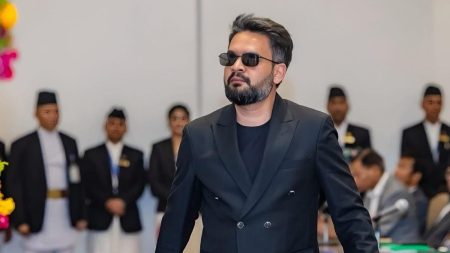
To call Gagan Thapa “the man Nepal cannot ignore” is not to overstate his power, but to acknowledge his singular position. At 48, the three-time MP and Nepali Congress general secretary is the only leader who commands credibility among disillusioned youth, the urban middle class and even wary factions of the old guard. He is both a generational bridge and a test of whether such a bridge can bear the weight of real reform.
Nepali politics is adrift. The once-dominant KP Sharma Oli, a populist who rode nationalist sentiment, squandered his mandate through pandemic mismanagement and authoritarian tendencies. Sher Bahadur Deuba, the septuagenarian face of the Nepali Congress (NC), presides over a party paralysed by inertia. The federal system, supposed to decentralise power, has instead birthed bloated bureaucracies and local fiefdoms. Meanwhile, the youth—facing 11.4% unemployment and rampant underemployment—are voting with their feet, leaving in droves for foreign jobs. Politics, for many, is a closed shop run by the aged and entitled.
Thapa’s trajectory defies easy categorisation. Born in 1976 into Kathmandu’s conservative middle class, he cut his teeth as a student activist, leading protests against the monarchy and enduring arrests during King Gyanendra’s autocratic interregnum. Amnesty International declared him a prisoner of conscience. Unlike many insurgent figures, however, Thapa never defected from the NC, despite repeated marginalisation by the party’s old guard. His persistence—winning a parliamentary seat in 2013, becoming health minister in 2016 and ascending to general secretary in 2021—reflects tactical resilience. Critics call it co-optation; supporters see it as the only way to reform a sclerotic system from within.
Thapa’s political style straddles two worlds. He deploys the tools of digital populism—TikTok explainers, polished campaign videos and direct social-media engagement—yet his substance is policy-heavy and institution-focused. He draws cautious comparisons to Emmanuel Macron, who built a centrist movement outside France’s political duopoly, and Alexandria Ocasio-Cortez, whose media fluency re-energised progressive politics. But unlike demagogues who thrive on grievance, Thapa’s rhetoric leans on aspiration: universal healthcare, educational equity and accountable federalism.
His tenure as health minister (2016–17) gave a glimpse of his governance approach. He pushed digitisation and decentralisation, earning rare bipartisan praise. Yet bureaucratic inertia and intra-party resistance stymied lasting change. The civil service remains a patronage network, resistant to reform. Thapa’s hurdle is whether he can dismantle a system he is still part of.
Electorally, Thapa dominates urban centres. His Kathmandu-4 constituency, among Nepal’s most educated and connected, has re-elected him three times by wide margins. But Nepal’s electoral map is not drawn in Kathmandu. Rural areas remain strongholds of Maoist and UML networks, where the NC’s feudal structures still hold sway. Thapa’s urban appeal may not translate nationally unless he either remakes his party or breaks from it, a risky gambit that could fracture his base.
Nepal’s recent history warns against charismatic saviours. KP Oli’s nationalist bluster gave way to authoritarianism. Rabi Lamichhane, a media star turned populist, now epitomises the dangers of shallow disruption. Thapa’s more inclusive charisma could yet succumb to the same trap: inspiring followers without empowering them. The lesson from Arvind Kejriwal in Delhi—whose anti-corruption crusade ossified into top-down control—looms large.
Internationally, Thapa is viewed cautiously but favourably. India sees him as predictable, unlike Oli’s China flirtations. The US regards him as a liberal moderniser. China is indifferent but wary of his transparency rhetoric. His foreign policy stance is still undefined: he has said little on BRI, MCC or Nepal’s role in Indo-Pacific realignment.
Thapa’s path forward hinges on three scenarios: the NC undergoes generational turnover, and Thapa navigates coalition politics to enact reforms; frustrated by NC inertia, he forms a centrist movement, reshaping electoral maths but risking opposition fragmentation; last, Thapa is sidelined, and disillusioned youth turn to flashier, less grounded figures.
Is Thapa a transformative leader or a polished iteration of the status quo? The answer remains unclear. He embodies Nepal’s contradictions: a modernist in a medieval party, a democrat in performative politics, a reformer with no clear path to reform. His moment depends on timing. Too late and he risks irrelevance; too early and he may falter without institutional backing.
For now Gagan Thapa is not Nepal’s solution. But he is its most pressing political question. And that is why the country cannot afford to ignore him. ■
A version of this article previously said “A 2023 survey by the Centre for Social Research found him the most trusted politician among under-35s, scoring highest on integrity and reformist potential.” It was incorrect. Sorry.