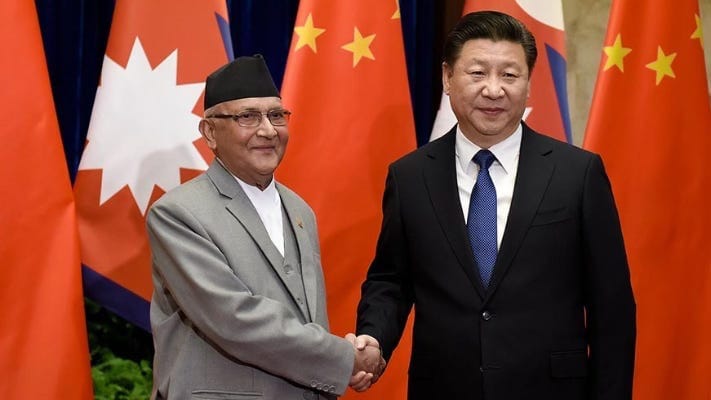
When Nepal’s pugnacious prime minister, KP Sharma Oli, chose Beijing over Delhi for his first official visit in December last year, he did more than ruffle diplomatic feathers. He signalled a pivot in Kathmandu’s foreign policy. By arriving with an entourage of 87 officials and inking a dozen new agreements, Oli sought not merely warmer ties with China but greater bargaining power at home and abroad. For a country seen as a buffer state between two giants, the message was unmistakable: Nepal is done playing middleman and that it wants to be a player.
That turn northwards has rattled India. For nearly seven decades, Nepal’s foreign policy fell in line with Delhi’s, or so the thinking went. Shared borders, familial bonds and economic dependencies gave India both privilege and presumptions. Kathmandu’s currency is pegged to the Indian rupee; over 60% of its trade flows south. Indian officials have long assumed influence, if not outright deference. But in diplomacy, as in tectonics, fault lines shift. Beijing’s rise and Delhi’s sometimes clumsy handling of its smaller neighbours have created an opening. Nepal, with surprising agility, is stepping through it.
Mr Oli’s China visit was stunning for what it left unsaid as much as for what it sealed. Nepal signed on to China’s Belt and Road Initiative (BRI) in 2017, but the romance has cooled. Of the 35 original projects, only nine are on the table. Progress has been stymied by financial opacity and growing unease about sovereignty. Caution now prevails. The July visit side-stepped the BRI altogether. Rather a vague “cooperation framework” was announced, replete with pledges on infrastructure and education but free from loan announcements. Nepal appears eager to enjoy the perks without assuming the political mortgage often attached to Beijing’s largesse.
That instinct is not unfounded. Across the region Chinese financing has often come with uncomfortable aftershocks. In Sri Lanka the port of Hambantota had to be leased to a Chinese firm for 99 years after the government failed to repay loans. In Pakistan ballooning debts from the China-Pakistan Economic Corridor have prompted regrets. Nepal has studied these cases and perhaps unusually for South Asia, drawn the right conclusions.
Even so, the Chinese courtship is not without rewards. In 2024 China accounted for roughly 44% of Nepal’s total foreign direct investment (FDI) commitments. This is not chump change. FDI from China has surged from less than a billion in 2009 to above NPR 33bn by 2022. Most of it flows into hydropower and light manufacturing, sectors Nepal hopes will ease its dependency on remittances and subsistence farming. Yet imbalance lingers. Chinese goods swamp Nepali markets, whereas Nepali exports barely make it across the Himalayas. New rail links from Tibet promise connectivity, but so far they move more excavators than yak cheese.
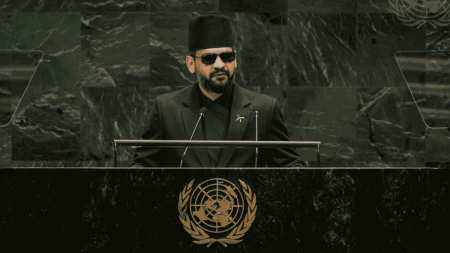
India meanwhile appears stuck in reactive mode. A meeting between Oli and Indian Prime Minister Narendra Modi on the sidelines of the UN General Assembly in September yielded little more than platitudes. Border disputes remain unresolved. Nepal’s ballooning trade deficit with India irritates. Electricity exports are growing, though not fast enough to offset dependence. India, for all its rhetoric about historic bonds, has failed to match China’s speed and scale of delivery.
China’s strategy is not merely economic. It is courting Nepali political and cultural elite with equal vigour. Confucius Institutes are multiplying. Mandarin language programmes are expanding. There are even attempts to export “Xi Jinping Thought” through party-to-party training. But for every Nepali politician awed by Beijing’s developmental swagger, there is a bureaucrat wondering what it will cost. Cultural diplomacy, it turns out, is harder to calibrate than cement.
Nor is China the only game in town. America’s Millennium Challenge Corporation (MCC) compact, a $500m grant for electricity transmission and road upgrades, was finally ratified after years of drama, only to enter a phase of limbo, sadly. Japan and the European Union are increasing aid too, though their style is more grant-driven and less headline-grabbing. Nepal, seemingly a master of aid alchemy, is managing a crowded bazaar of patrons: some benevolent, others strategic.
Still, this is not about seduction. Nepal is not being swept off its feet by a shiny new suitor. It is rather courting many—and marrying none. Its leaders understand balancing China and India is both a necessity and a game of diminishing returns. Playing one against the other can bring short-term concessions but risks long-term entanglement. The coalition government—led by Oli’s CPN-UML and supported by the ideologically incongruent Nepali Congress—reflects that internal tug-of-war. Some urge deeper ties with Beijing; others warn of becoming a client state in all but name.
Eventually the country’s diplomatic tightrope is a wager on autonomy. It seeks to parlay its geostrategic location into genuine leverage. But leverage is not an influence. Geography still binds Nepal to India in ways Beijing cannot replicate. Electricity flows more easily south than east. Migration is easier across the plains than through the mountains. And for all the talk of Himalayan grandeur, Nepal is a small, import-dependent, politically fractious nation and thus vulnerable to the ambitions of others.
Back in the USSR
In seeking to recalibrate its role, the country is not wrong to want more agency. But ambition must be matched with realism. Playing chess with two queens on either side is a dangerous game. Kathmandu may dream of leverage but it is a pawn on a board drawn by others.
A pawn it may be—but even pawns, with the right moves, can reach the other side. ■
Correction (June 15th 2025): A version of article said Mr Oli visited China in July last year. It was December. Sorry.