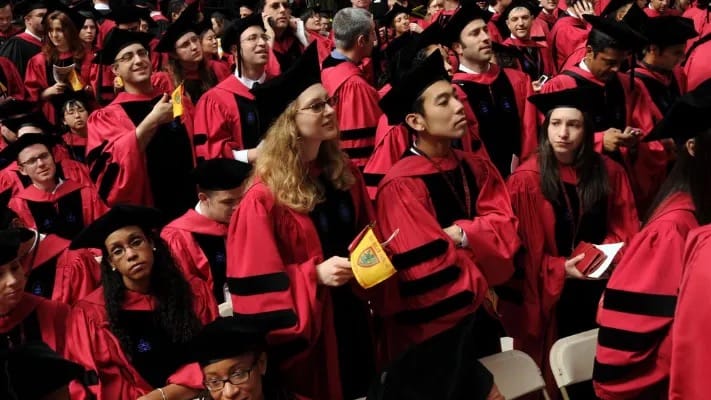
A university degree used to be a golden ticket for generations. It conferred status and a reliable path to middle-class comfort. Yet in much of the rich world, that bargain is fraying. In America for the first time on record, the unemployment rate for young graduates has climbed above the national average. Across the European Union tertiary-educated youngsters are no more likely to be employed than their less-schooled peers. Even in the hallowed halls of Stanford’s business school, job placement rates have tumbled. The diplomas still hang on the wall. The jobs are not always following.
The slump in graduate privilege is not sudden, nor is it the fault of a single villain, though artificial intelligence (AI) is commonly blamed in that role. In truth the trends long predate ChatGPT’s debut. Entry-level “knowledge work” had already begun to hollow out. Legal services employ only slightly more people than they did in 2006. Young recruits into finance and insurance have tanked by 16% across the EU since the global financial crisis. In Britain the once-reliable graduate scheme into banking is now a narrower funnel.
Part of the problem is excess supply. Enrolments in higher education have leapt even as graduate job creation has slowed. From 2013 to 2022 the number of Americans entering bachelor’s programmes shrank by 5%, according to The Economist. But across much of Europe and Asia, student numbers are still growing. France, Ireland and Japan have all seen double-digit rises. Governments have subsidised ever more degrees in subjects that yield ever fewer jobs: arts, journalism and sociology remain inexplicably popular. One might call it a Keynesian jobs programme, except the jobs have failed to materialise.
Skills, too, have not kept pace with credentials. Even though elite universities continue to attract bright minds, the massification of tertiary education has diluted quality elsewhere. A study by Susan Carlson at Pittsburg State University, cited by The Economist, found many English majors could not parse a sentence from Dickens. Employers have noticed. The signal once sent by a diploma has grown faint. In sectors from business services to tech, companies are dropping degree requirements entirely.
That is not necessarily irrational. The returns to a degree ( known as the university-wage premium) have plunged. In 2015 the median American graduate earned 69% more than a high-school graduate. By 2023 the gap had narrowed to 50%. And the “graduate satisfaction gap”, the difference in job satisfaction between graduates and non-graduates, has shrunk to a statistically negligible three percentage points. In the age of smartphones and YouTube tutorials, digital fluency is widespread. Once, universities were the only route to acquiring basic technical skills. Now the internet is faster and cheaper.
The consequences are both economic and social. Peter Turchin, a historian and demographer, calls this “elite overproduction”: when a society creates more educated people than it has high-status roles to provide. The fallout, he argues, is disaffection, radicalism and eventually revolt. He traces a line from surplus graduates to the revolutions of 1848. Today the evidence may be subtler but the undercurrents are no less volatile.
That may sound distant from the dusty campuses of Nepal. But the implications are closer than they appear. Like many developing countries the country is pursuing an aspirational, education-first development model. Enrolments in universities are soaring rapidly, and seen as a sign of progress. Degrees are prized as social mobility boosters, especially abroad. Yet if the graduate job crisis of the West is any indication, Nepal risks walking into the same trap: producing more degrees than jobs, and more expectation than fulfilment.
A shift in mindset is overdue. Not every job requires a degree, but nearly every job requires skills. This is not a plea for abandoning university education but for rebalancing it. Vocational training, apprenticeships and technical courses have played second fiddle to BA programmes. They shouldn’t. In Germany and Switzerland “dual training” systems blend work and study, producing skilled workers who rarely struggle for employment. Singapore has poured investment into technical education with enviable results.
Nor should prestige be confused with productivity. Many of the fastest-growing sectors—logistics, renewable energy, digital services—value competence over certificates. Yet Nepali parents continue to push children towards engineering or medicine, even when aptitude or interest is elsewhere.
Worse, students invest time and money in foreign degrees with little labour-market value, only to return home disillusioned and indebted.
Governments, too, must reckon with the incentives they create. Funding universities based on enrolment rather than outcomes has encouraged quantity over quality. Pushing more students into tertiary education may inflate GDP in the short run. But it also risks building a generation of overqualified, underemployed graduates. The social cost of dashed aspirations is harder to measure, but real.
Thus the question: is university still worth it? Unquestionably, for some. Elite institutions still confer networks and credentials the market rewards. But for the average student, especially in countries like Nepal where higher education means private debt or foreign remittances, the answer is more complicated.
Education should be about expanding minds, rather than inflating CVs. In today’s labour market, the difference matters more than ever. Nepal has a chance to learn from the West’s mistakes before they become its own. Degrees are not destiny. Skills, not only schooling, will shape the future of work. And sometimes the most enlightened policy is simply not to follow the crowd into the graduation queue. ■