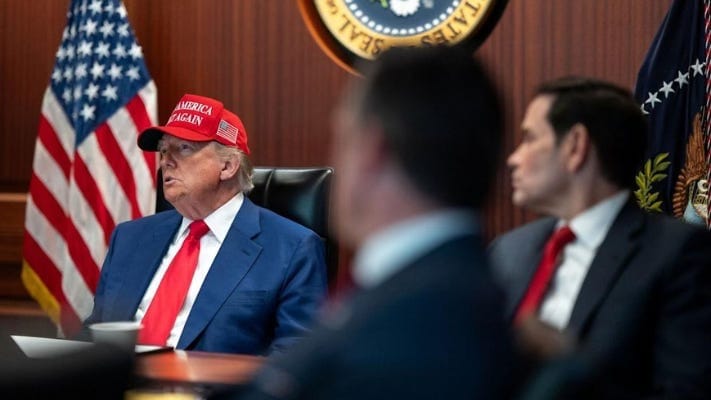
For a man frequently dismissed as an isolationist, Donald Trump has an odd way of showing it. His most recent decision to bomb Iranian nuclear facilities caught much of the world off guard. Beijing, in particular, had wagered Trump 2.0 would be more bluster than bite. That bet now looks wrong. And so does the long-held idea that America under Trump is retreating from the world stage.
Trump’s foreign policy was never one of absence; it was one of assertion, albeit on his own terms. He spurned traditional alliances and scorned diplomacy’s niceties and treated treaties as disposable. But he never stopped flexing. From the assassination of Iran’s Qassem Soleimani to threats of war with North Korea, Trump wielded power like a sledgehammer. His recent actions suggest America may hesitate but it rarely hides.
To many observers, Trump’s Iran strike seemed out of character. Hadn’t he spent years railing against “endless wars” and promising to bring American troops home? He had, but that was never the full story. Trump’s version of disengagement meant fewer troops on the ground, not fewer missiles in the air. His administration oversaw an uptick in drone strikes and maintained a sprawling military footprint across the globe. Far from folding its tent, America merely changed its methods.
That is consistent with a broader pattern. Barack Obama, often called the anti-Bush president, still launched air campaigns in Libya; expanded drone operations in Pakistan and Yemen; and authorised the mission to kill Osama bin Laden. His successor simply adopted the same approach, though with less multilateral finesse. The difference was tone rather than substance.
The empire that won’t quit
True that the wars in Iraq and Afghanistan ended with shame and Americans have grown weary of nation-building. But the machinery of the empire—bases, fleets, aid programmes, covert operations—keeps humming. As one Pentagon official once put it, America doesn’t really do “exit strategies”; it does rebranding.
Isolationism, in its classical form, meant something else entirely. After the First World War, America pulled up the drawbridge: it rejected the League of Nations, shunned entangling alliances, let Europe fester until it had no choice but to intervene again. Today’s America, by contrast, has more than 750 military installations across more than 80 countries. It leads NATO; props up allies in East Asia; doles out development aid with strategic strings attached. Rather than retreating, it is reallocating.
Even far-flung Nepal—seldom at the centre of global-power plays—has become a case study in America’s selective engagement. Recently the Secretary of State granted a special exemption allowing the $500m Millennium Challenge Corporation (MCC) Compact with Nepal to proceed, notwithstanding a sweeping review of foreign aid. In a region where Chinese-funded infrastructure has become a geopolitical calling card, the MCC exemption shows Washington’s intent to stay in the game. For all its internal dysfunction, America remains determined to contest Beijing’s economic diplomacy.
The American Embassy in Kathmandu was careful to couch the decision in terms of partnership and prosperity. But the message to China was unmistakable: even in the Himalayan foothills, America is still watching.
If the MCC Compact in Nepal was a soft nudge, the Iran strike was a jolt. Chinese officials had assumed a second Trump term would favour inwardness over intervention. His past rhetoric suggested he preferred tariffs to troops, trade deals to treaty guarantees. Some in Beijing believed this would give them freer rein in the Taiwan Strait. Not anymore. Trump’s sudden deployment of B-2 bombers and submarine-launched missiles has provoked a reassessment. The Iranian attack, American officials claim, has “rebuilt some deterrence”, meaning unpredictability is a strategic asset. Nixon had his “madman theory”; Trump, it seems, has revived it. Beijing’s analysts are now weighing whether Trump, for all his disdain for multilateral entanglements, would actually blink in a Taiwan crisis.
Taipei, for its part, appears to be breathing a cautious sigh of relief. President Lai Ching-te’s administration sees Trump’s Iran strike as a sign American restraint has limits. The narrative of a retreating superpower no longer feels so certain.
Deterrence cuts both ways, of course. China relies on “grey zone” tactics—aircraft flyovers, cyber intrusions, diplomatic bullying—to rattle Taiwan without provoking open conflict. But if Trump is willing to get engaged, Beijing may have to rethink how close to the edge it wants to play.
The lingering question, though, is whether America can continue to sustain this muscle-flexing indefinitely. With an $800bn annual defence budget, more than the next ten countries combined, the temptation to use force is always present. As the ancient Greeks might put it, the hammer draws the hand. But empires, like corporations, eventually face diminishing returns.
There are also competing priorities. The Iran attack, while effective, risks diverting attention and assets from the Indo-Pacific, which most strategists see as critical. In the early 2000s Washington’s fixation on the Middle East arguably delayed its response to China’s rise. A similar mistake now would be costlier still. Yet America appears determined to multitask. The White House wants to reassure both Gulf partners and Asian allies it can still walk and chew gum.
What all this points to is not a new doctrine but the entrenchment of an old habit. America is not retreating from the world. It is choosing where, when and how to engage—and increasingly doing so on its own terms. It is less interested in shared burdens, more inclined to act alone, but no less willing to act. Isolationism may be a popular campaign slogan. But it has little bearing on the realities of American power.
The world should take note. When America says it’s tired of war, it usually means it’s tired of casualties—not of influence. ■