Nepali politics has never been accused of lacking drama. It has, however, struggled with reinvention.
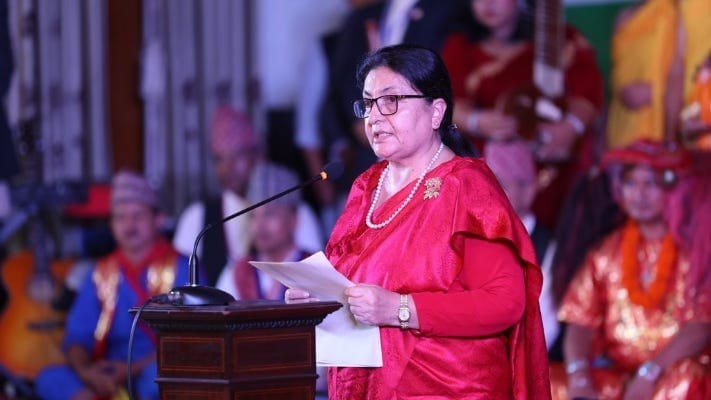
That makes the political return of Bidya Devi Bhandari—Nepal’s former president and a long-time communist stalwart—something of a novelty. Having spent eight years in the ceremonial corridors of Sheetal Niwas, Bhandari has emerged, not as a dignified retiree, but as a contender. Her re-entry into the Communist Party of Nepal (Unified Marxist–Leninist), or UML, is being received with a cocktail of intrigue, anxiety and opportunism.
Predictably, it has unsettled KP Sharma Oli, the party’s ageing supremo. Less predictably, it has also revived a dormant question: what really does the left stand for in modern Nepal?
In the months leading up to her political resurrection, Bhandari crisscrossed the country: meeting party veterans; gathering sympathetic ears; and rekindling networks. Her trip to China, where she reportedly met senior officials of the Communist Party, added a touch of foreign signalling Nepali politicians have long perfected. In Kathmandu’s gossip mills, the visit was read less as diplomacy than declaration. She was not there to reminisce.
Formally she has resumed her place in the UML fold ahead of a pivotal party statute convention scheduled for September. The timing is strategic. The convention will debate age and term limits for leadership roles: an agenda that could dislodge Oli, 72, and other senior apparatchiks.
Bhandari, a decade younger, would be eligible. Her past credentials—vice-chair of the party, widow of Madan Bhandari (the UML’s ideological icon), former head of state—furnish her with gravitas. To her allies, she represents experience without exhaustion. To her rivals, she is a risk wrapped in nostalgia.
Oli, who has wielded power with absolute confidence, now faces the slow erosion of authority that afflicts all long-serving leaders. His allies insist the party remains united. Senior figures in the secretariat speak of tension that belies this claim. Shankar Pokhrel, the general secretary, has floated proposals to bar former presidents from rejoining active politics, a clause with one clear target. Others appear more ambivalent, perhaps seeing in Bhandari a lever to weaken Oli’s dominance. As ever in the UML, factionalism disguises as constitutional reform.
It is not the first time the party has faced internal upheaval. The UML has fractured twice in two decades—once over ideology, then over egos. The scars are still visible. Today it occupies an awkward space: numerically strong but intellectually thin. The party that championed “people’s multiparty democracy” in the past now flirts with personality cults and crowd-pleasing populism. In this vacuum Bhandari’s re-entry functions as both a provocation and a proposal. She could help recentre the party’s ideological compass—or she could tilt it into a third rupture.
The legal and political implications of her return are equally knotty. Scholars argue a former president returning to active politics undermines the constitutional neutrality of the role. The political elite, however, has never treated public office as a terminal post. In that context Bhandari’s move is more revival than scandal. Still it underlines how blurred the lines between statecraft and party discipline have become.
Supporters claim she brings clarity and credibility. Oli, they argue, has become erratic: preferring stunts to substance and Beijing to Baluwatar. Under his watch, the UML has lost its ideological coherence, drifting into nationalist populism tinged with China-friendly rhetoric. Bhandari, by contrast, is leashed to the vocabulary of the 1990s: sovereignty, social justice, self-reliance. Her political grammar is unfashionable but at least it is legible.
Political language alone will not suffice, however. The UML’s structural problems are now chronic. Younger leaders complain of gerontocracy. Organisational discipline has eroded. Provincial bases are fragmented. If Bhandari hopes to restore the UML’s vitality, she will need more than the memory of Madan Bhandari and a few flattering editorials. She will need to win over a party that has grown used to operating as a one-man show. Oli may be weakened, but he is far from finished.
Three outcomes now appear plausible. One, Oli endorses Bhandari, yielding to generational pressure and allowing for an orderly transition—an unlikely but tidy outcome. Two, the rivalry intensifies, producing a protracted power struggle that paralyses the party’s machinery. And three: a new splinter group emerges, pulling disaffected leaders from both camps into yet another leftist experiment. That last option, historically, has proven most popular amongst Nepali communists.
Bhandari’s return also raises wider questions about the ideological future of the left. The political landscape has changed. Class-based appeals carry less resonance in a federal republic marked by ethnic diversity and economic aspiration as well as social mobility. The traditional pillars of the left—agrarian reform, state-led development, redistribution—have lost their electoral edge. In their place: fragmented mandates; provincial baronies; and a younger electorate more interested in jobs than dogma. The left needs to reinvent itself. Bhandari’s re-entry could catalyse that process or delay it further.
There is also an untapped narrative angle. The political elite is overwhelmingly male. The prospect of a former female president contending for executive leadership is not insignificant. It provides the UML an opportunity—should it wish to seize it—to modernise its image, if not its mindset. But Kathmandu’s political culture is skilled at symbolism without substance. Bhandari’s gender will be an asset only if she uses it to challenge, rather than replicate, the patriarchal norms that shaped her rise.
What happens next will not be decided in grand speeches or public rallies but in committee corridors and deal-making over dal-bhat. Bhandari has re-entered with ambition and calculation. Whether she reshapes the UML or simply rearranges its furniture will depend on whether the party still has the capacity to evolve.
Nepal has no shortage of politicians with pasts. What it lacks are those with futures. ■