ILLUSTRATION: KATMANDU JOURNAL
The world’s most powerful currency has begun to test the patience of its most loyal users.
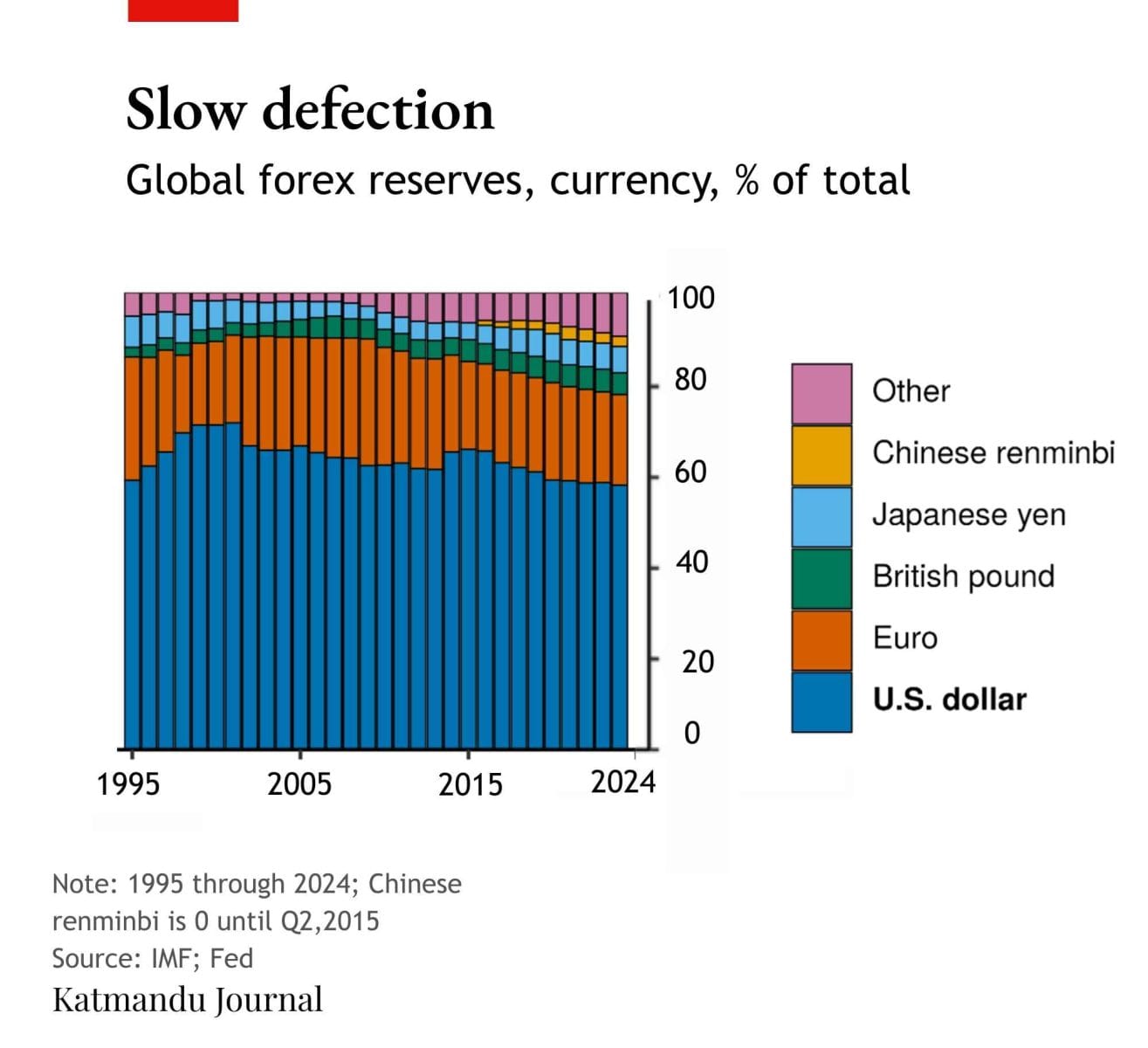
The greenback is still central to global finance. It is used in nearly nine out of ten foreign exchange transactions. It backs almost 60% of official reserves (see chart) and underpins half of all cross-border trade. This privileged position has long allowed America to run a fiscal policy most governments could not imagine. Foreign investors have funded vast deficits. Their confidence has rested on an unspoken contract: Washington may overextend, but the rule of law, a deep bond market and a strong central bank will ultimately steady the ship. That contract is fraying.
President Donald Trump has launched a direct assault on the predictability of American policy. The reimposition of sweeping tariffs in April, followed by their partial reversal weeks later, was the latest in a series of moves that have rattled investors. His administration’s messaging on dollar policy has been similarly erratic. Treasury Secretary Scott Bessent has reaffirmed allegiance to the “strong dollar” mantra repeated by his predecessors. But Stephen Miran, the president’s economic adviser has described reserve-currency status as a liability.
Markets have noticed. The dollar index, which tracks the greenback against a basket of other major currencies, fell by more than 10% in the first half of 2025—its worst such performance since 1973. US Treasuries have failed to act as the haven asset investors expect during periods of uncertainty. Central banks have accelerated efforts to diversify reserves. A shift that began following the Biden administration’s decision to freeze Russian assets has gathered heat.
There is still no clear successor, however. The euro remains hemmed in by fragmented capital markets and institutional spats. China’s renminbi is constrained by capital controls and Beijing’s reluctance to cede monetary sovereignty. Crypto-assets lack state backing and suffer from extreme volatility. Stablecoins, digital currencies linked to fiat money, typically reinforce rather than challenge dollar dominance. Gold is bulky and offers no yield. Yet the absence of an heir has not stopped the erosion of imperial influence.
A multipolar monetary system is taking shape. Central banks are increasingly experimenting with alternatives. BRICS countries are discussing a cross-border payment system that circumvents the dollar entirely. Wealthy Asian families and institutional investors are trimming their US exposure, owing to erratic economic policy and Washington’s growing fiscal indiscipline. Even European policymakers, usually cautious in monetary matters, sense an opportunity.
The economic consequences of diminished dollar dominance are measurable. Fewer foreign buyers of Treasuries mean higher yields. Barry Eichengreen, an economist at the University of California, estimates a material decline in reserve demand could lift long-term US interest rates by up to 0.8 percentage points. For American consumers, that would translate into more expensive mortgages and slower consumption growth, for example.
For the federal government, the implications are even more painful. Washington currently spends more on debt service than on national defence. That figure will yank up sharply if borrowing costs continue to climb. The budget deficit, now close to $2 trillion a year, is largely funded through Treasury issuance. A reduced global appetite for that debt would force lawmakers to consider options that have rarely been entertained: tax rises, spending cuts or both. Elon Musk’s Department of Government Efficiency has saved less than $200 billion so far. The One Big Beautiful Bill—a centrepiece of Trump’s economic agenda—is forecast to add $3trn to the deficit over the next decade. Investors may not wait that long to demand fiscal seriousness.
The geopolitical consequences could be greater still. Reserve currency status affords America the tools of financial statecraft. Dollar-based sanctions pack a punch because so much of global commerce flows through American-controlled channels. That leverage becomes harder to wield should trade routes begin bypassing the dollar. The cost of maintaining overseas military operations would leap with a weaker currency. Surveillance of illicit financial flows, already a complex task, becomes even more difficult once those flows migrate to non-dollar networks.
Officials have acknowledged the stakes. Past Treasury secretaries have argued the dollar’s status is earned through economic stewardship, institutional strength and credible policy. The present trajectory suggests diminishing returns on all three fronts. President Trump’s public feuding with the judiciary, his efforts to politicise the Federal Reserve and the deterioration in public finances each chip away at the credibility underpinning the greenback’s role.
The dollar has weathered troubles before. Richard Nixon ended the Bretton Woods system in 1971 by closing the gold window and slapping tariffs on imports. The greenback wobbled but recovered. It shrugged off the global financial crisis despite being the epicentre of the quake. Yet the present challenge differs in one crucial respect: it is not economic collapse but political volatility that is driving the rebalancing. Investors are no longer fleeing from other currencies. They are reconsidering how far to trust America’s.
This may not provoke a wholesale replacement of the dollar, but the gradual normalisation of currency diversification carries consequences. In financial markets the world’s great reallocation has already begun. Capital tends to flow where it is treated with consistency. Confidence, once diluted, is hard to restore. And although the greenback may remain seated atop the throne, fewer subjects may feel obliged to kneel. ■