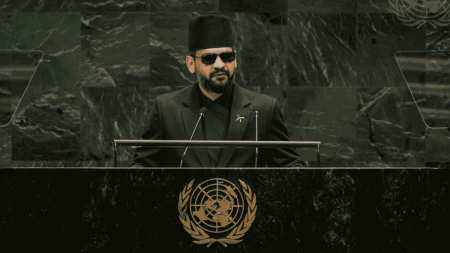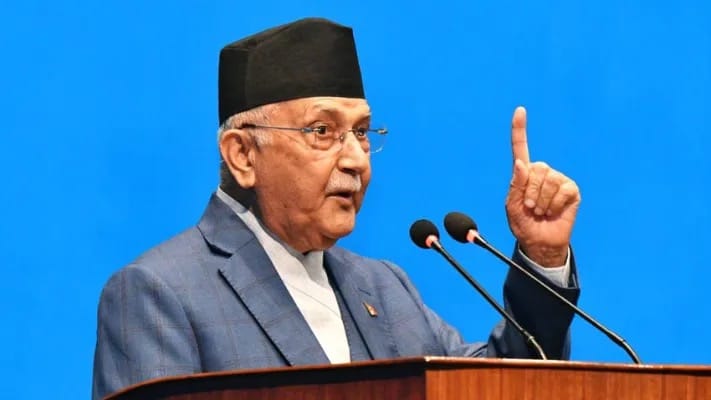
K.P. Sharma Oli built his career by erasing others. Rivals were outfoxed, institutions overruled and dissent dismissed. On Tuesday it was his own name that disappeared from the doors of power. Facing the fallout from the killing of 19 young protesters and more than 400 injuries during a nationwide crackdown on demonstrations, the four-time prime minister resigned, suddenly and sullenly.
His departure will not be enough. The mass mobilisation that began as a protest against corruption on September 8th has grown into a generational revolt against systemic rot. Office blocks have been torched and political homes stoned. Curfews too have been defied across the Kathmandu Valley and beyond. Public anger is not confined to party or province: it targets a regime that has come to symbolise impunity and incompetence. The question now is not whether the coalition will fall apart. It is whether Nepal’s current political architecture can survive at all.
Oli’s political instincts were always those of an operator rather than a statesman. His latest premiership, forged in July 2024 through a power-sharing pact with the centrist Nepali Congress, was neither inspired nor inspiring. It was a transaction masquerading as consensus, a cynical entente between ideological opponents united only by their hunger to stay relevant. The plan was to alternate power until 2026. The people have called time ahead of schedule.
Few should mourn the collapse. Oli’s rule was marked by authoritarian flourishes cloaked in nationalist theatrics. Under his watch federalism was eviscerated in practice, provincial autonomy reduced to performance art. His ministers rotated with impressive velocity but delivered little. Civil service was politicised and public procurement manipulated. And dissent was criminalised. Even in resignation, he remained characteristically unrepentant: issuing no apology and acceptance of failure, and certainly no vision for what should follow.
The security response to the protests bore his hallmarks. Instead of listening, the administration deployed force. Instead of addressing grievances, it wagered on suppression. The outcome was predictable and politically suicidal. The death toll on September 8th achieved what years of opposition rhetoric could not: the unravelling of Oli’s political edifice. Resignations from ministers have piled up from panic. Demonstrators, far from mollified, are demanding structural overhaul not elite musical chairs.
The problem is not just one man. It is the system that made him possible and the political culture that enabled his return. Oli is merely the most brazen embodiment of a bigger malaise: a political class more concerned with preserving patronage networks than pursuing reform. The ruling alliance between the Nepali Congress and UML, initially described as a mechanism for national stability, now lies exposed as an exercise in elite self-preservation. Protesters are not calling for a better version of the same order: they are rejecting the order altogether.
Nepal’s younger generation is not satisfied with symbolism. Many have watched relatives leave to work abroad while domestic opportunities remain choked by nepotism. Others have grown up amid endless political transition only to inherit stagnation. Their demands among others accountable government and a functioning economy are not radical. That they appear so to the establishment is revealing in itself.
With Oli’s exit, power may revert to his coalition partner, Sher Bahadur Deuba, who was brutally beaten by protesters on Tuesday along with this wife Arju Deuba, who is foreign minister. But Deuba, too, is facing mutiny within his own ranks. Senior Nepali Congress figures have already resigned or threatened to. The legitimacy crisis is metastasising across party lines. The opposition, fragmented and visionless, is hardly poised to present a compelling alternative. One party, the Rastriya Swatantra Party, has called for snap elections. Others are demanding an independent commission to investigate political corruption dating back to 1990. What unites these calls is a shared recognition that piecemeal fixes will not suffice.
Oli’s defenders will point to his nationalist agenda, his bold cartographic stunts as well as his effort to balance India and China. But Nepal’s foreign relations remain where he found them: strategic ambiguity with occasional outbursts. His economic legacy is even weaker. Growth stagnated and youth unemployment remained the defining feature of the labour market. His governance style, defined by executive fiat and institutional contempt, hollowed out both state and party. His legacy is not a strong republic, it is a brittle one.
What comes next is uncertain. The street may not yet have a leader, but it has clarity of purpose. The slogan is no longer “reform the government”: it is “remove it”. Some demonstrators have floated Kathmandu’s celebrity mayor Balen Shah as an alternative. But he neither has national reach nor constitutional authority. But he has one crucial advantage over the ancien régime: credibility. In a country starved of public trust, that may prove decisive.
Oli’s career illustrates both the resilience of strongmen and the fragility of the systems they inhabit. He outlived foes, weathered scandals and returned from defeat. But power built on manoeuvre rarely survives the mirror of public outrage. In the end, the bulldozer of Baluwatar was not overthrown by rivals. He was undone by a generation that had run out of patience.
Nepal has rid itself of one man. It has yet to dismantle the machinery that produced him. ■