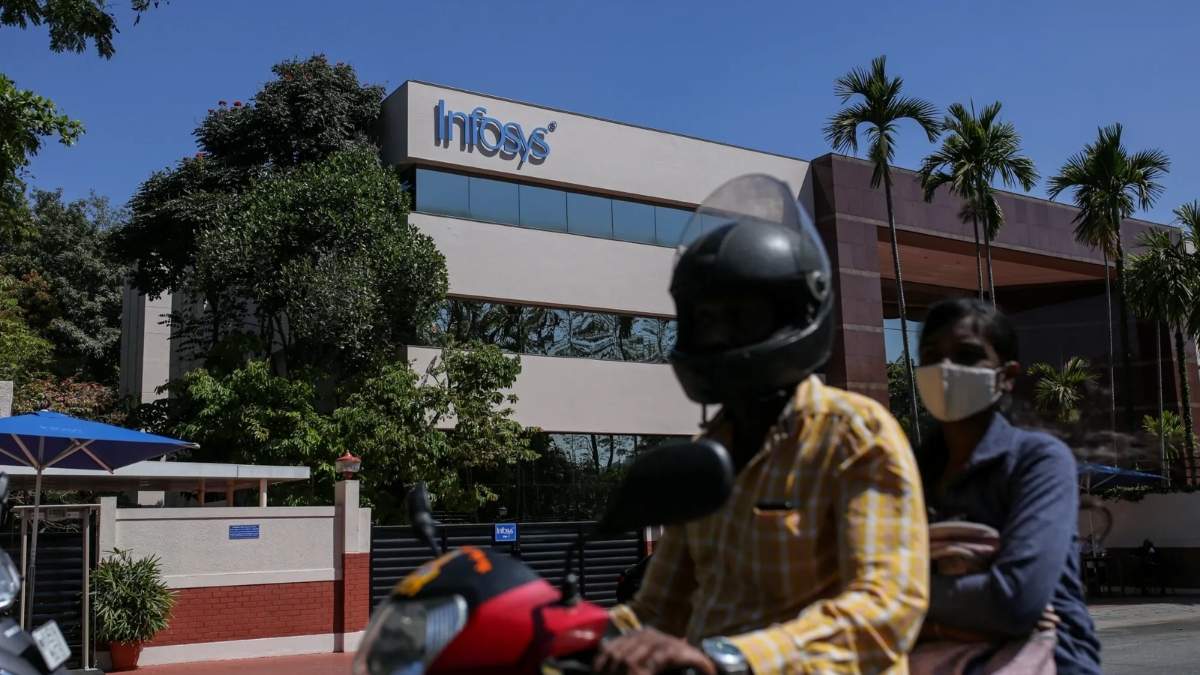
IMAGE: BLOOMBERG
Nothing terrifies an Indian outsourcing executive more than a client with a bright idea and an Excel spreadsheet. Especially when that idea involves replacing thousands of billable hours with a handful of silicon-powered agents that work for free, never sleep and do not expect an annual offsite in Goa.
India’s information technology services giants—Infosys, Tata Consultancy Services (TCS), Wipro and HCLTech—have spent decades building a formidable empire of middleware and middleware managers. Together they employ over 5m people, and generate revenues larger than the GDP of several African nations.
They have helped global clients shave costs by shifting repetitive work to India’s cheaper talent pool. Now those same clients are flirting with another way to cut costs: generative artificial intelligence. This is awkward. AI threatens to do to the outsourcers what the outsourcers once did to their Western clients’ IT departments—make them leaner and cheaper.
India’s IT majors are therefore racing to recast themselves as enablers, not casualties, of the AI boom. Whether they succeed depends on two things: their ability to convince clients that AI is a service to be delivered, not a threat to be feared; and their willingness to disrupt their own labour-based business model before someone else does it for them.
Thus far, the sales pitch has leaned heavily on bespoke AI agents. Infosys claims to have built over 300 such agents for clients from Germany’s Eon to Britain’s Lawn Tennis Association. TCS, meanwhile, is touting tools built for American insurers and transatlantic airlines.
That repositioning comes at a delicate moment. Growth across the sector has slowed to a crawl. Revenue increases have remained in the low single digits for two years, says HSBC. The “Trump bump” that many executives hoped would boost spending never arrived.
Instead a trade war and tariffs have put decisions on hold. More troubling still is the proliferation of global capability centres (GCCs)—captive units set up by multinationals across India to do their own tech work, often poaching the same talent pool that feeds the outsourcers. According to BNP Paribas, client demand deteriorated further during the most recent quarter despite the seasonally strong start to the financial year.
Artificial intelligence, far from rescuing the sector, has complicated matters. Clients are pumping money into AI pilots while putting other IT contracts on ice. Jayesh Sanghrajka, Infosys’s chief financial officer, has acknowledged some discretionary projects have been paused to make room for AI budgets. At the same time, AI itself remains a cloudy proposition—part technical marvel, part accounting riddle. It promises productivity but delivers little in short-term billings.
Executives have been careful not to panic. Aarthi Subramanian, newly installed as TCS’s chief operating officer, insists AI demand is “strong” even as revenues came in below analysts’ expectations. Kumar Rakesh of BNP Paribas is more sceptical, noting the hope of a recovery in the second half of the year may be misplaced. Infosys and Wipro performed slightly better, but largely on the strength of a few high-ticket contracts rather than broad-based momentum.
Even so, the long-term prize is hard to ignore. India’s AI market could strike $22bn by 2027, says a joint report by Boston Consulting Group and Nasscom, the industry lobby. The Modi government has launched a belated IndiaAI Mission, promising $1.2bn in funding to boost domestic capabilities. The ambition is to move up the value chain: from coding for others’ models to developing foundational technologies of their own.
Few of the big IT firms appear interested. Notwithstanding their capital heft and deep talent pools, none are investing seriously in building proprietary AI models. One senior official in Delhi sighed that companies like TCS and Infosys “should have invested in models five or ten years ago”. Anirudh Suri of Carnegie India argues the industry is “riding the wave” but failing to prepare for what happens if that wave knocks them off their surfboards.
Executives prefer to cast themselves as masterful adapters. Infosys chair Nandan Nilekani, who has seen off more tech cycles than most, is bullish AI spending will shift from buying core infrastructure to implementing business solutions. “We have seen many generations of technology in the last 40 years,” he noted, with the serene fatalism of a man who remembers COBOL.
That confidence has yet to soothe investors. Share prices of the IT majors remain underwhelming, reflecting uncertainty over whether AI is friend or foe—or both. HCLTech’s revenues beat forecasts but its profits fell. TCS has announced plans to lay off 12,000 staff, 2% of its workforce, mainly middle and senior managers, as part of an effort to become “future-ready”. It is the clearest sign yet the per-hour billing model, once the sector’s cash cow, is being led gently off the farm.
Whether the industry can reinvent itself before clients find leaner alternatives is the central question. Productivity-enhancing AI may allow firms to do more with fewer people, but for an industry that sells time as its primary commodity, that is hardly a comforting proposition.
Retraining armies of coders to build bespoke AI agents is no small feat. Doing so while defending market share against both internal GCCs and global AI giants makes it harder still. The real threat is not that India’s IT giants will be replaced by machines. It is that they will be relegated to customising tools built by others—stuck in the middle, again, between the cutting edge and the commoditised back-end.
As with all revolutions, the AI one is creating new winners. Whether the incumbents can join their ranks depends on their ability to think more like product companies, and less like staffing firms with better PowerPoints. India’s outsourcers have made their fortunes translating technology into service contracts. AI may demand a different dialect entirely. ■