IMAGE: THE KATHMANDU POST
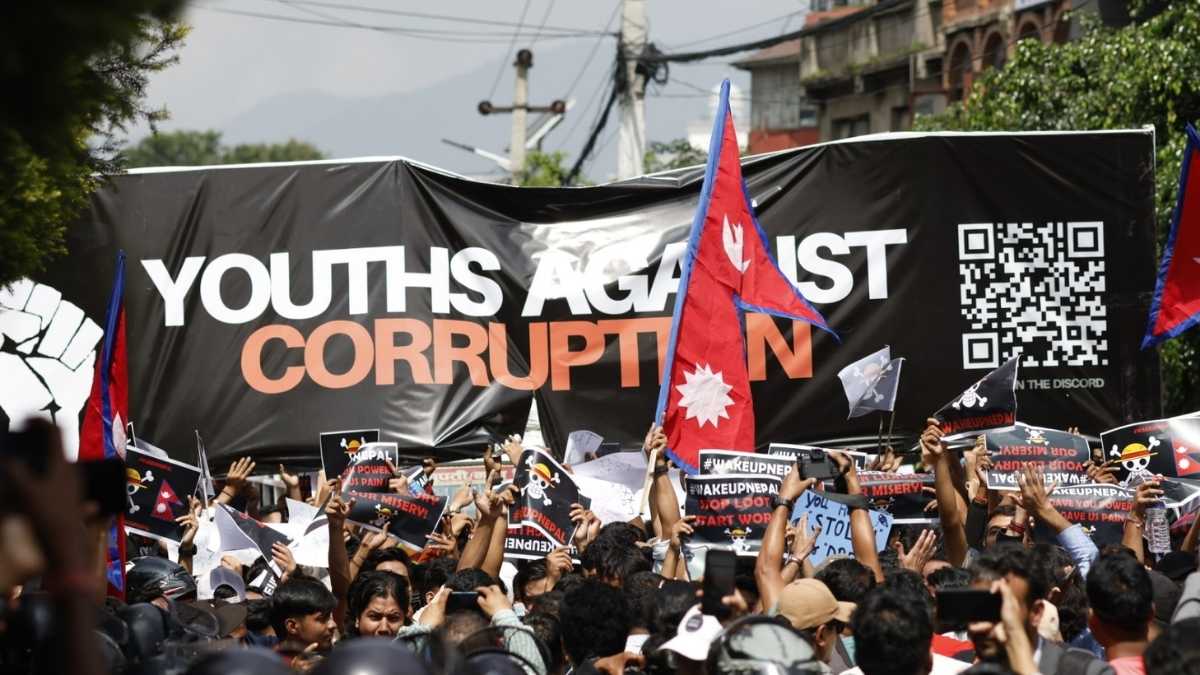
In the past, political parties in Nepal knew where to find their next generation of loyal cadres: on college campuses. Student unions, once vital incubators of democratic dissent, have historically supplied the Nepali Congress, Maoists and Marxist-Leninists with their loudest voices and, eventually, their youngest MPs. But when the parliament building went up in flames on September 9th, not a single youth wing raised the banner. The students who marched outside were not party proxies. They were part of a new force in Nepali politics: unaligned, disillusioned and uncompromising.
The fire marked the abrupt fall of a government and perhaps the twilight of a political model that has lasted for over half a century. Prime Minister K.P Sharma Oli resigned within 48 hours of the protests. At the centre of the upheaval were Gen Z activists, many of them college students, who had no allegiance to the Free Student Union (FSU), nor to the political parties. In the space of five days, protesters paralysed state institutions and forced an interim administration—something that took over five years to achieve during Nepal’s last revolution.
This is not Nepal’s first youth uprising. But it is the first to unfold entirely outside party structures.
Student unions were not always discredited. In fact they tended to be the tip of the spear. In 1947 students were among the first to protest against the Rana regime, demanding educational reform. When King Mahendra banned political parties in the 1960s, student organisations became their only viable stand-ins. During the 1990 revolution and again in the mid-2000s, student-led movements brought tens of thousands into the streets, catalysing Nepal’s transition from monarchy to republic. They weren’t just street protests. In fact they were tightly organised and driven by ideology.
By contrast the protests of this September had no visible command centre and no demands funnelled through party chains of command. Rather they were planned by horizontal coordination on social media and propelled by raw frustration over decades of misrule.
Since the end of the civil war in 2006, Nepali politics has operated under a form of elite stasis. Leaders in their 70s and 80s are unwilling to retire, and party hierarchies rarely allow upward mobility based on merit or public support. As a result, younger activists have no meaningful path to power unless they pledge loyalty to one of the dominant parties, and even then they wait decades to be anointed.
The consequences are evident in Kathmandu’s universities. Party-affiliated student unions have turned into fiefdoms for patronage and corruption. The FSU, once a forum for democratic debate, is now synonymous with embezzlement and nepotism. For Gen Z, which has grown up in the era of digital transparency and globalised protest culture, these institutions are neither inspiring nor credible. They are relics.
The youth are also less patient. A generation raised during the country’s post-monarchy “peace dividend” has had little to show for it. Unemployment is high, the cost of living is getting dearer and institutional corruption is endemic. Over 500,000 Nepalis leave the country a year in search of work abroad. For many young people, the best option is to leave. For those who stay, the only way to be heard, it seems, is to burn something down.
Across the world, young people are losing faith in established institutions, from Congress in India to the Republican Party in America. But Nepal’s version of this crisis is intensified by its recent political history: democracy here was not inherited, but won—through protest. That legacy creates both expectation and exhaustion.
What distinguishes Nepal’s Gen Z revolt is its apolitical posture. The students who took to the streets in September did so not in service of a new party, but in rejection of all parties. This radical dissensus is a strength as well as a weakness. It gives movements the moral high ground but leaves them vulnerable to fragmentation and co-option. The protests succeeded in toppling a government, but no coherent platform has emerged to take its place.
That may soon change. With elections looming in March, the pressure is now on for new political actors—independent candidates, youth coalitions and disillusioned ex-student leaders—to translate street momentum into parliamentary power. Their success will depend on whether they can offer more than just anger.
Political parties are preparing for battle, but few seem prepared to reform. Most have responded to the protests with platitudes. The question is whether any will survive the ballot box given that “anti-establishment” is now the political mainstream.
Perhaps this generation has already learned too well what becomes of those who join the system. Their movement, unclaimed by any party, untainted by ideology, is both a rupture and a return—a reassertion of dissent as the raw material of political change.
In Nepal, every generation rediscovers that to be heard, you must march. But for the first time in decades no one knows what happens after the march ends. ■