Image: ITONICS
When ChatGPT launched in late 2022, governments the world over scrambled to assess what generative AI meant for their economies. White-collar workers feared obsolescence; tech firms promised a productivity revolution. The reality was always likely to be uneven. In South Asia, the story is not so much about the arrival of artificial intelligence as it is about the region’s readiness—or lack thereof—to harness it.
New data from the World Bank suggest that South Asia is among the least exposed regions in the world to AI-induced disruption. Only 7% of jobs are highly exposed to AI technologies and lack complementary human skills, making them ripe for replacement. That is less than half the exposure seen in other emerging markets. But this insulation comes with a catch: it reflects a workforce dominated by agriculture, informal services as well as low-skill manual labour. Those are sectors that are unlikely to benefit from AI either.
The bigger risk for South Asia is not runaway automation but missed opportunity.
AI exposure is not evenly spread. It correlates closely with task content and worker skill. Generative AI (like ChatGPT and Gemini) excels at handling routine cognitive tasks like drafting emails and transcribing meetings. Roles that consist mostly of such work including data entry and basic programming are now vulnerable.
In advanced economies, that has sparked fears of “professional decapitation”: where AI hollows out mid-tier white-collar roles. In South Asia, however, these jobs are only a small part of the employment industry. Most of the workforce is still engaged in subsistence farming or informal retail. Consequently, South Asia’s average job scores 0.6 standard deviations below the global mean on AI exposure indices, compared with 0.4 in other developing economies.
Nepal, where over 60% of employment is agricultural, has the region’s lowest exposure. Bhutan and Sri Lanka, with more urban and educated workforces, have the highest. Even India with its booming tech sector is broadly insulated, for now, thanks to its vast informal economy.
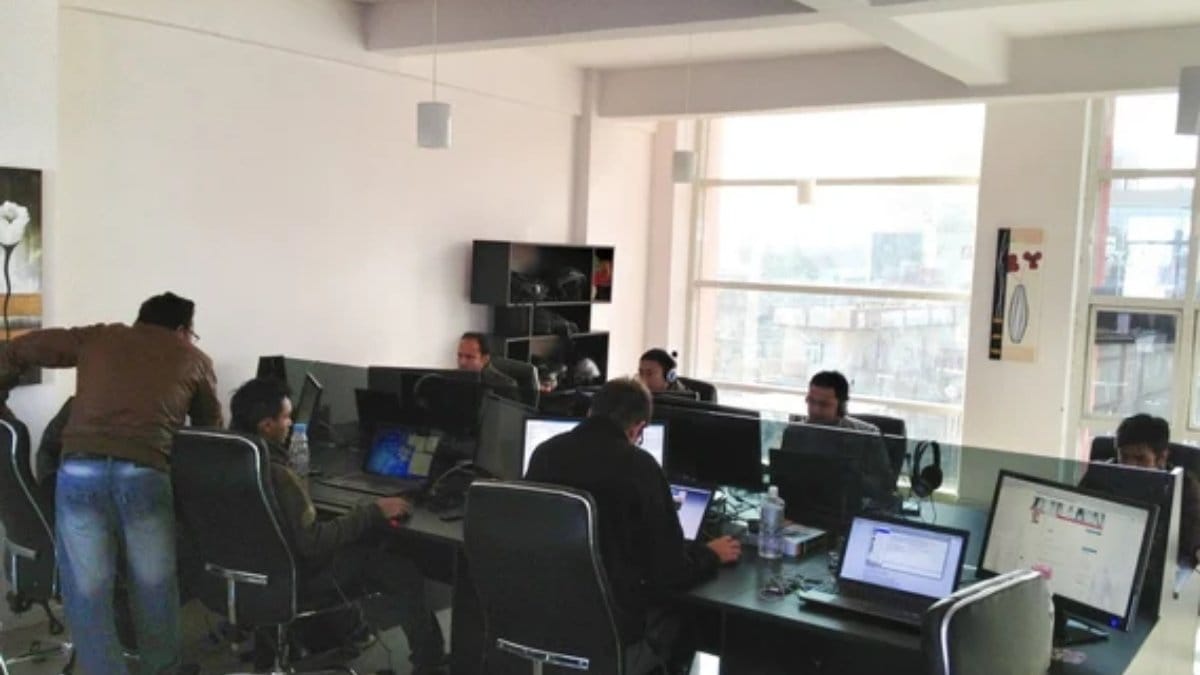
Yet the sectors that are exposed are starting to feel it. Since the launch of ChatGPT, job listings for highly exposed and low-complementarity roles have fallen by around 20%. The biggest declines have come in business-process outsourcing, information technology services and administrative support—industries that South Asian policymakers once championed as engines of middle-class growth. Entry-level and mid-skilled workers, especially those with moderate education but little specialisation, face the most acute risks.
Crucially, not all AI exposure is bad. Many roles including teachers, doctors, lawyers combine high exposure with high “human-AI complementarity”: the kinds of judgement or interpersonal skill that machines cannot easily replicate. In these jobs, AI could boost productivity rather than replace humans. South Asia does surprisingly well on this front. Around 70% of AI-exposed jobs in the region fall into the “complementary” category, the highest share among all emerging market regions.
This means the real promise of AI in South Asia lies in enhancing labour (not replacing it). A teacher in Kathmandu who uses AI to prepare lesson plans faster; a lawyer in Colombo who drafts contracts more efficiently—these are the kinds of gains policymakers should seek to scale.
But capturing these gains requires two things South Asia has in short supply: digital infrastructure and skilled workers. Only a fraction of firms and households enjoy consistent access to electricity and high-speed internet. The region’s education systems, meanwhile, are still geared towards rote learning rather than problem-solving, an ill fit for the new economy.
Where infrastructure and skills are in place, wage signals are already shifting. Jobs requiring AI and digital capabilities now command a wage premium of nearly 30% relative to other white-collar work. This is a warning: without rapid investment in skills and connectivity, the productivity boost from AI will accrue to a narrow elite, exacerbating inequality and fuelling brain drain.
South Asia’s economic model—particularly in India, Bangladesh and Sri Lanka—has long relied on exporting services. Unlike East Asia’s factory-led growth, South Asia’s bet was that code and customer support could substitute for physical goods. Generative AI may now test the viability of that strategy.
India’s IT and business services sector alone employs 5.4m people and accounts for 7.5% of GDP. Any big disruption here would reverberate across the region. Already anecdotal reports from major outsourcing hubs suggest that client demand is shifting towards AI-integrated services, putting pressure on firms to upskill or automate. Nepal, too—where the ICT sector is becoming a central plank of the growth strategy—could encounter headwinds, as AI begins to automate much of the work now driving its expansion.
This raises the spectre of a new kind of development trap. In the past, the concern was “premature deindustrialisation”—where countries de-industrialised before achieving high incomes. The AI era could usher in “premature de-professionalisation”, as service jobs become vulnerable before South Asia’s economies have matured enough to create higher-value alternatives.
Nepal presents a textbook case. With the lowest AI exposure in South Asia, it faces little immediate risk of automation. But that is not a cause for complacency. It also means that Nepal is unlikely to benefit much from the productivity boom AI might bring elsewhere. Small and informal firms dominate the economy. Many still lack basic accounting, let alone AI-enabled tools.
Yet there is a window of opportunity. With the right investments in broadband, electricity, education and skills, Nepal could leapfrog into niche AI applications suited to its strengths: remote education, agri-tech and digital freelancing. The same digital platforms that threaten low-end outsourcing jobs can also enable new forms of employment—if the workforce is prepared.
Mind the gap
South Asia’s relatively low exposure to AI may buy it time. But it should not breed inertia. Over one million people enter the labour force every month, and job creation remains an existential economic priority. Failing to adapt to the AI era could mean slower productivity, stagnant wages and rising inequality.
AI may not take South Asia’s jobs, but it could take its future growth if the region is not ready. Those jobs that are safe from automation today may simply not be good enough to build tomorrow’s economy. ■