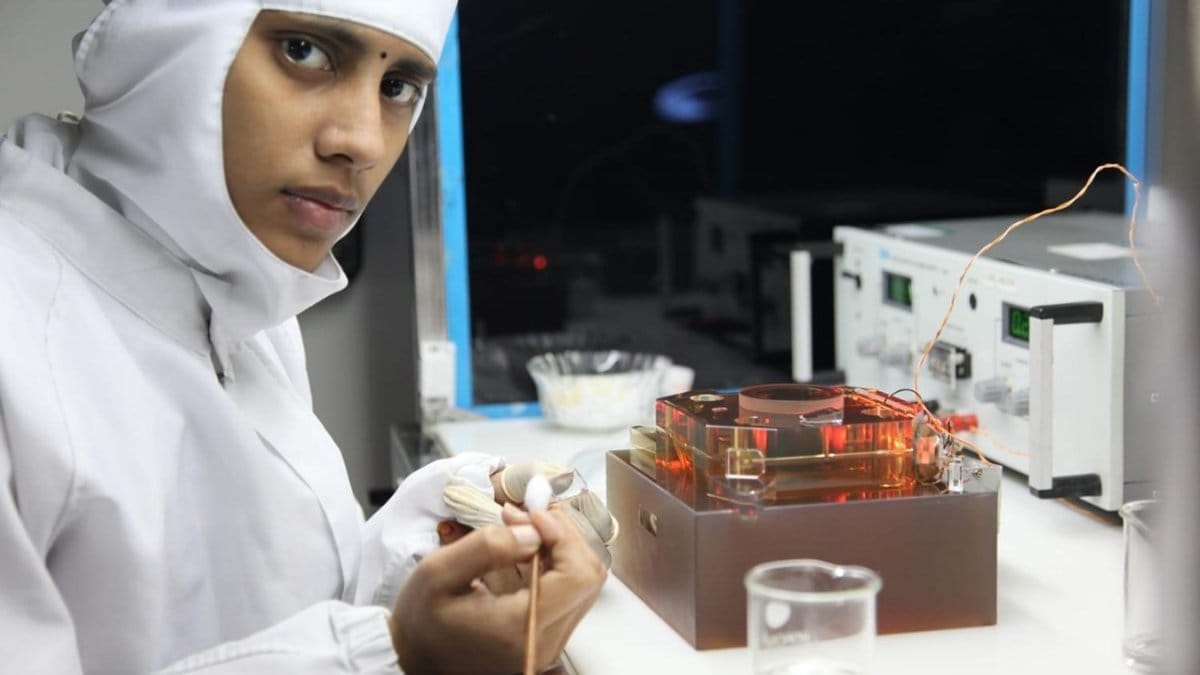
IMAGE: GETTY IMAGES
IN A classroom in Jhapa, a group of schoolgirls is being taught about gravity. Their teacher writes Newton’s laws on the board. He does not mention Bibha Chowdhuri, an Indian physicist who worked alongside Patrick Blackett on cosmic rays, or Asima Chatterjee, a pioneering organic chemist. The girls, uniformly neat in their blue pinafores, listen diligently. None will likely become a physicist. In Nepal, a country that has made admirable strides in getting girls into school, the journey into a laboratory or an engineering firm is forbiddingly steep. Less than 10% of researchers are women, a figure that would make even the most stoic development economist wince.
This is not about educational deprivation. Nepal’s net enrolment rate for girls in secondary school outperforms the South Asian average, according to latest available data from the World Bank. Yet that success does not translate into scientific careers. The pipeline, as development types are fond of saying, is leaky. The causes are a textbook case of how old habits as well as slow institutions and practical economics conspire to hold people back.
Also read: What this year’s Nobel in economics can teach Nepal
The conditioning begins early. “My father tells me science is for boys, that it is too tough for me,” says one 15-year-old in Kathmandu, her eyes fixed on the floor. The sentiment is endemic. Male teachers dominate science classrooms, and textbooks offer few female role models. The curriculum, says an education official, “is not a priority for reform at the moment.” The consequence is a cumulative erosion of confidence. By the time university choices loom, many young women have internalised the message that STEM (science, technology, engineering and mathematics) is not for them.
Family expectations then cement this early discouragement. The perceived stability of teaching or nursing makes them socially acceptable choices. Engineering or computer science, by contrast, are seen as male domains, involving late nights and fieldwork incompatible with future domestic duties. “A daughter becoming a doctor is prestigious,” a Kathmandu-based sociologist observes. “A daughter becoming a geological engineer is perplexing.” The pressure to marry and have children young further truncates careers before they can properly begin. For families investing scarce resources in education, the calculation tends to be brutally economic: why fund a risky, lengthy science degree when a safer bet exists?
For the determined few who persist, the professional landscape is bleak. Research grants are disproportionately awarded to men. Leadership positions in universities and research institutes are almost exclusively male preserves. Maternity leave policies are threadbare, and childcare facilities in workplaces are as rare as a quiet moment in Kathmandu’s traffic. A female computer-science lecturer describes attending international conferences while pregnant, hiding her condition for fear of being seen as uncommitted. “The system is not designed for women with families,” she says. “It assumes a wife at home.”
The absence of supportive networks intensifies this isolation. Without mentors to guide them through the byzantine politics of academic promotion or the opaque process of grant applications, many promising female researchers simply fall away. “You are always an outsider,” says one young microbiologist. “The old boys’ club decides everything over tea.”
Into this void step campaigners like Babita Paudel, “because, you know, these policymakers and academic leaders, they are not aware about this situation”. She is a biochemist who founded the Women in STEM, Nepal in 2022. Hosted by the Centre for Environmental and Agricultural Policy Research, Extension and Development (CENAS), the network compiles a national directory of female scientists, offers training workshops across provinces and runs online communities connecting more than 4,600 women in science and engineering. Her ambition is to make women visible, and thereby viable. “Believe in yourself and your abilities. That is the most important thing.”
The economic cost of all these sorts of barriers is big. Nepal is losing half its intellectual capital in fields critical to its development, from agricultural science to climate adaptation and public health. “We are trying to solve 21st-century problems with only half our brainpower,” quips one frustrated international-development consultant.
Policymakers offer sympathetic noises but little concrete action. A gender-equality unit in a government ministry produces well-meaning reports that gather dust. The cultural resistance runs deep. One senior academic, when asked about the disparity, shrugged: “These things take time.” For the young women in that Jhapa classroom, time is a luxury they do not have. The laws of motion are clear: an object at rest stays at rest. Without a sufficient external force, Nepal’s scientific establishment seems unlikely to change its trajectory. The nation’s potential Newton or Curie is probably in a classroom today, being steered towards a more “suitable” profession. ■