IMAGE: REUTERS
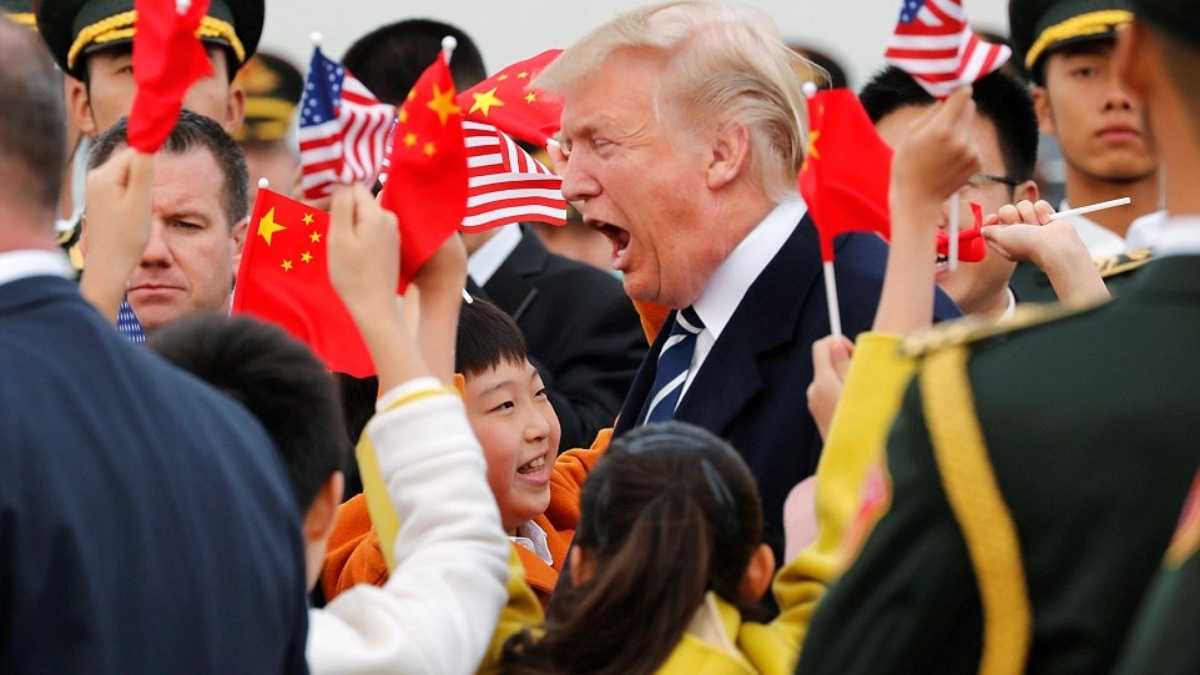
EVERY AMERICAN president who has sat across from a Chinese leader has arrived with roughly the same conviction: that personal rapport can soften structural rivalry. Some were disappointed quickly. Others took longer. Donald Trump, who once served Xi Jinping chocolate cake while informing him that American missiles were striking Syria, is about to test this theory again: this time on ground that has shifted considerably beneath Washington’s feet.
Mr Trump’s two-day visit to Beijing next week arrives at a moment worth understanding clearly. Last October, after American tariffs on Chinese goods reached 145%, Beijing squeezed America’s supply of rare earth minerals (indispensable inputs behind everything from electric vehicles to fighter jets). Washington folded. A truce followed. That episode matters because it punctured something: the assumption that America, as the incumbent hegemon, holds the stronger hand in any confrontation with China. China experts say that era is gone, probably for good.
This is the context in which Mr Trump now pursues what he has grandly called a “G2”: a grand bargain between the two superpowers. Yet the risks are considerable.
The history of these personal encounters offers an instructive guide to what they can and cannot achieve. Richard Nixon’s 1972 meeting with Mao Zedong is the gold standard: two leaders who shared no values but grasped that their strategic interests were, for the moment, complementary. They produced a workable framework on Taiwan and laid the groundwork for diplomatic recognition. That was diplomacy serving clear-eyed statecraft. Ronald Reagan’s meetings with Deng Xiaoping in 1984 were warmer and more expansive, but they also seeded the false conviction that economic integration would eventually bend China towards American-style liberalism. It didn’t.
Mr Trump will face a more confident counterpart. China’s economy carries real burdens from a property crash and high youth unemployment to a shrinking workforce, but its leaders believe they have found the measure of American pressure. Beijing now has more tools to respond than it did during Mr Trump’s first term: rare earth leverage; influence over Iran as its biggest oil buyer; and a 15-year industrial plan aimed squarely at displacing western dominance in advanced manufacturing. Mr Xi is, by all accounts, content to let Mr Trump claim visible wins—perhaps Boeing sales, soyabean purchases—while the structural competition continues on Chinese terms.
The danger for Washington lies in Mr Trump’s appetite for the dramatic gesture. American allies across Asia are watching anxiously for any hint of concession on Taiwan. Beijing would like Mr Trump to shift American language from strategic ambiguity to explicit opposition to Taiwanese independence.
What would a really useful summit produce? At minimum, a durable trade truce and a channel for managing flashpoints before they escalate. At best, Chinese pressure on Iran, where Beijing’s financial ties give it real influence.
Mr Xi, according to Beijing scholars, wants Mr Trump because the American president is less hawkish on Chinese security issues than his own officials. Mr Trump fancies himself the architect of a historic deal; Mr Xi is buying time to decouple from western supply chains and build out China’s own. One of these men has a coherent long-term strategy. Personalities, as a former CIA China analyst observes, matter only at the margins. The reserved Chinese leader, it is said, normally saves his hugs for Vladimir Putin. Mr Trump should consider what it means to be next in line. ■