IMAGE: SETOPATI
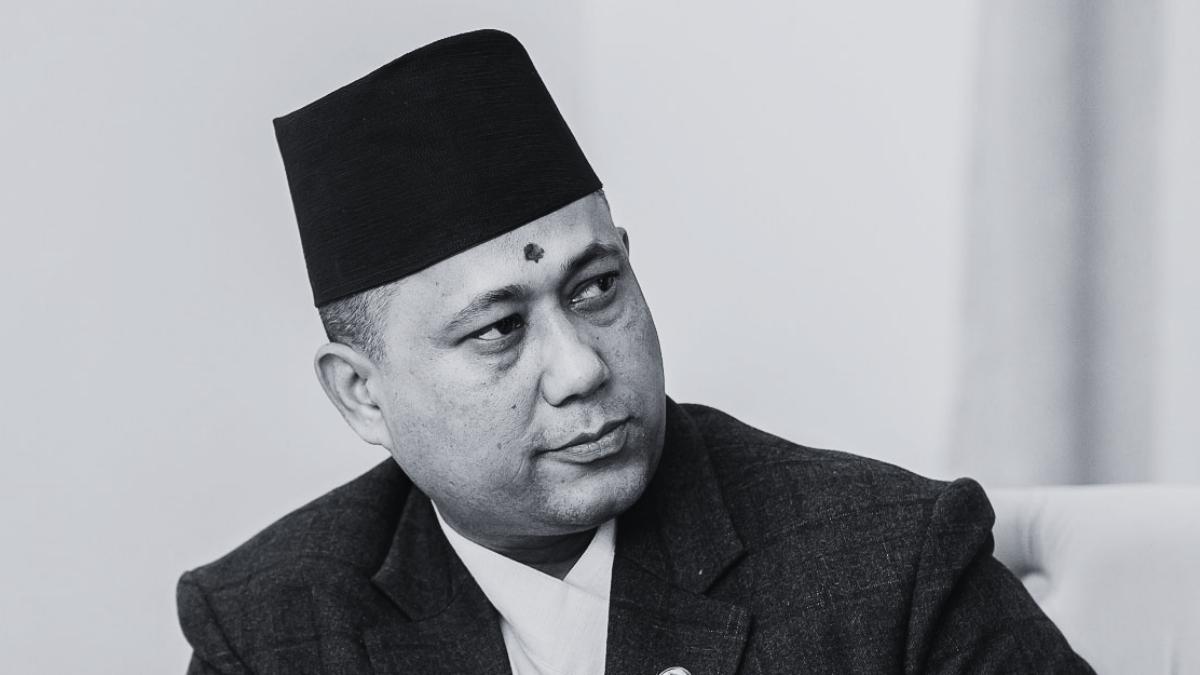
WHEN NEPAL’S foreign minister Shisir Khanal left for Beijing on June 14th, one week after returning from New Delhi, the sequencing was no accident. Two visits, two neighbours, ten days apart. The schedule announced that Nepal is a country that treats both its giants equally. Nobody in Kathmandu’s foreign policy community quite believes that. But the conversation about what the China visit actually means, and at what cost, has split the city’s analytical class into positions that are each coherent and each incomplete.
The first position is straightforwardly defensive and, given the circumstances, difficult to argue with. China has spent the past three months watching Nepal’s new government receive the United States, the European Union, Bharatiya Janata Party (BJP) delegations and the Indian prime minister in rapid succession—without a comparable engagement from the ruling Rastriya Swatantra Party’s side towards Beijing. A senior Nepali official says Beijing has developed “growing suspicion” that the government is tilting west. That suspicion is not groundless. Back-to-back visits by US officials, American pressure on Kathmandu to issue identity cards to Tibetan refugees living in Nepal, and the warm reception given to Rabi Lamichhane’s, the RSP chairman, New Delhi trip had all registered in Beijing as signals. Going to China is the least the government can do to stop the misreading from toughening into policy. Khanal said as much before his departure: “My visit is focused on dispelling such narratives, building trust and confidence.”
The second position accepts all of this and then asks what Nepal is paying for the reassurance. The pre-departure briefings described a visit in which Khanal would reaffirm Nepal’s commitment to the One-China policy, pledge that Nepali territory will not be used for activities against China, and commit to the BRI framework—though officials noted that Nepal may seek revisions to the project list agreed during former prime minister K.P. Sharma Oli’s 2025 Beijing visit.
These are not new positions. Nepal has been making these pledges to China, in various forms, for decades. The concern among a section of Kathmandu’s analysts is that reaffirming them in the current context—with US pressure over Tibetan refugees as the backdrop—amounts to Nepal choosing a side in the US-China competition by publicly ruling out positions that Washington would prefer it to keep open. The pledge that Nepali territory will not be used against China is, in this reading, not a neutral sovereignty statement. It is a specific answer to a specific American ask.
The third position, expressed most directly by those who were skeptical of the equidistance strategy before Khanal landed in either capital, argues that the whole exercise misrepresents Nepal’s actual situation. China’s BRI has been signed for nine years and has produced no implemented project in Nepal. The Kerung-Kathmandu railway is a feasibility study. The industrial zones are plans. The Trans-Himalayan Connectivity Network is a framework document. Against this record, Kathmandu is deploying its most senior diplomat to Beijing to reassure the Chinese leadership and rebuild trust: apparently without extracting any concrete commitment in return.
Nepal may also seek revisions to the project list, the briefings noted. But seeking revisions to a project list that has never produced anything is a negotiation over the terms of a promise, and not the delivery of a promise.
The strongest counter to all three of these positions is also the most pragmatic. Nepal cannot afford for China to withdraw its goodwill, reduce its investment; or shift its attitude towards the several hundred thousand Nepali workers who benefit, directly or indirectly, from Chinese economic activity in the region. The Chinese Ring Road grant of $82m, signed in April, is the most concrete recent evidence of what goodwill delivers. Losing it over a failure to send the foreign minister to Beijing would be expensive. Going is cheap by comparison.
That is what unites Kathmandu’s divided analytical class more than anything separates it. The disagreement is not about going. Meaning it is about what Nepal says when it gets there, and what it brings back. Khanal returns on June 17th. The city will be watching the outcomes closely, because the visit’s cost-benefit calculation depends entirely on what the trip actually produces and not what both sides say it will. ■