IMAGE: ICONICS
THE NUMBER that Gaurav Pandey, president of the Nepal Association for Software and IT Services Companies, cited at a Kathmandu press interaction in February was $1bn. That, he said, is what Nepal’s IT sector now earns a year from service exports, more than double the Rs67bn recorded in an IIDS survey just three years earlier. “As an industry practitioner, I am very confident we have reached that billion-dollar number,” he said, before adding, with unusual candour, that the figure is a best estimate based on industry growth patterns and multiple informal assessments, rather than a formal nationwide study.
That qualification matters but not in the way it might seem. Nepal’s central bank, the Nepal Rastra Bank, recorded some $87.5m in telecommunications, computer and information services exports in the first six months of fiscal year 2025-26—which, annualised, comes to around $175m. The chasm between the NRB’s figure and NAS-IT’s is a factor of six. Both are real measurements. They are measuring different things. The NRB captures what flows through Nepal’s formal banking system. The Katmandu Journal put it plainly in February: “A vast and surging share of Nepal’s digital exports never touches a Nepali bank account in any traceable way.” Freelancers collect payment through Payoneer, Upwork and PayPal. Small development shops take cryptocurrency. Bigger firms with diaspora connections book revenues through overseas subsidiaries. The WTO’s broader measure of “digitally delivered services” for Nepal put the 2023 total at $836m, far closer to NAS-IT’s estimate than to the NRB’s. The $1bn is probably real. Nepal’s formal financial system just cannot see most of it.
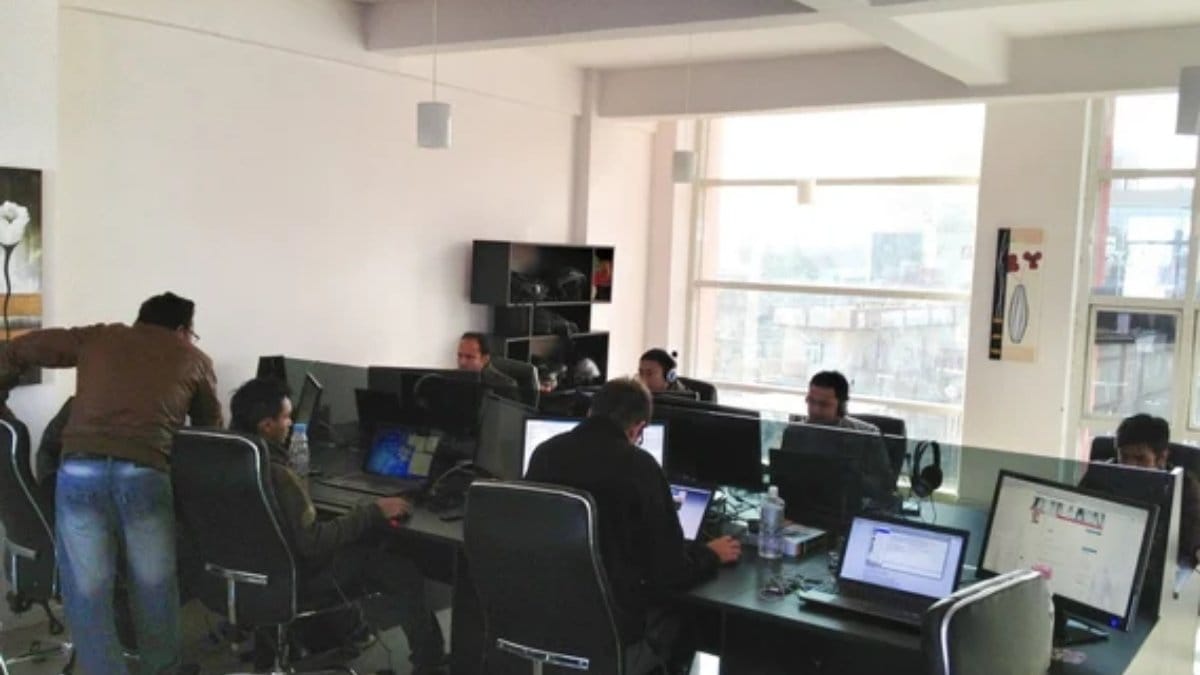
This statistical hall of mirrors is the industry’s defining paradox: Nepal’s most successful new export sector has built itself almost entirely outside the infrastructure the state uses to track and support economic activity. Over a dozen Nepali companies now process home loan applications for Australian banks: a niche so big that Pandey described Australia as a primary destination with thousands of Nepali workers spending their days assessing mortgage files from lenders in Melbourne and Sydney.
Similar clusters have emerged in US healthcare data analytics, where HIPAA-compliant outsourcing to Kathmandu has become an established category. Fusemachines, founded by Nepali AI researcher Sameer Maskey, has built an AI services company operating across Nepal, North America and Asia, training local talent while servicing global clients.
None of those businesses were seeded by industrial policy or developed in a government-designated technology zone. They happened because English proficiency as well as competitive wages and a workable time zone alignment with Australia and the Gulf created a natural commercial opportunity, and entrepreneurs found it.
The workforce behind this has grown from an estimated 70,000 professionals in 2022 to some 100,000 today, 90% of them concentrated in Kathmandu. That concentration is simultaneously a source of the industry’s strength—the clustering of colleges, firms and talent that makes specialised labour available—and its most obvious constraint. A sector whose entire workforce fits within a single ring road around a single city is not yet a national industry. It is a Kathmandu phenomenon that happens to earn in foreign currency.
The policy environment is catching up, but with the characteristic lag that marks every sector of Nepal’s formal economy. The IEBEEI Act, passed in March 2025, allowed IT companies to invest abroad and their foreign earnings to be deployed internationally for the first time.
A tax framework offering exporters a 75% rebate and an effective rate of around 6.25% on export income is already among the more generous in the region. What is still missing is a double taxation avoidance agreement with the US, the UK or Australia—the three largest markets—leaving Nepali firms exposed to paying tax twice on the same income. Around Rs400m in VAT refunds owed to IT companies is stuck in the government’s pipeline. NAS-IT’s request for an IT Promotion Board, modelled on the Nepal Tourism Board, remains unfulfilled. And the absence of a formal nationwide measurement system means nobody—including the government that has set a target of $22bn in cumulative IT exports over ten years—actually knows the sector’s true size.
That ten-year target of $22bn implies growing from $1bn today at a rate that would require sustained annual expansion of roughly 36%. Vietnam’s technology export surge, which is the model Nepali industry leaders most frequently cite, was accompanied by large-scale foreign direct investment into manufacturing-adjacent tech parks, deep bilateral trade agreements and a government that treated the sector as a strategic priority rather than a pleasant surprise.
Nepal has the talent. It does not yet have those other things. Whether it can build them before the talent finds somewhere better to go is the question the next decade will answer. ■