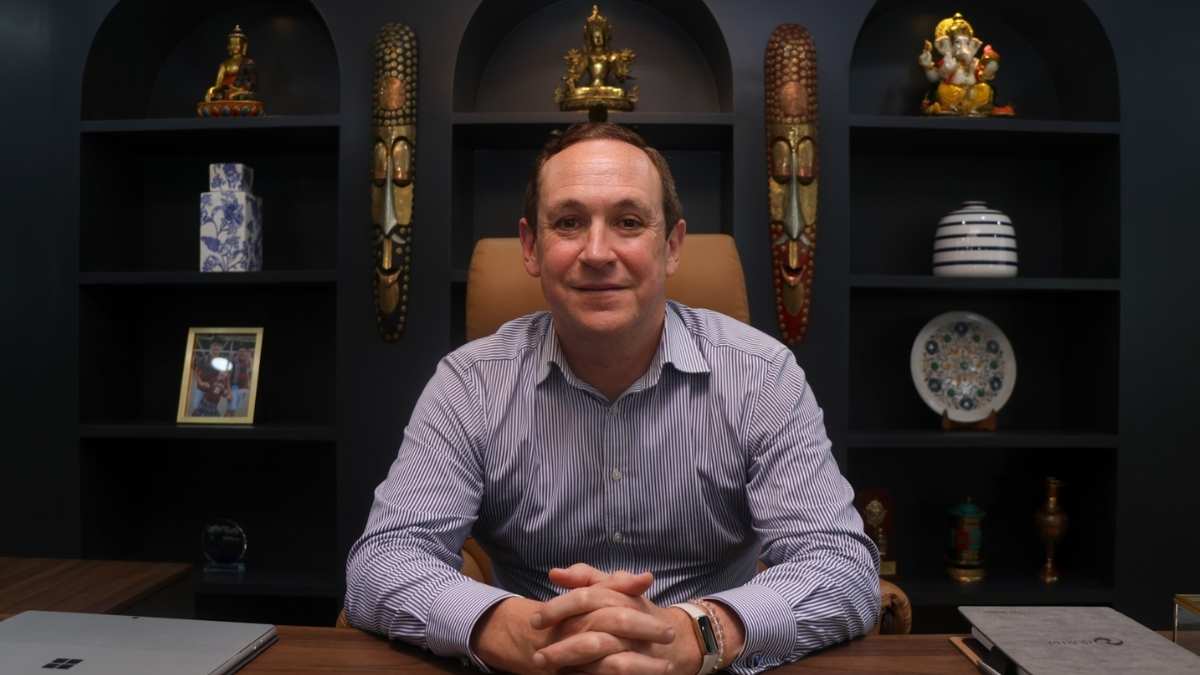
TIM GOCHER arrived in Nepal in 2003 on what was supposed to be a two-week trekking holiday. He is from Essex, had spent his career as an investment banker in London, New York and Singapore, and had worked, as he puts it, for a billionaire. Nepal was in the middle of a Maoist insurgency. He fell in love with it anyway. He went back, started a non-profit called the Dolma Foundation, eventually married a Nepali woman he had met through the charity, spent eleven years getting to know a country that most international investors could not find on a map, and then in September 2014 made the first close on Nepal’s first international private equity fund. He spent three years raising it. “People just did not understand us,” he said in a 2024 interview with OnlineKhabar. He thought they were, briefly, the unluckiest fund in the world. Not because of Nepal. Because no one had ever done it before.
That fund, Dolma Impact Fund I, backed by a small constellation of development finance institutions and a £300,000 initial grant from what was then the UK’s Department for International Development, eventually closed with around $27m. What it did with that money is probably the most consequential eleven-year experiment in private equity that any frontier market in South Asia has ever seen. Dolma invested in CloudFactory, a data processing company with deep roots in Kathmandu that trained Nepali workers to do digital tasks for global technology firms. It was, in 2014, not an obvious bet.
By 2019, when Dolma sold half its stake in a growth equity round, it had made what Gocher described as “a great exit”—the first successful international institutional private equity exit in Nepal’s history, proving that repatriation of foreign capital out of the country’s highly restrictive central bank system was actually achievable. CloudFactory subsequently expanded to Kenya, opened offices in the UK and became the template for a model that has since been replicated across the developing world: hire people in the global south, train them on high-value AI data labeling and annotation work and sell the service to enterprises in the north.
Dolma also invested in Fusemachines, an enterprise AI solutions company founded by Cornell-trained Sameer Maskey, and in WorldLink, one of Nepal’s main internet service providers. In October 2025 Fusemachines—originally built as a US-headquartered corporation to bridge Wall Street capital with its engineering engine in Kathmandu—officially completed its SPAC merger and began trading on the NASDAQ under the ticker “FUSE”. It became the first company of Nepali origin to accomplish such a feat. That listing shows what DFI-backed private equity can deliver in a frontier market when given enough time: take a bet on an ecosystem that formal capital would normally never touch, hold through years of slow growth and eventually hand it a platform that connects its talent base to global investors.
The clean energy side of the portfolio has worked differently, and in some ways more directly. Dolma’s five energy investments—Setikhola Hydropower, Swet-Ganga, Suri and others—have collectively generated some 50 megawatts of installed capacity. Gocher says these projects have averaged 17% returns, which is the number he cites when trying to persuade international infrastructure investors that Nepali hydropower can work commercially. The Swet-Ganga project listed on the Nepal Stock Exchange (NEPSE), completing the full cycle from private equity investment to public market exit. The Setikhola project, Dolma’s earliest hydropower bet, has since become a case study in how to relocate communities affected by dam construction in a way that actually improves their living standards—a film the fund produced about the resettlement won attention at impact investment conferences in Europe.
By the time Dolma celebrated its tenth anniversary in September 2024, the fund had deployed $108m across both vehicles, created an estimated 11,500 jobs in its portfolio companies, and announced a third fund: the Dolma Climate Fund, focused on attracting private capital into Nepal’s response to climate change, including clean energy and climate resilience. Gocher’s own estimate of the quality employment generated by Fusemachines and CloudFactory alone—around 5,000 jobs, most of them for Nepalis who might otherwise have been on a plane to the Gulf—is the metric he returns to most often. “If there is one metric that drives our team it is quality employment generation,” he told Impact Investor in 2023.
What Dolma built was not just a fund but a proof of concept. When Gocher started raising Fund I, there was no track record of foreign institutional private equity entering Nepal and exiting profitably. There was no template for how to structure a fund for Nepali regulations, how to get DFI approvals through SEBON (Securities Board of Nepal) and the NRB (Nepal Rastra Bank), or how to exit when a secondary market for unlisted shares barely existed. He spent years creating all of those precedents while simultaneously running the investments they were supposed to enable, laying the direct groundwork for SEBON to formally pass its Specialised Investment Fund (SIF) regulations in 2019. Fund II, which closed at $71.96m in December 2022 with FMO, BII, Swedfund, DFC, IFC, JICA and others as investors, raised more than twice as much as Fund I because Fund I had created the track record that Fund I didn’t have. That is how all new asset classes are built.
The wider ecosystem Dolma helped create has since attracted Team Ventures, True North Associates, Avasar and newer entrants like Nivesh Fund. Dolma’s own investment in Foodmandu attracted follow-on capital from Team Ventures and ultimately Himalayan Capital. Its energy investments demonstrated IRRs that are now being used to pitch Nepali hydropower to international infrastructure funds. The fund that spent three years raising $27m from institutions that “did not understand” what it was doing has, by the most honest accounting, done more to build Nepal’s private capital market than any policy announcement or investment summit in the same decade. The country is richer, and several thousand Nepali families are together rather than separated by migration, because a man from Essex went trekking in the wrong place at exactly the right time. ■