IMAGE VIA ARTHA NEPAL
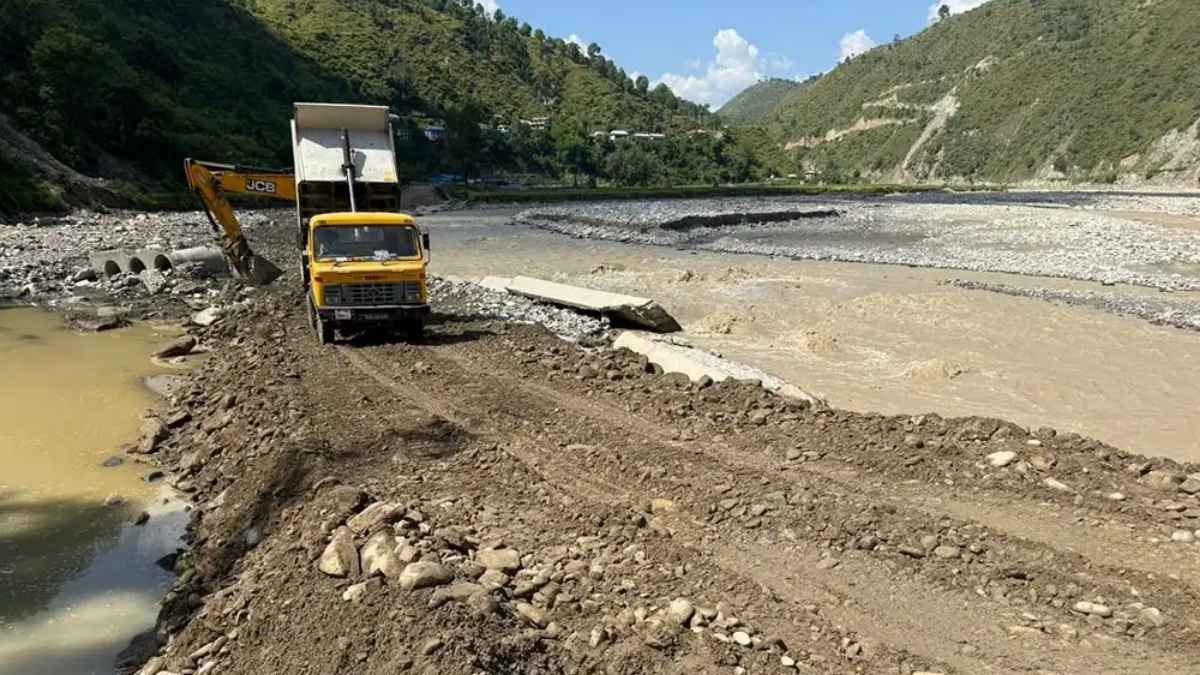
BHAKTA BAHADUR LAMA has rebuilt the same section of temporary road seven times in less than a year. His company, Khani/Kamaljit/A-one Joint Venture, won a Rs1.22bn contract in July 2025 to reconstruct 8.5 kilometres of the BP Highway along the Roshi river corridor in Kavre district, east of Kathmandu. Each time the rains come (and since the Roshi’s banks were destabilised by the October 2024 floods, even moderate rainfall is now enough to do it) the diversion his crew builds on the riverbed gets swept away. Each rebuild costs between Rs6m and Rs7m. Equipment meant for permanent concrete work, including steel rods, pipes, generators and formwork, was washed away in separate floods in February and April 2026, adding an estimated Rs20m in losses.
“The money we spend building diversions is literally being swept away by the river,” Lama told the Kathmandu Post. “Sometimes workers have to run for their lives.”
This is Nepal’s capital expenditure problem at its most literal: a government that spent months last year trying to improve its dismal 12.1% capital spending execution rate in the first half of the fiscal year, and a contractor who has executed his contract six times over—just not in a way that shows up on any infrastructure completion table.
The BP Highway (officially the Banepa-Bardibas section of the B.P. Koirala Highway) connects Kathmandu to eastern Nepal’s most densely populated and agriculturally productive lowlands. It is not one of several options. There is no practical alternative route that can carry freight or passenger traffic at scale. When it closes, which it now does with every significant rain event, the consequence is not merely inconvenient. Journeys that once took three hours commonly take six or more. Food from the eastern Terai (vegetables, grains, lentils) cannot move west towards Kathmandu at normal speed or volume. Manufactured goods and construction materials cannot move east. The eastern hills, which supply the valley with much of its seasonal produce, become commercially isolated during exactly the season when their crops are maturing and need to reach markets.
The October 2024 floods destroyed eight of the highway’s twelve most vulnerable kilometres completely: not damaged but removed by the Roshi river. Emergency repairs costing nearly Rs100m reopened a fragile diversion within ten days. The Bhaktapur Road Division spent a further Rs39m on maintenance and diversion rebuilding between October 2024 and mid-July 2025 alone. Three reconstruction contracts totalling some Rs3bn were awarded. None of the contractors could begin meaningful permanent work because the monsoon was still running. Floods in October 2025 caused fresh damage before a single kilometre of permanent road had been rebuilt. As of June 2026, reconstruction is ongoing and the monsoon is starting again.
The World Bank’s April Nepal Development Update measured the macroeconomic damage of the September and October 2025 flooding at around 1.3% of GDP, including the broader economic disruption from the September political unrest. The preceding year’s floods were separately assessed at 0.8% of GDP and Rs46.7bn in direct losses. Together those two monsoon seasons have cost Nepal roughly two full percentage points of cumulative economic output—lost agricultural cycles, stalled supply chains, damaged infrastructure that has to be rebuilt before it can be used, and construction work that cannot happen because it keeps getting undone before it is done.
This is the mechanism behind a number. Finance Minister Swarnim Wagle presented a budget on May 29th targeting 7% growth for fiscal year 2026-27. The World Bank’s own projection for the same period is 4.6%. Part of the disparity between those two numbers is a policy disagreement about revenue and capital spending. Part of it is a seasonal fact: Nepal’s fiscal year runs mid-July to mid-July, its monsoon runs June to September, and its construction window runs roughly October to May. Every rupee of capital expenditure budgeted for roads, irrigation and infrastructure has to be physically executed in those eight dry months, in terrain that spends the other four months actively undoing what the eight months built. The 12.1% capital spending execution rate in the first half of the year is not only a governance failure. It is partly a climate calendar. You cannot pour concrete in a riverbed during a Himalayan monsoon and expect it to stay there.
Nepal’s Department of Roads manages 29,000 kilometres of road network. During the 2024 monsoon alone, there were 814 highway closures across 41 national highways, according to a peer-reviewed study published in the Journal of UTEC Engineering Management. 78% of Nepal’s annual rainfall falls between June and September, with roughly half concentrated in July and August. In those two months, capital Nepal could be spending on building things is instead spent keeping things from washing away—or, when they wash away anyway, rebuilding them in time for the next flood.
The BP Highway contractors are not uniquely incompetent. They are working in a river valley whose hydrology has shifted, on timelines set by procurement rules that assume a construction season, with equipment that the weather destroys before they can use it. The Rs3bn budgeted for reconstruction is real money. The Roshi river, which does not read budget documents, is indifferent to it. Wagle’s growth target assumes Nepal can spend its capital allocation and build what it plans to build. The monsoon, which starts every June and ends every September, has a different schedule. ■