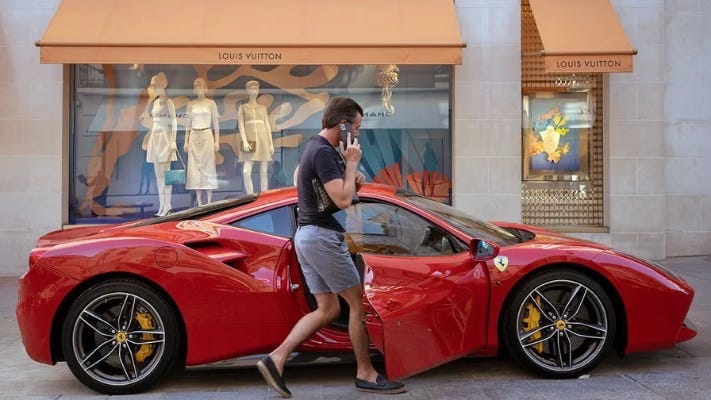
Scale in economics is a virtue. Scale in luxury is a vice. Nowhere is this more apparent than in Maranello, a nondescript Italian town that has produced fewer cars in 75 years than Toyota builds in a month. And yet Ferrari, Maranello’s best-known export, is worth nearly €76 billion, triple the market capitalisation of Stellantis, a sprawling automotive leviathan whose factories churn out millions of Jeeps and Peugeots a year. Ferrari’s strategy is simple: manufacture mystique not metal.
There is a lesson here for Nepal’s nascent luxury economy (estimated at less than 1% of GDP), which is torn between middle-class aspirations and upper-class appetites. The country has no shortage of heritage. It has materials—cashmere, copper, timber, tea. It has artisans who still work by hand. What it lacks is philosophy. Ferrari has one. So do Hermès and Patek Philippe. Nepali brands from Pashmina shops in Thamel to boutique hotels in Mustang are still searching for theirs.
Ferrari sells fewer than 14,000 cars a year. Its operating margin, however, surpasses 25%, a feat that would make most airlines weep. This is not an accident. The company follows a mantra: “Always sell one fewer car than the market demands”. In doing so it converts scarcity into prestige and prestige into pricing power. A Ferrari buyer does not pay for horsepower alone: they pay to be admitted into a circle. Even then entry is not guaranteed. First-time buyers are told to start with a used model; attend several events; and wait their turn. Some spend years in the wings.
Such rituals may sound absurd. They are in fact lucrative. Ferrari’s F80 hypercar, priced at €3.6 million, was three times oversubscribed last year. The firm does not employ a chief marketing officer so much as a gatekeeper-in-chief: a man known internally as “Mr No”, whose job is to turn down probable clients. In Maranello customers cry not from buyer’s remorse but from emotional overload. At Ferrari’s atelier clients customise their car’s every stitch. A headrest may be embroidered with a family crest. Even the paint has a story.
In Kathmandu the wealthy have by now embraced selective consumption. Memberships to golf clubs; British boarding schools; and inner-circle weddings function as social passwords. The property market feeds on similar instincts: gated communities in Budhanilkantha advertise not amenities but altitude. The logic is not economic but tribal: who lives here matters more than what is built. Yet many Nepali brands, but particularly those with premium ambitions, continue to pursue scale. They discount. They franchise. They dilute.
The alternative is clear. Build less, charge more. A luxury brand is not born of bulk. It is cultivated through meaning and refusal. Ferrari does not sell downmarket perfumes, unlike Hermès. It has no need. Every detail from the stitching of the steering wheel to the angle of showroom lighting is designed to signal reverence. Nepali boutique hotels and cashmere houses, by contrast, copy Western aesthetics without absorbing the logic behind them. Handwoven scarves are shrink-wrapped in plastic. Heritage lodges play American pop music in the lobby. The experience becomes less temple, more airport.
Even the wealthiest firms fall prey to misaligned incentives. A conglomerate launching an electric vehicle line might be tempted to outprice Hyundai. A luxury school (eg, Rato Bangla) may attempt to expand too quickly. Ferrari’s success suggests the opposite. Benedetto Vigna, the physicist-turned-chief executive, did not emerge from Detroit or design school. He came from semiconductors. What he brought was perspective. Ferrari, he insists, is part racing laboratory and part philosophical brand. Few car companies sell emotion by the litre.
Nepal does not lack ambition. From high-altitude resorts in Manang to elite international schools in the Valley, it is brimming with aspirants. Nor does it lack an audience. The wealthiest households spend more on weddings than they do on houses. Many have second homes in Australia and children in Boston. What they do not yet have is a homegrown brand that makes them feel chosen. The country’s luxury sector remains import-dependent: foreign liquor, foreign watches, foreign status.
Yet it is not inconceivable a Nepali firm could build its own version of Maranello. Patan has the craftspeople. Mustang has the mystique. The Valley’s elite already believes in ritual even if its entrepreneurs do not. Scarcity is the language the rich understand best. Selling less, more expensively, requires discipline. But it also builds resilience. A boutique that sells 500 scarves at $200 makes more profit, and keeps more dignity, than one that sells 5,000 at $20.
Nepali luxury economy looks outward when it could look inward. It scales when it ought to withhold. But the fundamentals are promising. After all if a sleepy Italian town can become synonymous with global aspiration, there is little reason a Himalayan one cannot. Provided it learns to say no. ■