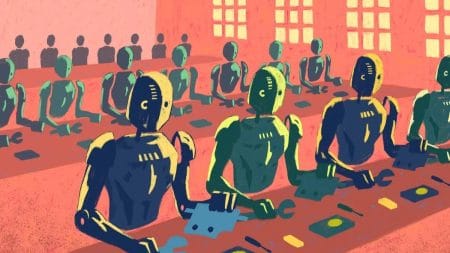
In co-working spaces from Lagos and Silicon Valley to Lisbon, a new kind of founder is emerging. They have no staff, little capital as well as no technical background. Yet they are launching companies with global reach. Their assistant is not a co-founder or a consultant. Rather it is a suite of generative artificial intelligence tools: bots that draft contracts, build websites, run ad campaigns and provide customer service. Tasks that used to require months and a small team can now be completed over a long weekend.
The rise of the “solopreneur”, a solo founder using AI in place of human staff, offers a glimpse of how artificial intelligence may change the economics of starting a business. In Silicon Valley, investors speak, only half in jest, of a race to fund the first one-person unicorn: a company valued at over $1bn with no payroll. A decade ago or so, a start-up needed coders, designers, marketers and lawyers. Today a half-decent idea and a laptop may suffice.
This is not the first time technology has disrupted firm structure. In the 19th century, the advent of railroads and large-scale manufacturing gave rise to the modern corporation. In 1937 Ronald Coase, a British economist, argued that firms exist because they lower transaction costs: coordinating within a company is cheaper than negotiating every task in the market. But when those transaction costs fall thanks to better communications, outsourcing or now AI, the rationale for big firms weakens.
The internet began this erosion, enabling remote work and global freelancing. Cloud computing pushed it further, allowing firms to rent processing power instead of owning servers. Generative AI now takes the logic to its frontier: automating tasks once considered creative or cognitive. Entrepreneurs can use AI to develop product ideas, test markets, write code and answer customer emails—often in minutes and often for free.
Business schools are adapting. At Harvard, executives now simulate product launches using AI to conduct stuff such as supplier research and design packaging. In one study, individuals using generative tools performed as well as two-person teams without them. Some even outperformed their human peers. As one instructor put it: “The assistant is becoming the operator.”
Early evidence suggests behaviour is changing. According to Carta, a platform that tracks private-company data, the average time from incorporation to first hire has leapt from under six months in 2022 to more than nine in 2024. Founders are staying leaner for longer. Some avoid hiring altogether. An AI-driven development firm was acquired last year for $80m, with only eight employees.
By lowering costs AI is also lowering barriers. Not everyone can code; nearly anyone can prompt a chatbot. For aspiring founders in emerging markets (where capital and tech talent are scarcer) the levelling effect is big. In theory a 22-year-old in Nepal can now build and test a product as fast as a Stanford graduate in Palo Alto.
But in reality the model has limits. Generative tools are fast, though flawed. They hallucinate, miscalculate and make odd decisions. When one AI firm tested its agent on a real vending-machine business, the model underpriced items, ignored demand signals as well as issued unprompted discounts. The machine did not run out of snacks but it did run out of money.
More troubling is the dependence on infrastructure controlled by a few tech giants. The AI stack—models, compute, distribution—is dominated by Amazon, Microsoft and Google. These firms provide cloud access and invest in leading AI labs. Also they host the platforms on which most start-ups depend. Between them, they now account for 7% of all corporate profits in America, up from 2% a decade ago. As with cloud computing in the 2010s, the rise of AI may democratise access while entrenching platform dominance.
The tools also flatten competitive advantages. When everyone uses the same models and access is cheap or free, differentiation becomes difficult. Intellectual property is thin; execution, easy to copy. Unless a founder possesses unique data or deep expertise, for example, defensibility is scarce. AI enables rapid iteration but weakens barriers to entry. In this world first-mover advantage tends to look like first-mover exposure.
Moreover, the enthusiasm notwithstanding, the solo-founder boom has not produced a boom in successful companies. In America and Europe, firm formation is still below pre-2008 trends. Ageing populations, sluggish productivity growth and risk-averse regulation still weigh on entrepreneurship. Technology may speed up the cycle, but it cannot erase structural headwinds.
Still, something is changing. AI lowers the cost, labour and time needed to launch a startup. That changes not only who can start a business but how it is financed and scaled, too. Capital providers, platforms and founders are re-negotiating their roles in the startup economy. Efficiency is replacing headcount as the metric of ambition. The solo entrepreneur is no longer an oddity. In some cases it may be the model.
Whether all this produces more innovation or simply more churn is unclear. Yet the economics of business creation are being rewritten. Starting a company has never been easier. Building one that lasts is another matter entirely. ■