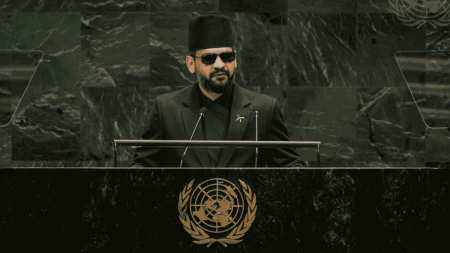
The revolution will not be televised Image: Kantipur Television
IN THE 1980s a television set was a sign of modernity. In Nepal, when the state launched its first broadcaster, Nepal Television (NTV), in 1985, families would crowd around the blue glow to watch nightly bulletins and imported dramas. It was the country’s only window to the wider world, and its authority was rarely questioned.
Forty years on, that window has shattered into a million screens. The medium that used to unite a nation now competes for attention with the restless chatter of TikTok and YouTube. Nepal’s television industry, which experienced a chaotic, rapid boom, is now grinding through an equally swift bust.
Television’s rise was once global and glorious. After the second world war, broadcasters such as NBC in America and the BBC in Britain turned the new medium into a public institution. By the 1950s the world had entered television’s “golden age”, with satellites carrying live events across continents. Nepal arrived late to the revolution, but with similar hopes: that television could inform, educate and perhaps civilise. Under the monarchy, NTV’s task was less to question power than to project it. Its cameras followed ministers’ speeches and royal ceremonies.
Democracy in 1990 loosened the airwaves. A new constitution enshrined press freedom, and the 1992 National Broadcasting Act opened the door to private investment. By the late 1990s entrepreneurs were buying airtime on NTV; in 2001 Channel Nepal became the first private satellite station. It brought competition—and curiosity. Newsrooms started covering opposition parties, corruption, public grievances and so on. For the first time, television felt like journalism rather than ritual.
The boom that followed was as chaotic as it was creative. After 2006 the number of television licences ballooned from five to more than 180. The government issued them freely, often without market studies or regulatory oversight. Many new channels were owned not by journalists but by businessmen, party loyalists and industrialists seeking influence. Some were little more than vanity projects; others fronted for unrelated ventures. The airwaves filled with copycat talk shows, endless music videos and partisan commentary. Advertising, once the lifeblood of the medium, spread too thinly to sustain so many players.
The economics soon turned cruel. Nepal’s small advertising market—around $133m a year according to some rough estimates—was split across hundreds of outlets. Meanwhile, brands began migrating online, where Facebook and YouTube offered cheaper and more targeted reach. Revenues for television collapsed; salaries stagnated; experienced reporters left for NGOs or foreign jobs. “Trainees are running newsrooms,” laments one editor. The consequence is a peculiar inversion: more channels than ever, but fewer journalists.
Technology hastened the death. Smartphones and broadband made every citizen a potential broadcaster. The social networks that first borrowed television’s vocabulary—“channels”, “feeds”, “live”—have now devoured its audience. Viewers no longer wait for the 8pm news; they scroll for it. Many television stations, desperate for relevance, simply upload their entire bulletins to Facebook or YouTube, mistaking platforms for audience. The visual grammar of the internet—short, fast and interactive—has replaced the stately cadence of broadcast news.
Regulators, ill-equipped to police this sprawl, have struggled to uphold standards. Ethical codes are habitually flouted. Some outlets use exposure as leverage for advertising or political favours. Labour laws are ignored; reporters are dismissed without pay. Audiences, once deferential, have grown cynical. In surveys, trust in television journalism now trails behind online media, even as misinformation flourishes there. The profession’s old pride in verification and balance is being replaced by an economy of outrage and imitation.
The malaise is not uniquely Nepali. Across the world, television news has been humbled by the attention economy. In America cable networks have lost younger viewers to streaming platforms; in India, hundreds of channels fight for ever-shrinking ad slots. But Nepal’s case is distinctive for its speed and fragility. The country built an entire television industry within a generation, then watched it unravel before reaching maturity. It faces a problem similar to that of many Western public broadcasters, but in fast-forward and without the financial cushion.
This collapse has consequences. The first casualty is truth. A hollowed-out press corps lacks the resources to hold power to account. Complex stories go untold. The second is social cohesion. When the shared experience of the evening news fragments into personalised feeds, a nation’s common narrative splinters. The third is the journalists themselves, trapped in a system that offers neither professional dignity nor a living wage. They are the human fallout of an industry in freefall.
Is there a way out of this mess? One path is continued drift—a slow, painful descent into irrelevance, punctuated by state bailouts for politically connected outlets. This is the fate of many struggling broadcasters from Greece to Venezuela, kept on life support to serve partisan ends. The alternative is harder but more honest. It requires consolidation. Nepal does not need hundreds of channels; it needs a handful of viable, independent ones. Regulation must be enforced, not to muzzle the press, but to protect its integrity by ensuring fair wages and transparent ownership. Broadcasters must stop chasing clicks and rediscover their unique value: credible, original reporting that algorithms cannot replicate.
Yet that comfort is deceptive. The real trouble is not technological but institutional. Nepal’s television bust is a symptom of a deeper ailment: the difficulty of building robust, independent institutions in a young democracy where political and business interests are deeply entangled. The same pattern can be seen in its banking and industrial sectors. The lesson is that a free market in licences is not the same as a healthy market in ideas.
Television journalism in Nepal is not yet dead. But it is ageing fast, burdened by habits formed in monopoly and threatened by technologies born in chaos. Its future will depend more on trust. In an era when anyone can broadcast, journalism’s rarity lies in the discipline to tell the truth when no one else will. The path of drift leads to a public square dominated by noise and power. The path of reform is harder—but it is the only one that leads back to light. ■