
Illustration: Katmandu Journal
IN KATHMANDU’S banking circles, Roshan Kumar Neupane was known as the magician. He arrived early, spoke quickly, set targets that made colleagues blanch and then watched, with a practised smile, as the numbers appeared on cue. Loans boomed. Deposits followed. Profits grew fat. For much of the past decade, NIC Asia Bank looked like the most dynamic institution in a staid industry. In September this year the magician walked off the stage.
Mr Neupane resigned on September 17th, citing health and family reasons, nearly a year before his second term as chief executive was due to end. By then the applause had faded. The bank’s once-polished metrics lay scuffed and dented. Profits had collapsed. Bad loans were swelling. Depositors were edging away. Nepal’s most ambitious bank had become its most conspicuous headache.
The arc of NIC Asia’s rise helps explain its fall. When Mr Neupane took charge seven years ago, aged just 38, he inherited a respectable but boring lender. Banks were conservative creatures, shaped by a small economy and a regulator inclined to forbearance. Mr Neupane brought a different instinct. Trained as a chartered accountant, he believed that scale itself could be a source of strength. Grow the balance-sheet fast enough, spread fixed costs slimly and dominate retail banking before rivals woke up.
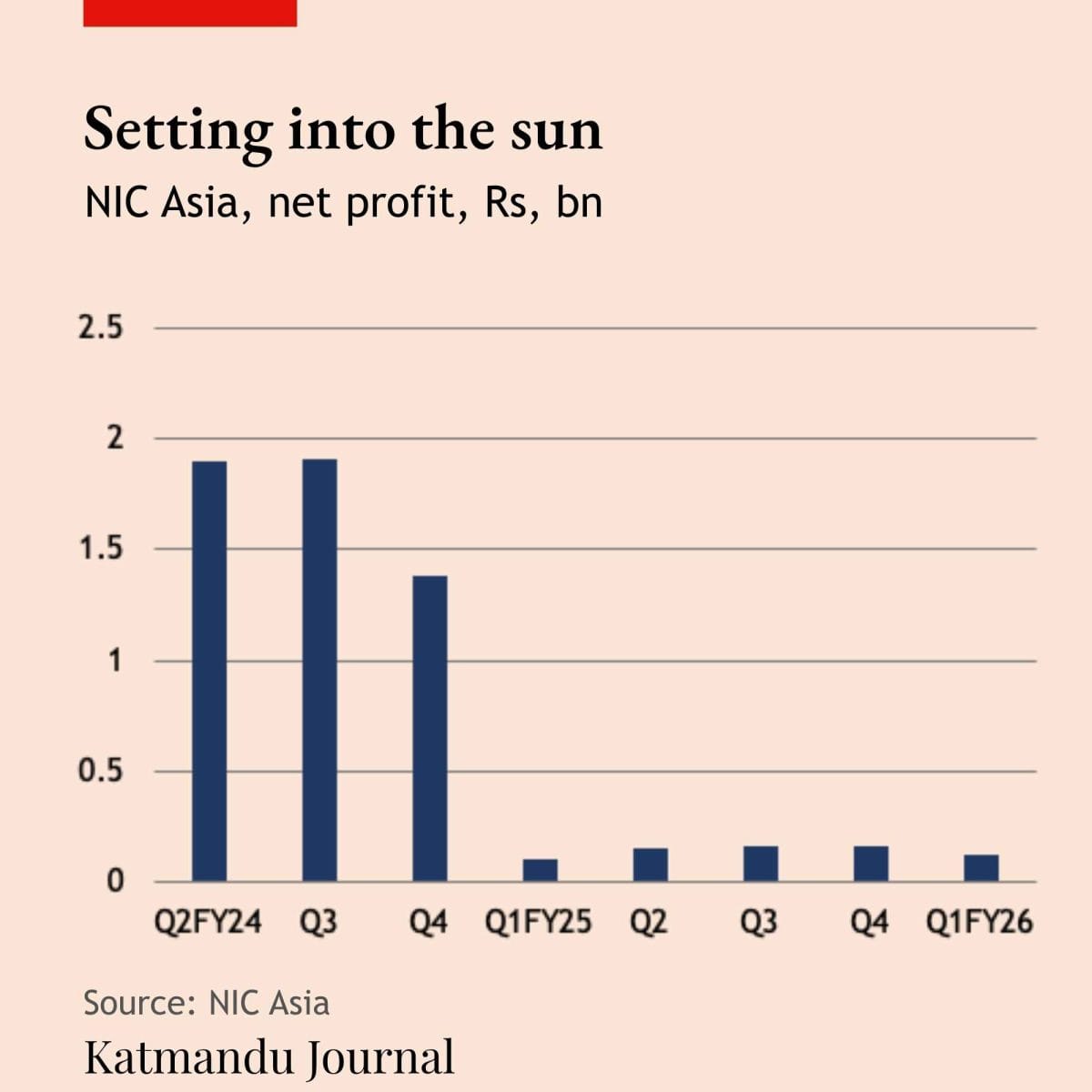
The results were startling. Between 2017 and 2023 NIC Asia expanded both loans and deposits at roughly 24% a year, far faster than the economy that sustained them. At its peak, it accounted for more than 5% of all private-sector credit in Nepal, a stunning share in a crowded market. Net profit climbed to around Rs 4.5bn in the 2022–23 financial year. Return on equity hovered comfortably above 14%. Investors and analysts held it up as a yardstick.
To fuel that growth, the bank pushed hard into retail and small businesses, which provided higher yields than staid corporate lending. It also rolled out deposit products that sounded almost alchemical. One, branded the “10 times deposit” scheme, promised to turn a sum into ten times its size over two decades. Such offers drew money in fast. They also locked the bank into long-term liabilities whose cost would bite later.
Inside the bank, the culture matched the numbers. Targets were relentless. Branch managers lived by weekly scorecards. Those who missed them were reminded loudly. For a while, the pressure worked. NIC Asia built the largest branch network in the country, more than 360 outlets, under the slogan “Bank pani sathi pani”—the bank is also a friend. The brand seeped into towns where banking had once felt distant.
Yet rapid growth carries a cost. Loans written quickly are harder to know intimately. Retail credit, spread across thousands of borrowers, looks diversified until a shock hits everyone at once. And a culture that celebrates expansion can begin to misread momentum for judgement. Former employees speak of a confidence that curdled into hubris as the good years stretched on.
The first tremor came with the economic hangover alongside soaring interest rates that followed the pandemic. Other banks, bruised but intact, began to steady themselves. NIC Asia did not. Its numbers diverged sharply from the pack. By early 2025 its net profit had dwindled to Rs 161.5m, a fall of 96% from its peak. Return on equity collapsed to barely half a percentage point. The distributable profit vanished, halting dividends for a second year and angering long-loyal shareholders.
The most alarming figure sat on the asset side. Non-performing loans, once a boast at 1.19%, leapt to 6.28% by mid-2025. In a system where anything above 5% rings alarm bells, the rise was deafening. One quarter alone saw write-offs surpassing Rs 1bn. Provisions for future losses swelled, eating into capital that had already grown slim.
Why did the rot spread so fast? Part of the answer is down to the nature of the lending itself. During the boom, NIC Asia leaned heavily into sectors that thrive on optimism: property-linked retail credit, consumption loans and small enterprises sensitive to cash-flow shocks. When demand cooled and rates climbed, repayment schedules buckled. A portfolio built for speed proved fragile under strain.
Another part sits with accounting and oversight. Investigations by the Nepal Rastra Bank, the central bank, found that NIC Asia had reclassified certain risky commercial loans as residential ones, a manoeuvre that lowered the provisions required against them. Such practices flattered short-term profits while storing trouble for later. There were also allegations of inflated fee income from microfinance loans, which padded earnings without strengthening the core business.
The regulator eventually issued formal warnings under Section 100 of the NRB Act, including over the provision of interest rates above published levels to directors and their family members. These were not trivial slips. They pointed to a governance culture willing to test boundaries in pursuit of growth.
Regulatory context matters, too. Until recently, Nepal’s provisioning rules were forgiving. Loans could remain classed as standard even 90 days past due, far laxer than the 30-day norm in India. During the pandemic, capital requirements were eased further. Such leniency allowed problems to be postponed rather than solved. When the rules tightened, reality arrived all at once. The International Monetary Fund has since flagged weak supervisory enforcement as a systemic risk. NIC Asia became its most vivid exhibit.
As losses mounted, the bank’s capital cushion faded. Its Tier 1 ratio hovered near 8.5%, the regulatory floor. That left little room to absorb further shocks without raising fresh capital, a difficult task when confidence is ebbing. Depositors noticed: by mid-2025 deposits were down around 10% year on year. In banking, trust evaporates faster than liquidity. Once savers begin to glance nervously at headlines, even solid institutions feel the tremor.
Global parallels offer comfort only in the sense that NIC Asia is not alone. India’s Yes Bank collapsed in 2020 after years of aggressive corporate lending masked by creative classification. Silicon Valley Bank in America fell in 2023 when unhedged interest-rate bets collided with a sudden run. In each case, growth dazzled until conditions changed, then amplified the damage.
Mr Neupane’s defenders argue that he shook Nepal’s banking from complacency. There is truth in that. He proved that scale was possible, that retail banking could be built nationwide, that profits need not crawl. For a while, competitors scrambled to imitate his tactics. Yet disruption without restraint can hollow out the institution it animates. A bank’s balance-sheet is not a start-up’s pitch deck. It rewards patience and punishes bravado.
By the time Mr Neupane left, relations with the board had soured. Reports speak of tense meetings and public rebukes as results deteriorated. The image of a single, confident leader gave way to something messier. Shareholders felt betrayed. Shares in the bank have plunged 24% in the last five months. Customers felt uneasy. The Prabal Janasewashree medal he received in 2019 for services to banking now reads like an artefact from another era.
In November, Sujit Kumar Shakya took over as chief executive. With nearly three decades of experience at institutions such as Nabil, Himalayan and Laxmi Bank, he arrives with a reputation for caution rather than flair. His task is unglamorous. He must clean the loan book, rebuild capital buffers and coax depositors back. This will take years not quarters. Growth, for now, is a dirty word.
The bigger lesson stretches much further than one bank or one country. Finance thrives on confidence, but it feeds on discipline. Rapid expansion can disguise weak risk management, just as buoyant markets can flatter poor judgement. Regulators who indulge success stories for too long tend to end up policing crises instead. Investors who chase returns without asking how they are made usually learn the answer late.
NIC Asia once stood like a Himalayan peak, admired for its height. Today it looks more like a warning sign on a steep trail, reminding climbers that thin air tests even the strong. In banking, as in mountaineering, speed impresses, but survival depends on respect for limits. The next few years will show whether the institution can relearn that lesson. Others would be wise to study it now while the memory is fresh. ■