IMAGE: RSP
TWO MONTHS after Balendra Shah became prime minister, his party held a district meeting in Bara, a town in Nepal’s southern plains. It did not go well. The district chairman was expelled before the meeting began. When it started, a dispute erupted over who would get to stand in upcoming local elections: the long-time party workers who had built the organisation from scratch, or the newer arrivals swept in by the election wave. The argument turned physical. Three people were injured. Four members of parliament were escorted out of the venue for their own safety.
The Rastriya Swatantra Party—the vehicle that carried Shah to 182 of 275 parliamentary seats in March, two short of the two-thirds needed to amend the constitution alone—is not yet two months old as a governing party. It is already showing the strain.
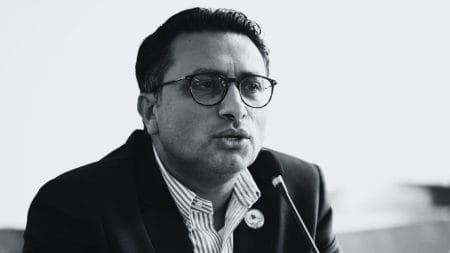
The Bara incident is not the only signal. On May 11th Rabi Lamichhane—the RSP’s founder and party president, who controls the party organisation from outside the cabinet—felt the need to convene an orientation programme for the party’s new lawmakers and warn them, in explicit terms, not to form factions. “Sometimes friends in the media give many headlines out of a desire to see the party split,” he told them, before addressing circulating rumours about a rift between his people and Shah’s. Within the same week, Lamichhane was reported to be holding one-on-one consultations with individual RSP lawmakers: a classic tool of party management in moments of internal stress, not of settled confidence.
These are early-warning signs rather than a crisis. But they illuminate something important about what kind of political force the RSP actually is; and whether the anger that put it in power has been converted into anything durable.
The RSP has two origin stories, and they sit awkwardly together. The first is Lamichhane’s: a television celebrity who founded the party in 2022, fell into legal trouble over a citizenship technicality and later a cooperative funds embezzlement case, and emerged from that controversy—including a jail term—with his supporters largely intact.
The second is Shah’s: the former Kathmandu mayor who joined the RSP only in December 2025, brought an enormous personal following with him, and became the face of the March election within weeks of formally signing on.
The arrangement they agreed was this: Lamichhane remains RSP party president, controlling party discipline. Shah runs the government as prime minister and parliamentary party leader. Two men, one vehicle, power formally divided between them.
That arrangement carries a big tension the Bara brawl made evident. The party workers who feel sidelined are right to notice that there are effectively two hierarchies to appeal to: the government in Singha Durbar and the party in Chamati. Lamichhane’s one-on-one sessions with lawmakers after the Bara chaos are a reminder that the power to shape the RSP’s next candidate lists, and therefore the careers of every sitting MP, sits with the party president rather than the prime minister. Shah can govern. But Lamichhane can, in ways that matter to ambitious parliamentarians, reward and punish.
The bigger question is whether the RSP has ideas or only imagery. Its stated platform such as anti-corruption and cleaner governance is what every reformist party in every country promises. Beyond that, the RSP has been notably reluctant to define what it actually believes on the questions that divide reasonable people: how to tax, what to spend on, how to balance development against environmental protection, what Nepal’s foreign policy should look like in practice.
Wikipedia’s own description of the party’s ideology spans social liberalism, constitutional socialism and progressivism: a range broad enough to accommodate almost any position, and therefore a guide to almost none. When difficult trade-offs arrive—and in a country with Nepal’s fiscal position, they will arrive quickly—the RSP will need something more than shared anger at the old guard to hold its coalition together.
The party’s internal architecture does not obviously provide it. The “right to recall” provision—which allows the party to remove any lawmaker who violates its disciplinary code—is a striking instrument for a party that ran on accountability. It is a top-down tool in a party built on bottom-up energy, and it sits in the hands of the party president, not the prime minister. Most of the RSP’s directly elected lawmakers are young, inexperienced in national office and known primarily for their social media presence and association with the anti-establishment wave. They do not share a common ideological formation or the kind of local party machinery that older parties built over decades. What they have is a brand, and the brand is primarily two men who agreed, formally, to share it.
Shah’s personal approval remains high. He has made a point of ordering street repairs and responding to citizen complaints on social platforms in ways that his predecessors never did. The style is effective. It is also, by definition, not transferable. What happens to the RSP’s appeal when Shah is no longer at its centre is a question the party has not begun to answer.
The comparison that Nepali analysts reach for is Bibeksheel Sajha, an earlier anti-establishment party that briefly excited the same demographic before fragmenting and eventually merging into the RSP itself. Bibeksheel Sajha had earnest, educated founders and coherent policy ideas. It could not convert its urban base into a broad enough coalition to break through. The RSP has done what Bibeksheel Sajha could not, but partly by absorbing it and partly by replacing its policy substance with Shah’s personal magnetism and Lamichhane’s organisational infrastructure. Whether that combination is more durable than its predecessors, or merely larger, is what the next few years will reveal.
A party with 182 seats, a finance minister with real economic credentials and a public still willing to give it the benefit of the doubt can accomplish a great deal. Nepal’s other parties are fractured and unlikely to mount a coherent challenge soon.
But the Bara brawl and the denied rumours of a split are a reminder that the RSP is still, at bottom, a movement rather than a machine. Movements win elections. Machines run countries. Nepal’s new government has not yet made the transition between the two—and the man who controls the party that makes the transition possible is not the one sitting in the prime minister’s chair. ■