IMAGE VIA ONLINEKHABAR
MANOHAR ADHIKARI launched Foodmandu in November 2010, before Swiggy existed and when Zomato was two years old and still called Foodiebay. He was solving a problem specific to Kathmandu: a city dense with restaurants, most of them without delivery capacity, and a growing urban middle class with disposable income and aversion to traffic. In the fiscal year ending July 2025, his company processed Rs750m ($4.9m) in gross merchandise value, growing 40% year on year, and handled some 2,000 orders a day across five cities. Adhikari has publicly targeted Rs1bn in GMV for the current fiscal year. On a line chart, the business looks strong. Inside the unit economics, it looks rather harder.
Foodmandu charges restaurants a commission of 20-22% on every order. Apply that to Rs750m GMV and the platform earns some Rs150-160m in commission revenue before adding delivery fees from customers—perhaps Rs50-60m more, at around Rs80 per delivery across some 730,000 annual orders. Total revenue is in the vicinity of Rs200-220m. Against that sits a cost structure that is more expensive than most of Foodmandu’s competitors have chosen to run.
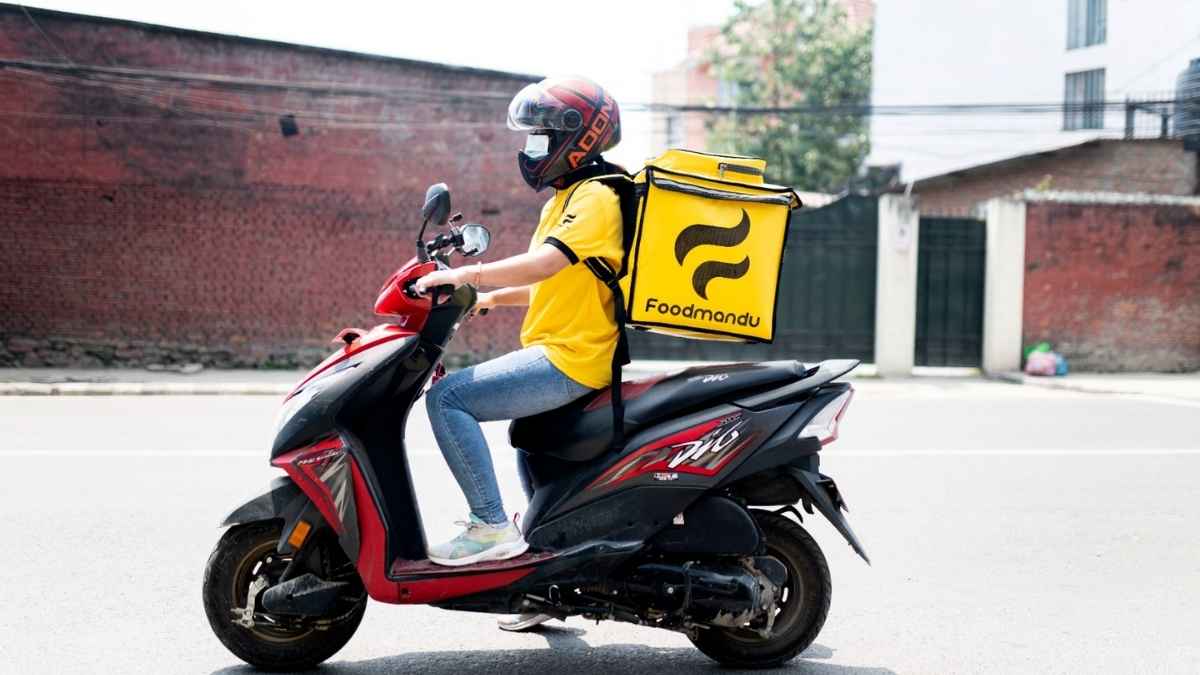
The company employs more than 200 riders on full-time contracts. They earn between Rs20,000 and Rs70,000 a month, receive Social Security Fund contributions from their employer, festival allowances and accident insurance. At a midpoint salary of some Rs40,000 a month, the wage bill alone approaches Rs100m a year. The mandatory employer SSF contribution adds another Rs20m. Bikes, fuel and maintenance add more. Before a single server bill, marketing rupee, or management salary is counted, the rider operation consumes most of what the commissions bring in.
This is an intentional choice. Pathao, the ride-hailing company that entered food delivery in 2020, runs its operation using a gig model: freelance riders working on their own terms, absorbing their own fuel and maintenance costs, with no employment relationship that generates SSF obligations. Pathao charges restaurants some 18%—slightly below Foodmandu—while keeping its own cost base lighter. According to the Asian Productivity Organisation’s 2024 report, Pathao alone has more than 200,000 registered workers in Nepal, including over 5,000 food delivery riders. It can scale up and down without carrying fixed payroll.
Foodmandu’s founders know this and have chosen to employ anyway. The Social Security Fund contributions, the accident insurance, the stable salary: these cost more per delivery and compress margins. Whether this is a principled trade-off or a disadvantage depends on how the business develops. For now it functions as both.
The market itself constrains the answer. Foodmandu operates in Nepal’s urban centres, five cities in a country where the most economically active, digitally engaged demographic—young people aged 18 to 35—is leaving in large numbers. At least 557,000 Nepalis obtained labour approvals to go abroad in the first eight months of the current fiscal year alone. Many of them are from the Kathmandu neighbourhoods that place the most food delivery orders. The total addressable market, already small, is not growing uniformly.
On the investment side, Foodmandu raised a Series C of $4m from Dolma Impact Fund II in 2023—its largest round and first from an international impact investor. That same year Team Ventures, which had acquired a 20% stake in 2020, sold part of its holding to Himalayan Capital Limited, a subsidiary of Himalayan Bank, achieving 2x returns. The new stakeholder is a bank subsidiary rather than a growth-stage fund. Himalayan Capital’s involvement signals consolidation rather than acceleration: patient capital aligned with stable returns, not the kind of investor that funds years of cash burn in pursuit of market dominance.
The comparison that haunts every food delivery startup in this region is Zomato. Founded in India in 2008, it posted its first net profit—Rs3.5bn—only in the fiscal year ending March 2024. That was sixteen years after founding, in a market now worth some Rs660bn. Foodmandu is operating in a market perhaps three orders of magnitude smaller and has chosen a cost structure that limits its ability to subsidise growth. The Rs1bn GMV target is arithmetically achievable at current growth rates. Whether it is enough to change the underlying calculus is a different question altogether.
What it produces, for now, is a business that is substantially better than it was five years ago, probably approaching breakeven and structurally squeezed between the wages it has committed to pay and the commissions the market will bear. The riders are paid. The margins are waiting. ■