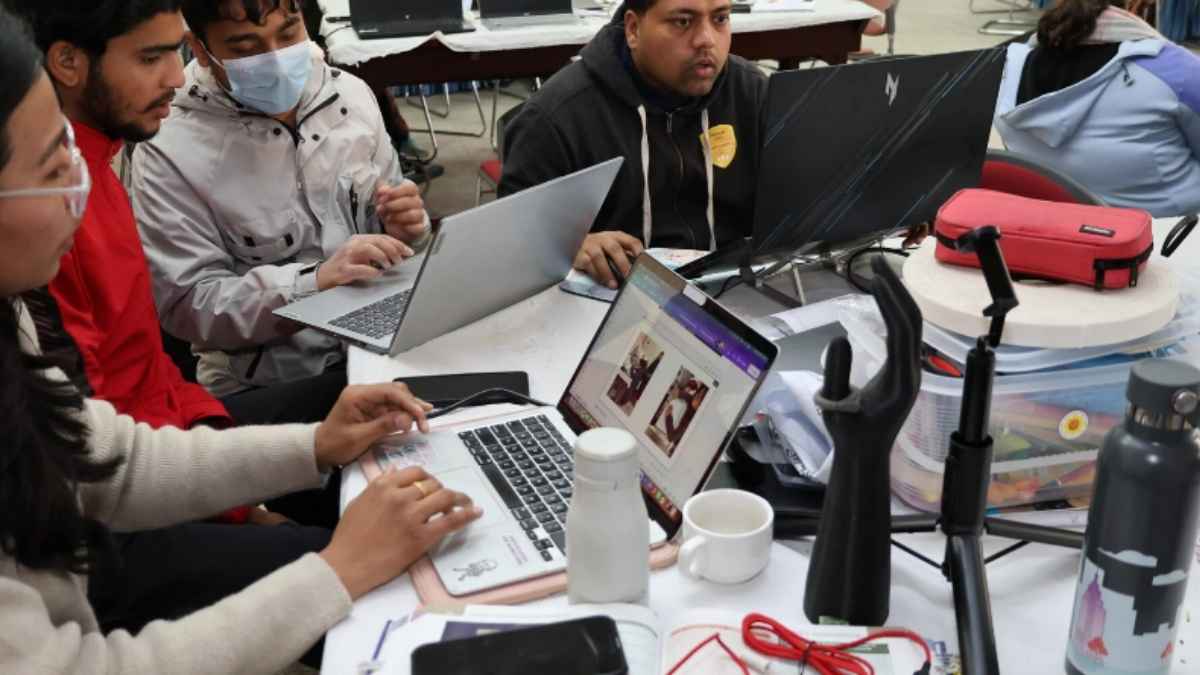
IMAGE: IMPACT HUB KATHMANDU
ON ANY given weekday morning in Jhamsikhel or Bakhundole, the café-dense neighbourhoods that have become Kathmandu’s default backdrop for the entrepreneurially inclined, you will find flat whites and young people with laptops describing themselves as founders. The aesthetic is convincing. The pitch decks are well-designed. The business cards say things like “CEO & Co-Founder” for companies incorporated six weeks ago. The conversation is fluent in the language of disruption, iteration and market fit. What is less frequently evident, at those tables, is a product that anyone outside the room has paid money for.
This is not a Kathmandu-specific observation. Every city with a startup culture has its café-founder surplus: people who have adopted the identity before they have built the thing. What makes Kathmandu’s version worth examining is the chasm between the infrastructure that now exists—from the coworking spaces and the pitch competitions to the government loan schemes and the accelerator programmes—and the companies that have actually emerged from it. StartupBlink, which tracks and scores startup ecosystems in more than 1,000 cities worldwide, placed Kathmandu 525th globally in 2025. The ecosystem grew, by StartupBlink’s own measure, by 0.1% over the year. That is a flat line.
The infrastructure itself has improved. Kathmandu now has more than a dozen coworking spaces, including Impact Hub Kathmandu, RayaSpace, Work Around and several others that offer fast internet, as well as backup power and the kind of relaxed environment that somewhere between the 1990s and now became associated with creative seriousness. Kathmandu University’s centralised incubation centre is currently working with some 24 startups, providing business development support, financial planning and mentorship. The government set aside Rs730m for startup loans in this fiscal year’s budget, offering collateral-free credit at 3% interest, in amounts from Rs200,000 to Rs 2m per venture. Events are plentiful: hackathons, demo days, pitching competitions and sector-specific meetups fill the calendar of any founder interested in filling it. None of this is nothing.
The problem is what the infrastructure is optimised for. A pitch competition rewards the ability to explain a business idea clearly to a panel of judges. A coworking space rewards the willingness to pay a monthly desk fee. A government startup loan rewards the completion of an application form. None of these things is a reliable proxy for the ability to build a product or grow revenue under the conditions of the real market. Kathmandu’s startup ecosystem has become very good at staging the early chapters of an entrepreneurial story, such as the idea and the aesthetic, while the later chapters, where someone has to actually sell something and make a margin on it, receive much less attention.
The companies that have built something lasting in Nepal’s technology sector largely did not come out of the ecosystem’s formal infrastructure. Programiz, which has over a million monthly users learning to code and has never raised external funding, was built by three people who sat down and made it. F1Soft, which owns eSewa and Fonepay and is the most valuable privately founded technology company in the country, was built over fifteen years by a founder who survived years without an investor and without a coworking desk.
TingTing, whose RIRI voice engine has just been demonstrated at Web Summit Qatar, was built by engineers focused on a specific technical problem that global platforms were ignoring. The pattern across all of them is the same: a real problem, a team focused on solving it and a willingness to work through the hard middle section that no pitch competition scores.
“The startup loan initiative now operates more formally than in previous years,” notes a June 2025 Kathmandu Post column on the ecosystem’s missing links, “but unlike previous approaches, the present budget relies on loans and tax reliefs rather than on direct grants.” That contrast—debt versus equity, repayment versus risk-sharing—is more important than the column suggests. Startups in their early stage do not primarily need to borrow money they must repay regardless of outcome. They need capital whose provider has an interest in their success, and which does not force a fixed repayment schedule onto a business model that may take three years to figure out. The government’s instinct to support startups is right. The instrument it is using, ie: a loan, is what a bank offers, not what an angel investor offers. Nepal’s startup ecosystem has plenty of the former and almost none of the latter.
The honest version of the Kathmandu startup scene is this: it is a community of people who are, in many cases, really talented and motivated, operating within a support structure that was built to make the ecosystem look like a startup ecosystem rather than to make companies. The flat whites are excellent. The pitch decks are polished. When the café closes and the pitch competition ends, the tough question, ie what did you build today and did anyone pay for it, is still waiting. ■