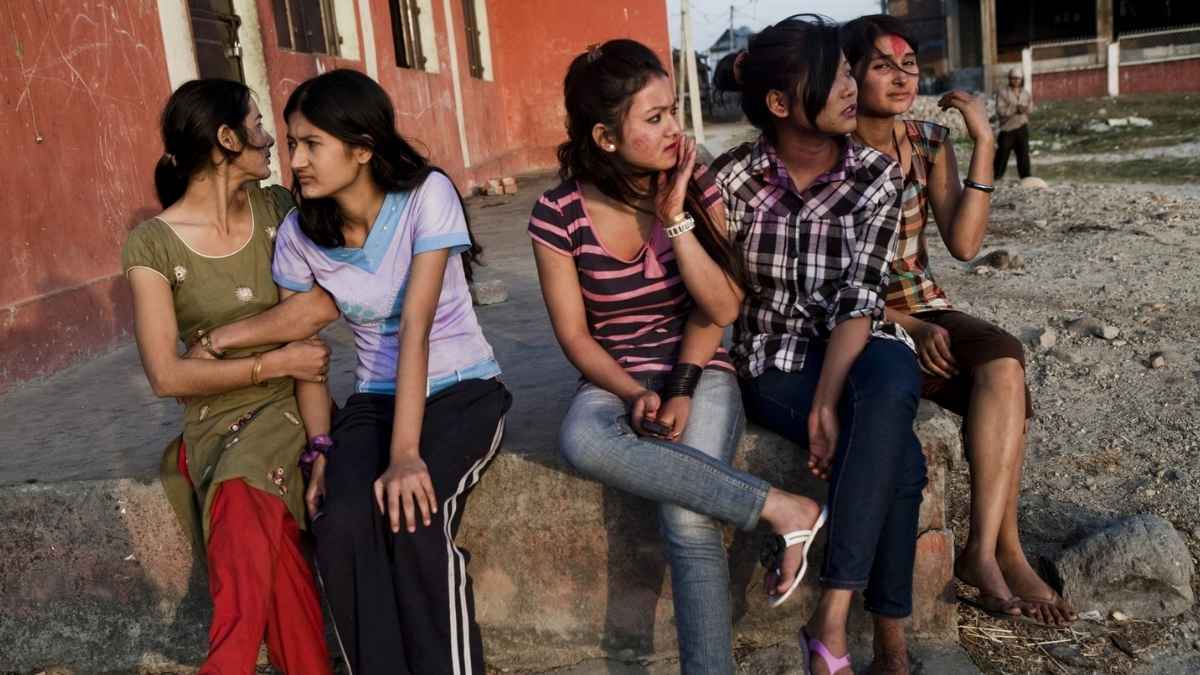
IMAGE: KATIE ORLINSKY
THE RAID follows a predictable script. Metropolitan Police officers move through a cheap hotel or a massage parlour in Thamel or New Bus Park. Women are detained. They are described in official statements as “rescued”. Charges follow under the Human Trafficking and Transportation (Control) Act of 2007, which treats prostitution as a form of human trafficking regardless of whether coercion was involved. The women are released, or not. The hotel reopens within weeks under a different name. The conditions that brought the women there are unchanged.
Nepal’s adult entertainment sector—the legal term that covers dance bars, cabin restaurants, massage parlours and dohori folk music venues—employs tens of thousands of women in arrangements that are intentionally ambiguous enough to evade the law while being widely understood to involve sexual services. A 2020 estimate by the National HIV and STI Control Board, a government body, put the number of female sex workers in Nepal at between 43,829 and 54,207, nearly double the figure from five years earlier. The authors attributed part of the increase to COVID-19, which erased the alternative livelihoods that some women had built after leaving sex work. “We were not earning enough, so we started this job,” one participant told researchers from Indiana University and the University of Minnesota in a 2023 qualitative study of female sex workers in Kathmandu published in the journal Sexuality Research and Social Policy—a formulation the researchers chose as their paper’s title because they heard it so many times.
The legal framework that governs this industry manages to be simultaneously punitive and permissive. Prostitution is illegal under the 2007 act, which includes it within the definition of human trafficking, but it has never been defined as a standalone offence in Nepali law. The Supreme Court of Nepal has interpreted it as “a profession or occupation irrespective of whether it is legal or illegal”.
That interpretive gap allows the industry to exist openly—cabin restaurant operators and dance bar owners are registered businesses—while leaving the women who work in them exposed to arbitrary police action. A report submitted to the Committee on the Elimination of Discrimination Against Women in 2025 by sex worker-led organisations documented more than 55 women forcibly removed in raids, alongside accounts of beatings and sexual extortion by officers. Shanti Tiwari of the organisation SWASA Nepal, a community-based organization, put it to the Annapurna Express in March 2025: “Sex workers are criminalized not because of any harm they cause, but because of moral and social stigma. This pushes them into more vulnerable conditions, making them easy targets for violence and exploitation.”
The United States State Department’s 2024 Trafficking in Persons Report downgraded Nepal from Tier 2 to the Tier 2 Watch List, noting that for the ninth consecutive year the government had failed to finalise amendments to properly criminalise trafficking. It also flagged “official complicity in trafficking crimes”. The 2025 report recorded 392 police investigations involving 818 suspects across 177 sex trafficking and 215 forced labour cases.
A 2024 study cited in the same report found that a majority of workers in Nepal’s adult entertainment sector were trafficking victims and that nearly half were children. These two realities—a workforce of women who made an economic choice and a workforce of women and girls who were coerced—coexist in the same venues, policed by the same undertrained and sometimes predatory law enforcement apparatus.
Understanding why requires looking past the bars and into the labour market. Nepal’s remittance economy sends some 840,000 workers abroad each fiscal year, the overwhelming majority of them men. They leave behind female-headed households in districts where the formal economy offers women few options above agricultural wage labour, which pays below subsistence. A woman in Sindhupalchok or Nuwakot—the districts that consistently produce the highest numbers of trafficking suspects and survivors alike, according to local reporting—faces a choice between staying rural and poor or migrating to Kathmandu.
In Kathmandu a dance bar or cabin restaurant pays more than domestic service or street vending. That differential is the market clearing the labour surplus that Nepal’s development model has created and its formal economy has failed to absorb.
This is not an argument that the sex trade is acceptable. A 2024 study finding that nearly half the minors in such establishments are trafficking victims makes the case against complacency by itself. It is an argument that raids are the wrong unit of analysis. Nepal has conducted raids for decades. The number of sex workers has roughly doubled. What has not doubled is the number of formal jobs available to women in Nepal’s secondary cities; or the quality of government schools that might have expanded their options; or the real wages available in the sectors where women predominate.
Nepal’s finance minister’s budget, presented last month, targets 7% economic growth and contains significant digital infrastructure spending. It says nothing specific about wages for women in the informal economy, about the adult entertainment sector or about aligning Nepal’s trafficking law with international standards after nine years of inaction. The trade will carry on. So will the raids. ■