IMAGE VIA GOOGLE
THREE YEARS is long enough to know whether an airport works. Gautam Buddha International Airport at Bhairahawa, Nepal’s second international gateway, opened for commercial international service in 2022 to considerable ceremony. Buddha’s birthplace at Lumbini, 22 kilometres away, drew pilgrims from across Asia; a dedicated international airport would funnel them directly to the district without the detour through Kathmandu. By January 2025, after 31.5 months of operation, the airport had handled 729 international flights in total—an average of 23 a month—and 45,573 passengers. The figure includes a 10-month period in which international flights were suspended entirely and a second gap of five months that followed shortly after. For context, Tribhuvan International Airport in Kathmandu, Nepal’s primary gateway, operates that volume in a matter of days.
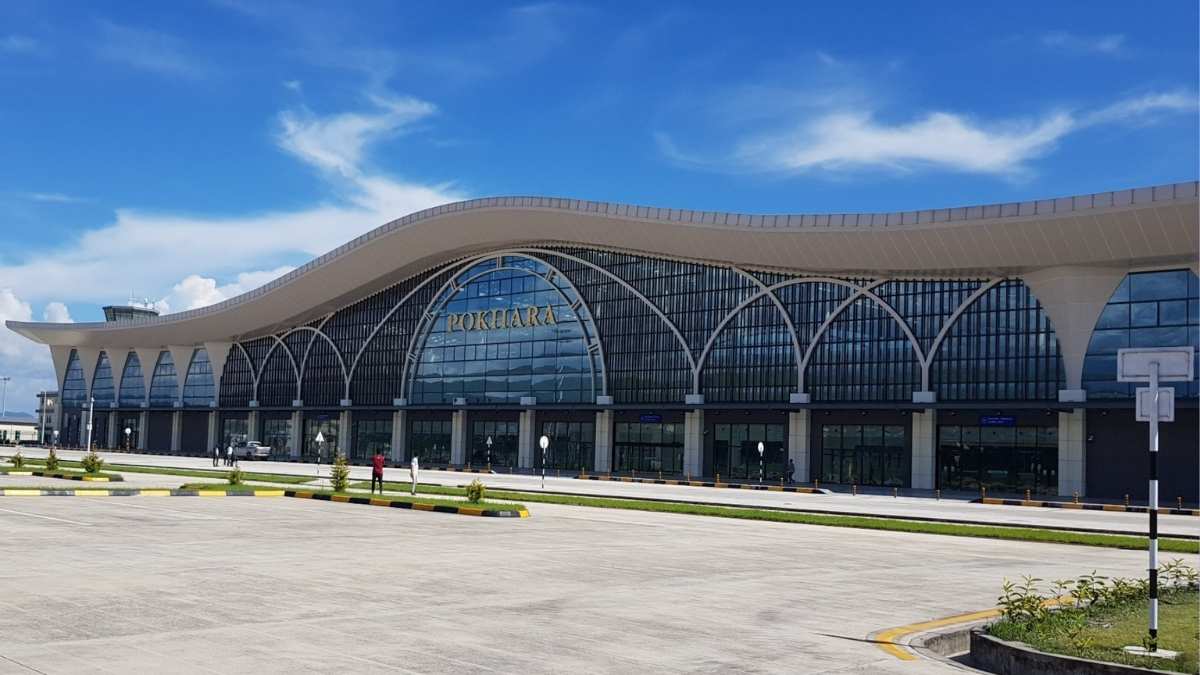
Pokhara International Airport, which opened in January 2023, built with a $215.96m loan from China’s Export-Import Bank, has no scheduled regular international flights at all as of June 2026. A Pokhara-Lhasa service launched by Himalayan Airlines in March 2025 lasted less than a year before being discontinued due to insufficient passengers. The airport has otherwise subsisted on sporadic charters. The government’s stated plan, as of May, is to “initiate diplomatic efforts to attract international airline operators”. That is the language of a project that has not yet started, three and a half years after the ribbon was cut.
The diagnosis that both airports require is this: Nepal invested in the hard infrastructure of aviation (runways, terminals, navigation systems, approach lighting) on the implicit assumption that airlines would follow the investment. They have not, and the reason they have not is that airlines do not route commercial services to airports because airports exist. They route services where the passengers already are; where the load factors justify the operating costs; and where the alternative airports do not already serve the same demand more conveniently.
The clearest illustration of this is what happened at Bhairahawa between January and March 2025. When Tribhuvan International Airport was taken offline for maintenance, international airlines were operationally compelled to divert to Bhairahawa. In those three months, 299 flights operated and 15,148 passengers used the airport. Nepal Airlines, Jazeera Airways, FlyDubai, Thai AirAsia and Air Asia all appeared. The moment Tribhuvan reopened, they left. The diversion experiment was in effect a controlled test of the regional airport’s independent demand. The upshot was that the airport had none: its activity was borrowed from Kathmandu, not generated from its own catchment.
The technical barriers are real but secondary. Bhairahawa sits in the Terai’s fog belt; winter visibility regularly drops below the 1,800-metre minimum needed for large aircraft operations. A Required Navigation Performance system capable of enabling approaches at 800 metres was announced in late 2024. The airport’s Instrument Landing System, installed at big cost, required Indian cooperation to operationalise because the approach procedures use Indian airspace—a detail that should have been resolved before construction rather than after.
Pokhara presents a different technical problem: topographical obstacles near the runway impose a payload penalty of five to ten tonnes on narrow-body jets, meaning a departing A320 must leave Pokhara carrying less weight than the same aircraft would carry from Kathmandu. That weight reduction in turn reduces the per-flight economics for any carrier assessing the route.
Behind the technical problems is a softer failure. An international airport requires bilateral air service agreements with the countries whose airlines will fly there, marketing arrangements with tour operators in those countries, ground handling and fuel supply contracts, and a credible projection of load factors that will allow airlines to price routes profitably. Nepal had built the terminal before completing many of these arrangements. Bhairahawa’s airport management is now exploring a “Fifth Freedom” arrangement that would allow foreign airlines to use the airport as a transit hub between two non-Nepali destinations—an ingenious solution that reveals, in its very ingenuity, how far the airport is from its original purpose.
The debt does not pause while the diplomacy proceeds. Pokhara’s loan repayments to Beijing are expected to begin this year. Parliamentary investigators found serious corruption in the airport’s procurement process in April 2025, and new cases were filed as recently as May. Nepal committed to repay 1.37bn Chinese yuan by 2036. The feasibility study commissioned before construction projected 280,000 international passengers through Pokhara by 2025. The actual figure, in a year when regular international flights still do not exist, is somewhere near zero.
Tribhuvan International Airport meanwhile operates on a single runway built in the 1950s and handles more than 90% of Nepal’s international traffic. It is chronically congested, constrained by surrounding mountains and incapable of substantial expansion.
The country needed new international airports. It built them in the wrong places, without the commercial agreements to make them viable, financed one with a Chinese loan whose interest clock was running from day one, and is now several years into a process of retrospective institution-building that should have preceded the concrete. ■