IMAGE VIA GOOGLE
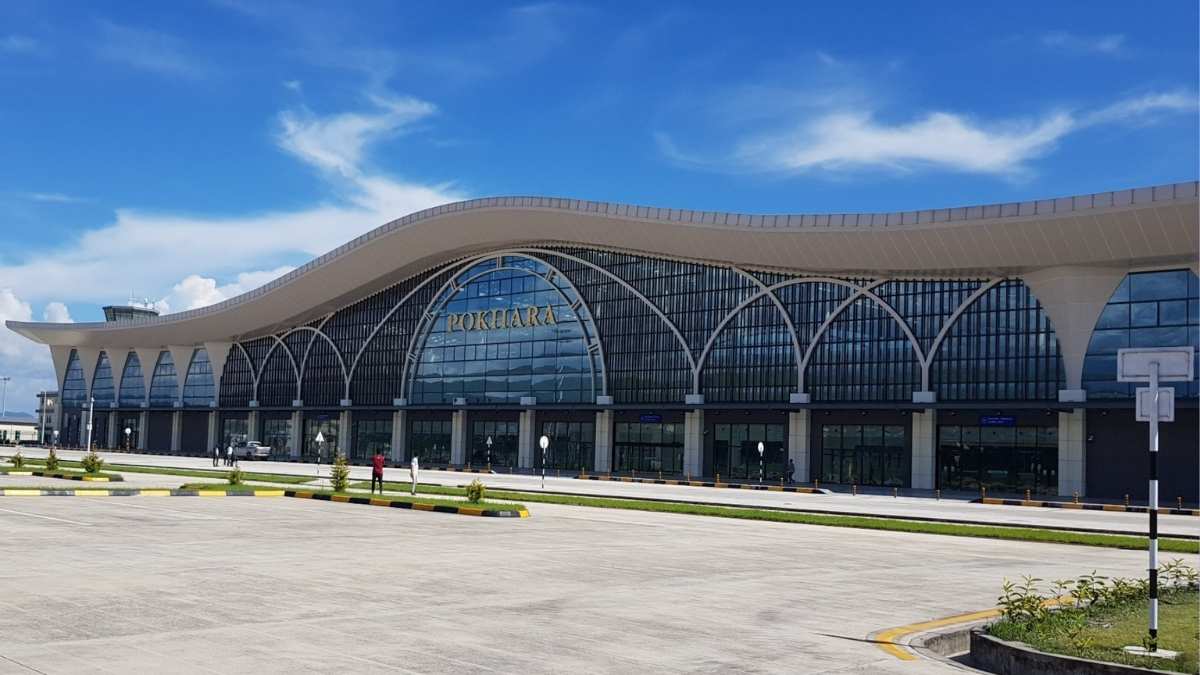
FLY INTO Pokhara International Airport on most days of the week and you will find one of Asia’s newest international terminals sitting almost entirely empty. Following the suspension of Himalaya Airlines’ brief Pokhara–Lhasa route, the modern facility has been left without a regular international flight. Everything else, from the long runway built for wide-body jets and the customs hall designed for a flow of foreign tourists that never arrived, sits there as a monument to a bet that has not paid off. And the bill for that bet is now coming due.
Nepal borrowed $215.96m from China to build the airport, under an agreement signed in 2016. A quarter of that came interest-free from China’s Ministry of Commerce; the rest, some $213m, came from China’s Export-Import Bank at 2% annual interest, with a seven-year grace period and a twenty-year repayment window. By the standards of commercial lending, those are gentle terms. The grace period has now run out. Nepal faces annual repayment installments approaching Rs840m on an airport that is, by any reasonable measure, generating almost no income to pay them with.
The terms look kinder from Beijing’s side of the table than from Kathmandu’s, because of a detail easy to miss. Nepal’s government did not spend the Chinese loan directly. It re-lent the money to the Civil Aviation Authority of Nepal, the state body that actually runs the airport, at 5% interest rather than the 2% Nepal itself pays China. CAAN, in other words, owes considerably more than the sovereign borrowed, on an asset that earns almost nothing. The gap between what Nepal pays Beijing and what its own aviation authority owes the Nepali treasury is where the airport’s debt problem actually concentrates.
Nepal has asked China to convert the loan into an outright grant. China has refused. That refusal tells you something about how Beijing is choosing to handle a project that has become, by most outside assessments, an embarrassment rather than a triumph for the Belt and Road Initiative. State media once described Pokhara’s airport as a Belt and Road achievement; Nepal’s own government has publicly disputed that, noting construction began before the BRI agreement existed. Beijing wants credit for the connectivity without absorbing the cost of its failure to materialise.
Underneath the financing is a second, messier problem: corruption. A parliamentary sub-committee’s 2025 report accused CAAN of corruption and negligence throughout the airport’s procurement and construction. Nepal’s anti-corruption body, the CIAA, has since filed four separate charge sheets: the first and largest in December 2025, a second days later, a third in March 2026 and a fourth in early May adding Rs3.62bn in damages tied to illegal tax exemptions. Across all four cases, the claims now top Rs12bn, making this the largest corruption matter ever to reach Nepal’s courts. Some of the money meant to build a working airport, in other words, never went into building one.
Should Nepalis be worried about a Sri Lanka-style default? Probably not, at least not yet. Nepal’s total external debt stood at some $10bn in 2024, equivalent to about 22% of GDP: a level the IMF still classifies as low risk. The Pokhara loan is a real liability, but it is not, on its own, big enough to threaten the country’s solvency. What it threatens is something narrower and in some ways more awkward: Nepal’s standing as a borrower whose flagship Chinese-financed project cannot pay for itself, on terrain Beijing chose to compare, in at least one foreign newspaper’s analysis, to Pakistan’s underused Gwadar port.
The airport’s only real route out of its debt trap is the one Nepal has spent three and a half years failing to build: enough scheduled international traffic to make the runway worth having.
A tentative lifeline finally appeared in June, when UAE-based carrier flydubai secured approval from CAAN to launch daily direct flights between Dubai and Pokhara starting September. Local tourism entrepreneurs, who have poured nearly Rs100bn into regional infrastructure, are watching anxiously to see if this Middle Eastern connection can successfully unlock codeshare access to global travelers.
Until that service proves its commercial viability, and until a civil aviation authority proves capable of executing future contracts without the kind of irregularities now working their way through the courts, Nepal will keep paying Rs840m a year to service a debt for a building that still waits for the world to arrive. ■