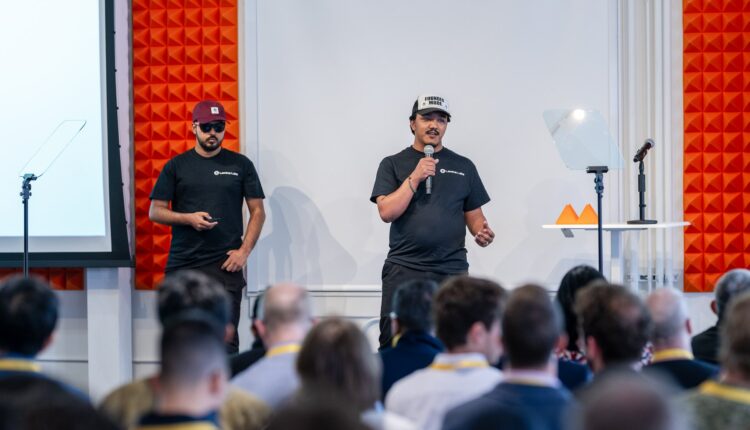
IMAGE VIA Y COMBINATOR
TWELVE DAYS after launching the public iteration of their software, Sudip Rokaya and Kartikesh Mishra had 4,000 users and 187 people actually paying for it. They hadn’t even finished building out the full infrastructure. Their company, Lamina Labs, had just secured backing from Y Combinator—an accelerator that rejects more than 99% of applicants—and closed a massive $3.5m seed capital pool. One investor was so eager that they agreed to lead the $3m external funding round before YC’s Demo Day had even taken place. “They told us not to raise with anyone else, and just get to work… we are actually having to decline other investors,” Rokaya noted. That is not something many founders, anywhere, get to say.
The product itself, called Simi (named after Rokaya’s remote childhood village of Simikot), turns a text prompt or raw document into a whiteboard-style explainer video. It balances accurate visual pacing over glossy cinematic clips, rendering instruction in dozens of languages. The two co-founders knew each other back in Nepal before crossing paths properly at MIT in Boston, where Mishra finished a full run through electrical engineering and computer science (bachelor’s in 2024, master’s in 2025) while Rokaya put his own maths and CS degree on hold to chase the company full time. Rokaya has said that he wanted Nepalis to be able to afford the tool, which is why they built it to run on cheap servers, hoping it could help teachers in isolated districts.
So here is the thorny part. None of that happened in Nepal, or because of anything Nepal built.
To get to the point where Simi could exist, two Nepalis first had to clear MIT’s admissions process, one of the tightest filters on the planet. Then they had to clear Y Combinator’s. Only after stacking two of the world’s most selective gates on top of each other did capital and infrastructure show up—and even then, the capital was Californian, and the company was legally wired as a San Francisco entity. Nothing about the funding, the mentorship network, the investors who wired money without a fight or the commercial client base that found them came from inside Nepal’s economy. The country supplied the raw human material. Everything that turned that material into a venture-backed machine happened somewhere else.
It gets uglier still. Education was the market both founders cared about most, the one tied to their own story and to Nepal specifically. They tried it first. It didn’t work—”the education business is slow,” Rokaya admitted—so they pivoted towards scaling an automated API layer for international businesses instead, serving global clients who blew through their monthly data quotas in days. The version of their product closest to home, the one built with rural Nepali teachers in mind, was the version the market wouldn’t pay for fast enough to keep a startup alive. The version that did pay was about as far from Nepal as a product can get.
None of this is really about whether Nepal has world-class engineering talent. It obviously does, and has for decades: Nepalis have been getting into MIT and Stanford for years. What this actually demonstrates is something this publication has tracked elsewhere: Nepal has built almost no domestic infrastructure capable of catching that talent on its way up, rather than after it has already left.
Development finance institutions have put barely $105m into Nepal’s entire private equity and venture capital ecosystem over the past decade, most of it concentrated in a single fund. There is no local institutional equivalent capable of locking down an entire multi-million-dollar round in one sitting. There was never a serious chance that Lamina Labs got built in Kathmandu, because nothing in Kathmandu was positioned to make that possible.
The lesson, if there is one, isn’t just to celebrate two young Nepalis making it big in San Francisco, satisfying as that is. It’s to notice where the value got created and where it didn’t. Mishra and Rokaya are Nepali by background, and the product still carries the emotional DNA of that origin. But the company, the global engineering jobs it will create, the capital gains it will eventually generate and the corporate tax base it will eventually feed all belong to wherever Y Combinator decided to deploy its money. Right now, that is San Francisco. It was never seriously going to be Kathmandu. ■