IMAGE: REUTERS
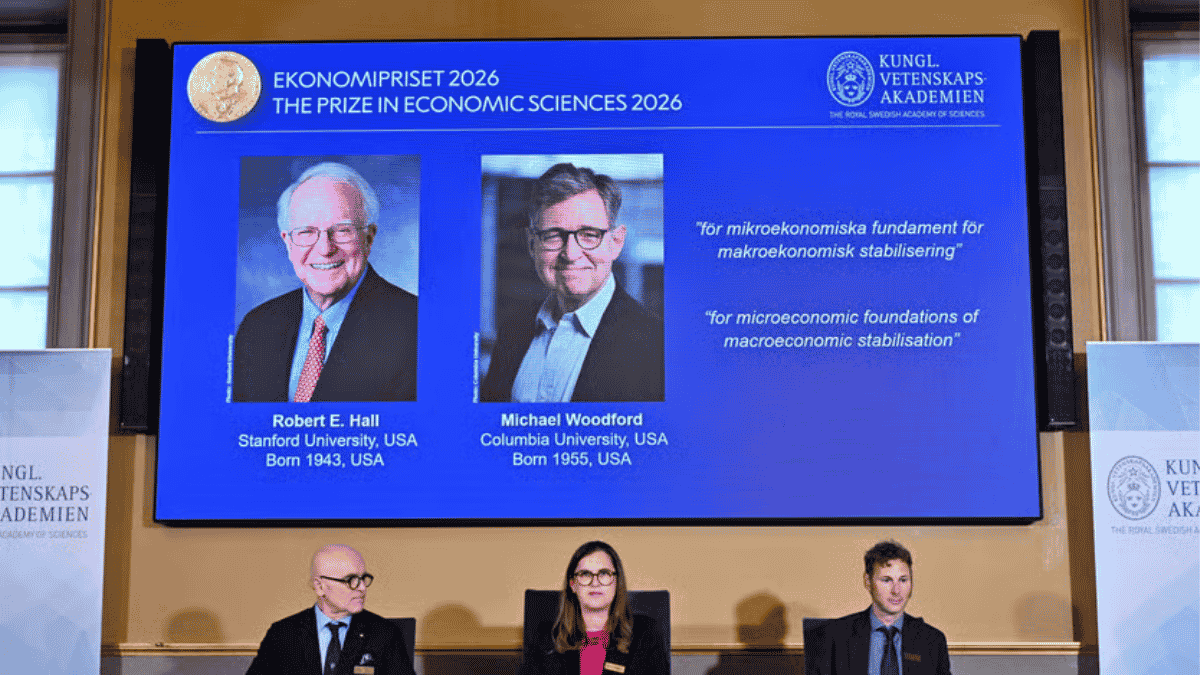
ON OCTOBER 12TH in Stockholm the Royal Swedish Academy of Sciences awarded the economics prize to Robert Hall of Stanford University and Michael Woodford of Columbia University. The citation honours “microeconomic foundations of macroeconomic stabilisation”. The prize is worth 12m Swedish kronor, about $1.2m, and is shared. The wording is a mouthful. The idea is simpler: an economy is the sum of millions of choices by households and firms, each looking ahead, and a central bank that ignores this will misjudge what its decisions do.
The older view was mechanical. Governments responded to a slump by cutting interest rates and taxes and raising spending. They assumed a stable trade-off between inflation and unemployment: when one fell, the other rose. Timo Boppart, a member of the prize committee, said the recipe worked well until it stopped working. It stopped in the 1970s, when oil shocks produced high inflation and high unemployment together. Robert Lucas then argued that relationships observed in past data cannot be trusted once policy changes, because people change their behaviour in response. A model built on correlations between aggregates would fail exactly when it was needed.
Mr Hall took up the question with households. In a 1978 paper he showed that a family that looks ahead spends according to what it expects to earn over its lifetime, not according to this month’s pay. Spending should then change only when news arrives, which makes it close to unpredictable. Optimists spend, pessimists hold back, as the committee put it, and expectations move with each new piece of information. Olivier Blanchard, a former chief economist of the International Monetary Fund, observed that this is “not good news for forecasters, or policymakers”, though it is news they must absorb. In a 1982 paper with Frederic Mishkin, Mr Hall found that about 80% of households chose their spending by looking to the future, while the rest lived hand to mouth, unable to borrow or draw on savings when conditions changed.
Mr Woodford did the same for firms. A business that expects its rivals’ prices and its own costs to rise will set a higher price today, and the interest rates it expects matter to it as much as today’s rate. His book “Interest and Prices” (2003) brought these parts together in what became known as the New Keynesian model: households that plan ahead, firms that adjust prices slowly and a central bank that follows a rule for its interest rate. Concepts that are now common at central banks, among them the neutral rate (the interest rate that neither stokes nor cools an economy) and forward guidance, the central bank’s public statements about future rate plans, come from this line of work.
The practical test came in two parts. After the financial crisis of 2008 central banks cut rates to near zero and struggled to revive activity; Mr Boppart pointed to that episode as a trial of the research. The second came this year. After the American and Israeli attack on Iran in February sent energy prices up, the committee said Mr Woodford’s model told central banks to raise interest rates to prevent uncontrolled inflation, where older Keynesian models would have urged them to support growth. The committee credited his work with making it possible to respond to recent supply shocks more effectively than in the 1970s.
The most evident consequence is that central banks talk. If firms and households set prices and spending according to what they expect, a central bank that explains its reasoning and plans can steer them with less effort. The new chair of the Federal Reserve, Kevin Warsh, has said that forward guidance went too far, and is trying to scale back how much the Fed says about its thinking. A prize for the research thus arrives as the practice it inspired is being questioned at the institution where it was most prominent. Commentators noted that the committee honoured a foundation for modern macroeconomics, not the last word on it.
The lesson reaches beyond rich countries. In Nepal the central bank has cut its policy rate to 4.25%, and banks lend at an average of 6.48%, yet private credit grew only 7.1% in the year to mid-August. Industry leaders grumble that factory owners have adopted a wait-and-see attitude, citing arrests of businessmen, disputes over power lines and uncertainty over land leases. A rate cut that firms do not believe will last, in an economy where they fear the next decision, reaches few borrowers. Mr Hall and Mr Woodford would not be surprised. Their models say policy works through what people expect to happen next. ■