IMAGE: FLICKR
NEPAL HAS spent most of its modern economic history growing slower than its ambitions. Its sixteenth development plan targets 7.1% average annual growth through 2029. The World Bank reckons existing policies deliver closer to 4%.
That chasm is brutal. Between 1996 and 2023 Nepal grew 4.2% a year, sixth among eight South Asian economies. Remittances slashed poverty. The country still failed to create enough productive jobs at home. By 2021 more than 7% of the population had buggered off abroad, according to the World Bank’s 2025 Country Economic Memorandum.
Countries that grew faster offer lessons. Their models differed. Several features keep repeating.
Start with exports. Vietnam shows what happens when a country stops strangling its own traders. Since the Đổi Mới reforms began in 1986, Vietnam has wedged itself into global manufacturing supply chains. Trade in goods and services hit nearly 170% of GDP over the past decade. Foreign direct investment averaged more than 4% of GDP a year. The IMF credits outward-oriented reform and foreign money. By 2025 Vietnam’s trade-to-GDP ratio approached 190% and the economy grew 8%, powered by manufacturing exports and investment.
Nepal can reproduce Vietnam’s geography, industrial scale or port access. It can slash the costs that keep its own firms from reaching foreign customers. The World Bank fingers expensive logistics, weak competition in transport, high tariffs and excise duties, plus an appreciating real exchange rate. It wants simplified tax refunds on imported inputs, lower import taxes that penalise exporters and extra trade preferences.
The practical test is basic: how much time and cash a Nepali firm burns getting an order out of the country. Customs clearance, predictable border procedures, reliable freight and access to international payments matter more than export-promotion slogans.
Another is electricity. Nepal sits on a resource fast-growing economies would kill for. The US International Trade Administration puts technically feasible hydropower potential near 83,000MW, with more than 40,000MW commercially viable.
Installed generation capacity stood at 3,435MW in 2025, with another 4,063MW under construction. Nepal has agreements to export 10,000MW of electricity to India over ten years and began shipping power to Bangladesh through Indian transmission lines in June 2025. The Nepal Electricity Authority exported 2,380GWh to India in fiscal 2024-25, 22% more than a year earlier. It imported 1,681GWh, making it a net exporter.
The next wall is infrastructure and finance. Transmission lines, cross-border interconnections, storage and dry-season generation decide how much electricity Nepal sells and when. The World Bank wants a clearer financing strategy, improved licensing and stronger legal and regulatory arrangements to pull investment into hydropower.
Electricity exports also open a domestic industrial door. Reliable, competitively priced power can support data centres, digital services, food processing and other electricity-hungry businesses. Hydropower’s return can stretch well beyond flogging surplus energy.
Third is infrastructure. Nepal struggles to turn approved projects into completed assets. The World Bank’s October 2026 Nepal Development Update reports capital-expenditure execution fell to 46.8% in FY2025-26, a record low. Earlier analysis found the federal government executed around 62% of its capital budget on average between FY2020-21 and FY2023-24. Across all three tiers of government, capital spending slumped from 11.4% of GDP in FY2020-21 to 7.8% in FY2023-24.
The rot starts before construction. Land acquisition, environmental approvals, project preparation, procurement and contract disputes delay work for years. On the 94.7km Nagdhunga-Naubise-Mugling road, land acquisition alone took 35 months, almost 150% longer than planned. That route carries an estimated 60-70% of goods entering Kathmandu.
A fatter budget can compensate for weak project preparation. Governments need completed designs, secured land, credible cost estimates and financing before allocating construction money. Publishing progress, delays and revised costs would make implementation easier to scrutinise.
Fourth is to attract investment that brings technology and customers. Vietnam also shows what foreign firms do. They supplied capital, access to international markets and links to global production networks. The model has a flaw: foreign-invested companies produced 73% of Vietnam’s exports in 2023, according to a World Bank analysis. Domestic firms struggled to capture a larger share of the value created.
For Nepal, pulling in foreign investment is only half the job. Local suppliers need finance, technology and training so they can sell to larger companies. Investment incentives should be judged against jobs created, exports, technology transferred and domestic suppliers developed.
South Korea offers another lesson. In the 1960s exports accounted for about 1% of GDP. After changes to foreign-exchange and trade policies and a deliberate export-promotion strategy, exports topped 10% of GDP by the end of that decade. The government used overseas trade-promotion offices to help domestic companies find customers. Research on the period finds the effectiveness of those offices depended heavily on the officials running them.
The lesson concerns implementation as much as policy: firms need people who can help them navigate foreign markets, secure buyers and solve practical obstacles.
Yet another is making remittances more productive. Remittances rank among Nepal’s biggest economic advantages. They have supported household consumption, cut poverty and helped finance imports. The World Bank estimated they represented around a quarter of GDP in 2023.
Their contribution to productive investment is harder to prove. Money sent home often finances housing, education, healthcare and daily expenses. Those uses matter. They fail to create firms or export industries on their own.
The World Bank recommends cutting migration costs, improving bilateral labour agreements, diversifying workers’ skills and destinations, and helping returning migrants enter entrepreneurship or retraining programmes.
Financial products could give households more ways to invest in productive businesses. Diaspora bonds, pooled investment funds and credit for viable small firms are possible instruments. Their success would depend on transparent management, credible returns and protection against political interference.
Last is raising productivity in agriculture and services. Agriculture remains a major employer yet low productivity limits rural incomes and the supply of raw materials for industry. Better irrigation, storage, seeds, agricultural extension and links between farmers and processors can raise output and cut post-harvest losses.
Tourism and digital services offer other routes to foreign earnings. The World Bank identifies both as sectors with significant potential, alongside hydropower and agribusiness. Its growth memorandum also points to limited infrastructure, regulatory obstacles and weak digital skills as barriers to expansion.
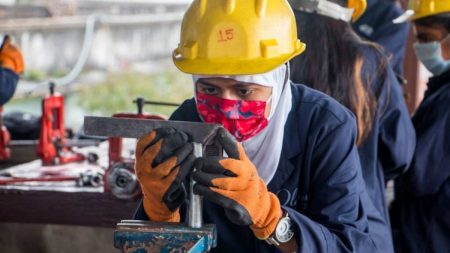
The gains depend on businesses hiring skilled workers, obtaining finance and operating under predictable rules. Training programmes tied to actual employer demand produce useful skills. Courses designed around enrolment targets produce certificates and bugger all else.
***
Nepal’s immediate outlook has turned uglier. The World Bank projects growth of 3.7% in FY2026-27 following the August 2026 floods, which wrecked hydropower, transmission and transport infrastructure. It expects recovery to 5.2% in FY2027-28 as reconstruction gathers pace.
Those forecasts underline the importance of resilient infrastructure. A road that fails during a flood, or a transmission line that keeps going offline, imposes costs on every business depending on it.
The international record offers zero shortcuts to rapid growth. Vietnam’s export expansion took decades. South Korea’s transformation needed sustained policy changes and an administration capable of carrying them out. Nepal’s geography, institutions and starting point differ from both.
The World Bank’s estimates suggest Nepal’s existing growth model will miss the government’s target. The evidence from other economies shows the kinds of changes that can alter that trajectory. ■