IMAGE: GETTY IMAGES
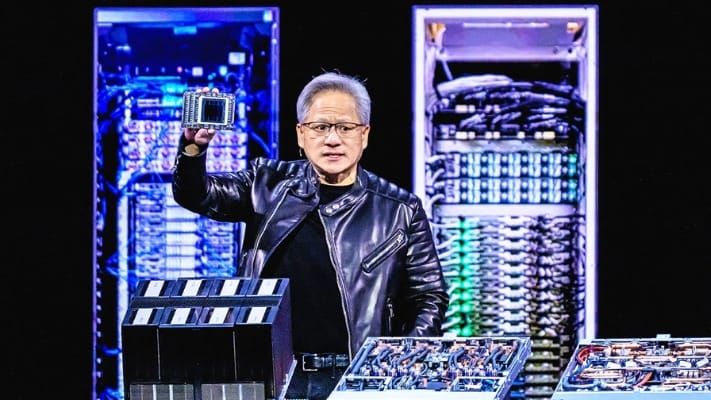
NVIDIA HAS lost the man who made it indispensable to the artificial-intelligence industry. On November 12th the company announced that Jensen Huang, its co-founder and chief executive, had resigned with immediate effect, including from its board. Colette Kress, the chief financial officer, will take over as interim chief executive while directors hunt for a permanent replacement. Harvey Jones, a veteran technology executive and investor, has become the board’s first chairman.
The departure ends a 33-year association between Huang and the company he helped build from a maker of graphics chips for video games into the world’s dominant supplier of AI processors. It also leaves Nvidia facing a question its extraordinary growth allowed it to postpone: how does a company so tightly chained to one man operate without him?
The proximate cause is a scandal that has slithered far beyond Huang’s private life. US intelligence agencies have reportedly identified Alice Huang, a Chinese businesswoman with whom the Nvidia boss had a personal relationship, as a suspected operative of China’s Ministry of State Security. (The two are unrelated.) She is associated with Megaspeed International, a Singapore-based cloud-computing company that bought billions of dollars’ worth of Nvidia chips and came under investigation over suspicions that equipment was being diverted to Chinese customers in breach of American export controls.
The allegations dump Nvidia at the intersection of two subjects Washington treats with unusual sensitivity: advanced computing and China. Nvidia’s most powerful processors are strategic assets in the contest over artificial intelligence. Their sale to Chinese buyers is restricted. Investigators have been examining whether a network of companies connected to Megaspeed helped Chinese firms obtain chips they were barred from buying directly. Reports have put the value of transactions involving this network as high as $7.5bn.
Yet zero public evidence has established that Huang knowingly helped Beijing obtain restricted technology, or that Nvidia’s intellectual property was compromised. The company’s board said on November 8th that it had no reason to believe national security or Nvidia secrets had been compromised. It nevertheless commissioned an independent investigation, overseen by independent directors and outside lawyers.
Huang initially faced the investigation with the board’s public support. In a message to employees on November 8th, he admitted being unfaithful to his wife and apologised to his family and colleagues. He said he would co-operate with the inquiry. The board said it had confidence in him. Four days later, the company announced his departure.
The situation grew more poisonous when the New York Times reported a second alleged affair, this time with Kimberly Powell, a senior Nvidia executive who reportedly worked under Huang. The newspaper cited five people familiar with the relationship. The allegations raise questions about executive conduct and the company’s internal controls, quite apart from the national-security investigation.
Congress has begun asking its own questions. Republican committee chairmen had requested a closed-door briefing from Huang about the alleged relationship and the possible exposure of sensitive American technology. On November 11th Democratic senators asked the administration to preserve records concerning Nvidia’s chip exports and the suspected intelligence operation. The controversy has also drawn attention to reports that senior officials in the Trump administration knew about the intelligence concerns. The administration has yet to provide a full public account.
The financial damage has been swift. Nvidia’s shares fell sharply as reports of the board’s deliberations emerged. By November 12th the company had shed hundreds of billions of dollars in market value since the investigation began, while the wider AI sector came under pressure. Suppliers in Taiwan and South Korea, chipmakers and companies building data centres have had to consider what a change at the top might mean for their own expansion plans.
A second source of anxiety festers. Nvidia is more than a chip manufacturer. Huang has cultivated an ecosystem of cloud providers, data-centre operators and AI developers, and the company has invested in businesses that are also its customers. Such arrangements have helped accelerate demand for its processors, but they have also tied Nvidia to the financing and fortunes of the wider AI boom. A leadership change at its centre could unsettle companies that depend on its capital, products and personal relationships.
Kress offers continuity in finance. She has been Nvidia’s chief financial officer since 2013 and is familiar to investors. Ian Buck, a senior executive associated with Nvidia’s CUDA software platform and hyperscale AI products, is among the internal names discussed as a possible longer-term leader. Neither has Huang’s public profile or his record of directing the company’s technological strategy. The board has said it will consider internal and external candidates.
Huang’s departure does erase Nvidia’s technological advantages. Its chips, software and developer ecosystem are deeply embedded in the AI industry. Demand for computing power will vanish because its founder has left. But Nvidia’s success has depended heavily on Huang’s ability to anticipate where the market was heading, persuade customers to build around its technology and secure manufacturing capacity years ahead of demand.
The company now has to prove those capabilities belong to an institution rather than a single executive. Its next earnings report, due on November 17th, will offer investors a first opportunity to examine the business under extraordinary pressure. The gruesome task will be restoring confidence in its governance and showing that its China exposure can be managed without compromising American export controls.
For years Nvidia sold the future of computing through the force of one man’s conviction. It now has to demonstrate that the future can survive his absence. ■