
Image: Getty Images
Taken at face value, the numbers shine. Last year private-equity and venture-capital investment in Nepal hit $64m, a record, according to Nepal Private Equity Association, an industry body. The sum constituted nearly 40% of all such capital deployed since the market’s infancy in 2012. Money is flowing into hydropower plants, fintech start-ups and pharmaceutical firms from a growing pool of nine fund managers, including three new entrants in 2024. The compounded annual growth rate since 2018 is some 32%. In an economy associated with adventure tourism and migrant earnings, the rise of private capital stands out.
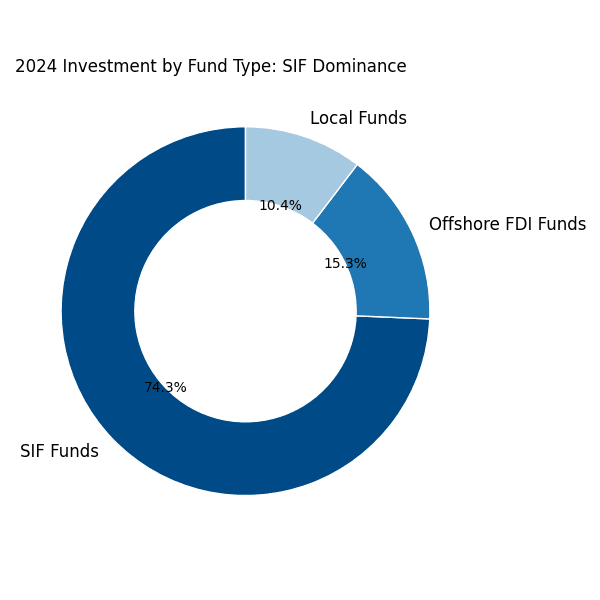
The revolution is being guided by regulation. In 2019 Nepal introduced rules for Specialised Investment Funds (SIFs), a formal structure for pooled investment vehicles. Seven SIFs have since been licensed, and they accounted for three-quarters of last year’s investment volume (see chart below). Capital comes mostly from domestic banks, insurance companies and development finance institutions, with a smaller portion from wealthy individuals and international funds. The framework has given institutional shape to what was a scattered, informal market.
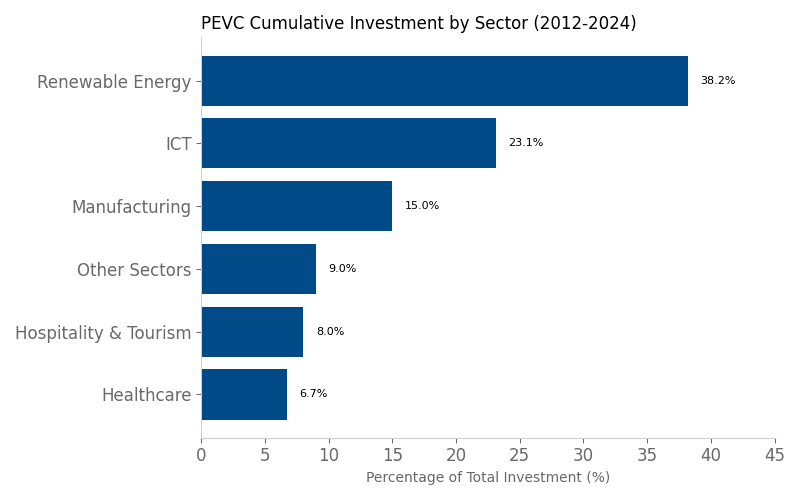
Sectors critical to Nepal’s development are receiving capital. Renewable energy, predominantly small hydropower projects, has attracted over a third of all investment since 2012 (see chart below). Information and communication technology follows at 23%, led by financial-technology firms. Manufacturing, healthcare and tourism absorb most of the remainder. The pattern reflects a pragmatic bet on domestic needs: power generation, digital finance and import substitution. The average deal size is small, at $1.6m last year, implying a focus on nurturing small enterprises rather than transforming big ones.
Yet for all this activity, a second, trickier equation looms. Exits—the process by which investors sell their stakes and realise returns—remain scarce. Of 137 deals recorded since 2012, only 19 have produced exits, just over half of them full sales. The average holding period is more than five years. Returns have been respectable with investors making about two-and-a-half times their money on average. But the pathways out are narrow. Nepal’s stockmarket is slim and illiquid. Big domestic companies capable of buying start‑ups are few. Selling to another private‑equity fund or back to the original promoter are therefore the most common exits (see chart below).

This mathematics problem is not confined to Nepal, but it is acute. “The market is growing fast, but it is still a small pond,” observes one fund manager in Kathmandu. “We need bigger fish or a river to the ocean.” The ocean, in this case, would be regional or international buyers, or a deeper local capital market. Without more avenues for exit, the risk is that the flow of incoming capital slows, as early investors find their money locked in.
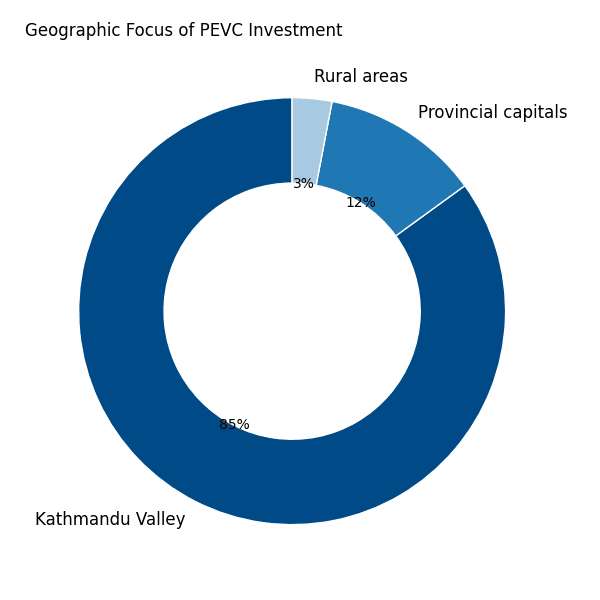
The market displays other developing‑world characteristics as well. Eighty‑five percent of investment is concentrated in the Kathmandu Valley (see chart below), despite the country’s diverse geography. Renewable‑energy projects are the exception, often located in remote areas where they can transform rural economies. One hydropower investment by the Dolma Impact Fund, for example, brought electricity to 45,000 households. Such projects marry financial returns with development impact, a blend that appeals to certain funders.
Regulators are aware of the constraints. A draft private‑equity and venture‑capital regulation has been under discussion since 2021. It seeks to clarify tax treatment and encourage longer‑term capital formation. The Securities Board of Nepal is also gradually strengthening reporting standards. The goal is to give institutional investors, particularly domestic pension funds, the confidence to allocate more to alternative assets. For now most local institutional money comes from commercial banks, which have strict investment limits.
The international perspective provides caution as well as hope. Nepal’s private‑equity investment as a share of GDP is 0.18%, lower than Bangladesh’s 0.35% or Sri Lanka’s 0.22%. This suggests room to grow. Foreign investors cite Nepal’s young population, rapid digital adoption as well as vast hydropower potential as reasons for optimism. They note, too, the political stability of recent years (before “Gen Z” protests toppled the establishment). But they also worry about currency‑convertibility constraints and the absence of a clear exit playbook.
Entrepreneurs are adapting, meanwhile. Consider Rara Labs, a Kathmandu‑based software firm. It began as a location‑services start‑up, pivoted to financial‑data tools and secured funding in 2024 to scale its sales. Its story is one of agility in a small market. For such firms, good governance and clear accounts are becoming a competitive advantage in attracting professional capital.
Nepal’s private‑capital experiment has reached an inflection point. The first wave of funds, raised half a decade ago, will soon need to return money to their investors. Their success or failure will influence the next wave. The essential puzzle is not about attracting capital—the figures prove that is happening—but about creating a financial ecosystem where capital can cycle out as efficiently as it cycles in. That needs bigger domestic companies, a more robust stockmarket and perhaps more cross‑border deals with neighbours like India. For investors with patience and local knowledge, Nepal confers a compelling cocktail of growth and impact. But patience, in finance, is always a calculation. The numbers must eventually add up. ■
Data source: NPEA