Image: Online Khabar
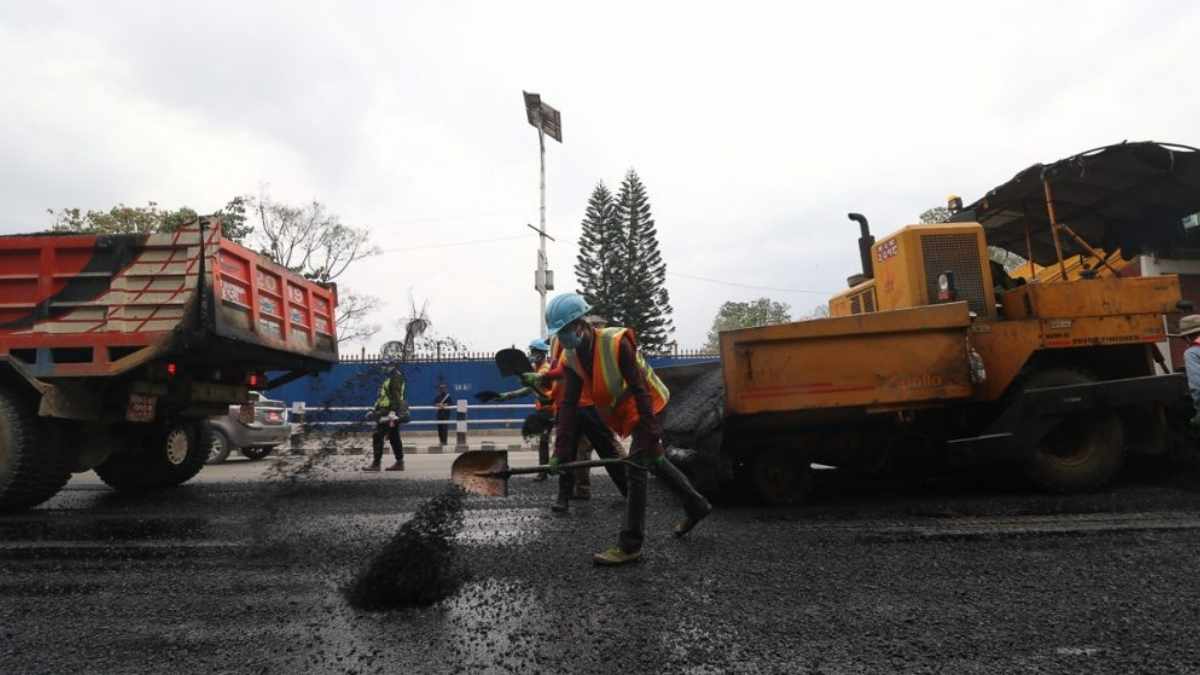
At the close of every financial year, a frenzy grips Nepal’s public works. Bulldozers are deployed with sudden urgency, cement is poured as if it were going out of fashion. And accountants work late into the night. This is a desperate scramble to spend budgeted money before the clock resets. In the last fiscal year, less than half of all capital spending was completed in the first nine months. The final quarter, and usually the final month, bears the overwhelming burden. The result is costs inflated by rushed contracts and assets that begin deteriorating almost as soon as the ribbon is cut.
This annual dash for cash is the logical endpoint of a system that manages public investment like a spigot: kept mostly shut, then opened wide until the tank is empty. The process begins with budgets that are on paper ambitious. Politicians are fond of announcing big capital allocations for roads, hydropower, bridges and so on. The trouble starts when the financial year begins. Legally, a spending ministry may commit its entire annual allocation once the budget is passed. In reality the Ministry of Finance doles out cash in quarterly tranches, generally using this control to manage liquidity. Revenue falls short or other pressures mount, and the tap is tightened. Projects that are slower to start or deemed lower priority find themselves starved of funds regardless of their contracts.
The cash-release system operates with a serene disregard for reality. Cash plans are created by the simple expedient of dividing a project’s annual budget by four. The actual rhythms of construction—procuring materials during dry seasons, pouring foundations before the monsoon—are ignored. So are existing contractual payment schedules. The system assumes a steady drip of expenditure while the real world demands surges. When the mismatch becomes too severe, the finance ministry rations. This leaves project managers idle for most of the year, waiting for the inevitable flood of funds in the final quarter when the authorities panic about underspending.
Foreign-funded projects face their own special torment. Most operate on a reimbursement basis, where Nepal spends first and the donor repays later. The government’s cash plan for the third and fourth quarters is released only after reimbursements for earlier spending are received. Poor planning tends to mean the state underpays its own co-financing share. Donors then refuse to fully reimburse the excess spending recorded against their grants, which in turn provokes the finance ministry to withhold later cash releases. It is a circle of frustration, guaranteeing low execution rates for the projects that teen to bring the best expertise and oversight.
This rigidity is compounded by a budgeting process that is often an exercise in fantasy. Money is allocated to projects that have not secured land, lack environmental approvals or exist only as vague lines in a party manifesto. Conversely, projects that are ready to break ground are underfunded. The system’s corrective mechanism is the virement, an in-year budget reallocation. Between the 2019 and 2024 fiscal years, positive reallocations to capital budget lines averaged 24% of the original annual allocation.
Yet even this vital repair mechanism is slow and centralised. The rules are stunningly restrictive. Virements are forbidden in the first quarter and the final month of the financial year. Almost any reallocation of significance, even between projects within the same ministry, needs approval from the Ministry of Finance. Neighbours handle this better. Thailand allows line ministries modest discretion to move capital funds without prior central approval. Sri Lanka permits reallocations throughout the year. In Nepal the process is a marathon of paperwork.
Consider a recent case study. Reallocating Rs1bn ($7.5m) for urgent road maintenance took 59 days. The request wound through 25 separate steps, five formal memos and letters, and eight divisions across three different agencies. The Department of Roads processed its part in 12 days. The Ministry of Physical Infrastructure and Transport took 22. The Ministry of Finance used 23. By the time the money was cleared, the optimal construction season had narrowed. This is how the system ends up stuck.
The cumulative effect is a public investment regime that systematically undermines its own goals. Projects start late, proceed in fits and starts and then accelerate into a dangerous, spend-at-all-costs finale. The quality of infrastructure suffers. Costs leap. The economic return on public capital, already low across much of South Asia, is depressed further. Nepal’s problem is not a lack of ambition or even a lack of funds. It is a failure of fiscal plumbing. The budget is a promise. The cash flow is a constraint. The virement is a clogged relief valve. Until the system is reformed to match cash to real project needs, and to allow managers on the ground the flexibility to adjust, the country’s capital spending will remain an annual sprint that gets it nowhere. ■