IMAGE: SUNIL SHARMA/XINHUA/IANS
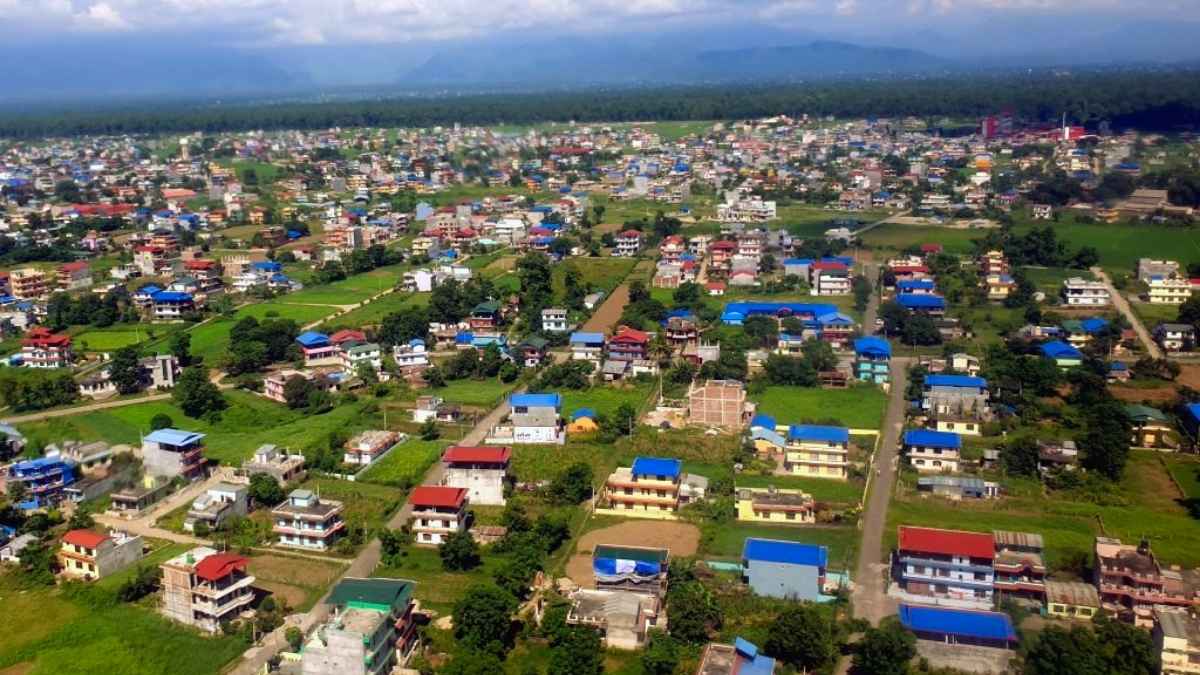
FOR AS long as anyone can remember, Kathmandu was the answer to every question about real estate in Nepal. Where do prices rise fastest? The valley. Where does banking capital flow? The valley. Where does political influence secure the choicest plots? The valley again. The rest of the country was an afterthought: a place of agrarian land swaps and remittance-funded houses that never quite entered the formal record. That era is ending, according to twelve consecutive quarters of data analysed by the Nepal Rastra Bank. Property transactions, surging values and even new construction are now spreading across seven provinces, from Bharatpur to Birgunj.
Start with the paradox at the heart of the capital. Kathmandu and Lalitpur still boast the highest per-square-metre prices in the country. But transaction volumes have collapsed. Land in the valley has become so expensive that ordinary buyers have given up. Over the 12 quarters through 2024-25, metropolitan areas accounted for just 4% of national transaction counts but 13% of total declared value. That gap is the sound of a market pricing itself out of the mass market. The real action has moved elsewhere.
Look at Bharatpur: it now leads all six metropolitan cities in both transaction numbers and area sold. The reason is federalism. New government buildings, civil servants relocated from Kathmandu and a growing army of contractors and suppliers have all created real property demand. Birgunj and Pokhara follow close behind. Even sub-metropolitan cities such as Butwal, Dhangadhi and Janakpur are recovering faster than the capital. Their transaction growth hit 38% year on year in the final quarter of 2024-25, against just 8% nationally.
What explains the decentralisation? Three forces. First, federal restructuring has given provinces real administrative heft. Provincial capitals need offices, housing and services. Second, infrastructure investment—from new airports and highways to the Madhesh-Lumbini corridor—unlocks land values within a 15km radius. Third, remittances, worth roughly a quarter of GDP, are flowing into provincial property. Households in Madhesh, Lumbini and Koshi are converting foreign earnings into land, creating a self-reinforcing loop of soaring prices and further investment.
The plot-size data reinforce the trend. Nationally the 2.5-to-10-aana category (roughly 856 to 3,423 square feet) accounts for 43% of transactions and 45% of declared value—the sweet spot of middle-class home-building. In denser metropolitan areas, plots are shrinking, a classic signature of urbanisation pressure. In sub-metropolitan cities, larger plots still trade, but the trend is shifting towards smaller parcels. These places are moving along the same arc that Kathmandu travelled a decade ago. The difference is that they are doing so with better roads and a federal system that has ceased to force every ambitious Nepali to move to the valley.
Even so the banking sector has yet to catch up. Real estate loans grew 72% over five years, to Rs276bn, and home loans rose 62%, to Rs418bn. But there is no strong correlation between loan growth and declared value growth. That suggests a big share of provincial transactions, especially in Madhesh and Lumbini, still run on family credit or informal networks. As financial inclusion deepens, formal credit demand will surge. Banks that expand branch networks and design province-specific mortgage products stand to gain.
Government revenue sends a warning signal, meanwhile. Real estate taxes peaked at Rs23.7bn in early 2021-22, then crashed 65% to a trough of Rs8.2bn by mid-2023-24. The recovery has been gradual. That volatility is a reminder that property booms are never a straight line. But the composition of revenue is improving. Capital gains receipts rose from Rs3.6bn to Rs6.1bn over the past four quarters through 2024-25, a sign that early buyers are finally cashing out at higher prices.
What does this mean for the next five years? The centre cannot hold, and that is a good thing. Provincial administrative build-out, urbanisation (Nepal’s city dwellers will rise from 21% to over 30% by 2030) and the spread of formal finance will sustain transaction growth in secondary cities. Bharatpur, Birgunj, Pokhara and Butwal will become property markets in their own right. Kathmandu will remain a high-value, low-volume enclave for the wealthy and institutional developers.
For everyone else, the future lies beyond the ring road. Investors and policymakers should act accordingly: build branches in the provinces, price collateral by region rather than national averages, and stop treating the valley as the only place that matters. The rest of Nepal is finally catching up. Do not be the last to notice. ■