You never give me your money IMAGE VIA X
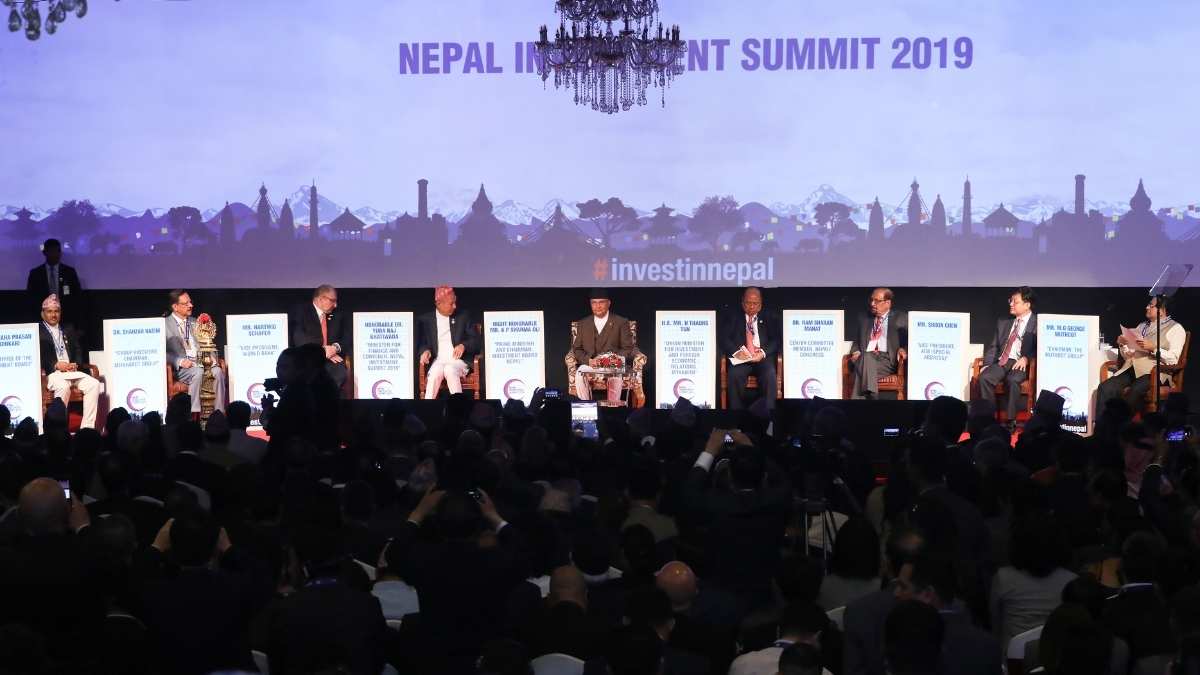
EVERY FEW years the swanky hotels of Kathmandu fill with foreign delegates, marigold garlands and PowerPoint slides promising a new Nepal. The ritual has run for three decades and its results are dismal. At the 2017 investment summit the government announced expressions of interest worth $13.7bn. Only $2.5bn ever materialised. The 2019 summit secured pledges of roughly $10.5bn; most vanished into the same void. In April 2024 Nepal hosted 2,500 delegates, 800 of them from abroad, to showcase 154 projects. Just three private-sector deals were signed, totalling Rs6bn (roughly $40m). Long-term government data shows that only about 20–25% of pledged sums ever arrive as actual capital: a conversion rate that has barely budged across decades. That is a chronic condition.
On May 18th the latest iteration takes place: the Nepal Business Summit, organised by the Nepal-India Chamber of Commerce and Industry and the Nepal Business Institute, at a modest venue in Naxal, Kathmandu’s diplomatic core. The language of the announcement is indistinguishable from that of its predecessors: “platform for dialogue”, “bridge policy and practice”, “actionable recommendations aligned with international best practices”. The organisers promise a distinguished lineup of national and international speakers. What they do not promise is a different outcome.
And yet something has changed in Kathmandu. A new government, led by former rapper Balendra Shah and powered by a near two-thirds parliamentary majority, has spent its first months firing 1,594 political appointees; cancelling all foreign travel by the prime minister for one year; and governing by ordinance. Its finance minister, Swarnim Wagle, is a former World Bank economist who talks of doubling Nepal’s economy to $100bn within five years. The question is: will this year’s summit break the pattern, or merely confirm it?
To understand why previous summits failed, look at the machinery behind it. Nepal’s regulatory system, as one detailed analysis puts it, “still reflects a time when uncertainty meant control. Decisions are slow because rules overlap and none clearly take priority.” Laws are amended in haste before each summit to create the impression of reform. They are then either unimplemented or undone by the next government.
The Investment Board Nepal, the Department of Industry, the regulatory bodies that issue permits and licences: these institutions operate with overlapping jurisdictions, as well as discretionary approvals and politically influenced decision-making. A permit does not mean what it says. That is what investors mean when they speak of an “image deficit”.
As of mid-2022 Nepal’s total stock of foreign direct investment stood at some Rs264bn (about $2.6bn). By 2024 that stock had grown to roughly $8.3bn according to UNCTAD, but even with that growth the gap with regional peers remains brutal. Cambodia, which joined the World Trade Organisation at the same time as Nepal, now attracts more than ten times the annual FDI flow relative to its economy. This is a canyon.
The Shah-Wagle government’s early actions suggest an attempt to fill that canyon with something other than rhetoric. Mr Wagle has used a series of recent addresses to deliver a message that is both reassuring and sharp.
At the Federation of Nepalese Chambers of Commerce and Industry’s annual general meeting this week, he promised a fundamental restructuring of the tax system and a “special strategy to protect and promote the private sector”. “An environment of unnecessary fear or arrest will not be created for businessmen,” he said, acknowledging the anxiety that the government’s anti-corruption drive has stirred in Kathmandu’s boardrooms. “There is no need for unnecessary suspicion or panic.”
But he added a warning: “We have not initiated new investigations; we have only reopened old cases that were hidden or shelved under political cover.”
That distinction—between legitimate business and criminal enterprise disguised as business—is analytically clean but operationally treacherous. In an economy where regulatory avoidance has been the norm for decades, and where political connections were essential to securing permits, the line is often invisible to those being investigated. Mr Wagle has signalled “some flexibility during the transition period for businessmen who were compelled to fall into the wrong cycle due to bad governance in the past”. That is an acknowledgment that the old system corrupted even honest operators. But vague assurances are not the same as legal certainty.
The government’s bigger posture towards the foreign investors it hopes to attract is no less contradictory. Last month the US assistant secretary of state for South and Central Asia, Samir Paul Kapur, concluded a three-day visit to Nepal. He met the Rastriya Swatantra Party chair, the foreign minister and Finance Minister Wagle. He did not meet the prime minister, who reportedly could not find time in his schedule. Nepali ministers assured Mr Kapur that they wanted to attract direct foreign investment rather than traditional aid; and that they would amend laws to make Nepal more investment-friendly. Mr Kapur replied that Washington would encourage investment “if Nepal ensures a predictable and conducive policy environment”.
The circularity is perfect: Nepal cannot attract investment without predictability, and it cannot signal predictability when its prime minister declines to meet the envoy from a country that accounts for a big share of global capital.
The summit on May 18th will therefore unfold in an atmosphere of productive confusion. On one hand the government has an economic agenda more coherent than any in recent memory. Mr Wagle’s target of a $100bn economy would need sustained annual real growth above 7%—compared with its average rate of 4.2% over the last two decades or so—and would demand the kind of foreign investment that previous summits failed to deliver.
But his specific promises—one-stop service for investors; protection of private property; implementation of signed agreements—are measurable in a way that past summit rhetoric was not. The FNCCI president, Chandra Prasad Dhakal, has called on the government to seize a “rare and historic opportunity”, noting that “Cambodia, which joined the WTO at the same time as Nepal, now attracts ten times more FDI. If they can do it, why can’t we?”
The answer, which everyone in the room knows, is that Cambodia built a predictable investment regime while Nepal built an investment-summit industry. Vietnam, Bangladesh as well as Georgia offer similar lessons. In each case the transformation came from sustained institutional reform rather than episodic promotional events: competitive civil service salaries, transparent permit processes, and—in Georgia’s case—a mass dismissal of corrupt traffic police followed by a leap from 124th to 48th place in Transparency International’s rankings.
The parallel with Mr Shah’s mass dismissal of 1,594 officials is striking. But Georgia’s reforms worked because they were followed by predictable enforcement of clear rules. Nepal’s businessmen do not yet know if they are living through a Georgian-style rupture or a witch-hunt.
The summit itself offers clues. Its modest venue and compressed timeline suggest a government that prefers substance to spectacle, or just lacks the organisational capacity for a bigger show. The prime minister is unlikely to show up, in keeping with his preference for isolation; his absence would signal that investment promotion is a usual exercise rather than a national priority. Mr Wagle is expected to speak but he cannot single-handedly override a prime minister who has cancelled all foreign travel and refused one-on-one meetings with foreign diplomats. The contradiction between Mr Wagle’s energetic outreach and Mr Shah’s diplomatic retreat is unsustainable. One of them will have to give.
Four tests will determine if this summit breaks the cycle. The first is the budget, due within days of the gathering. If it significantly reduces tax burdens and enacts the reforms Mr Wagle has promised, the government will have earned the benefit of the doubt. If it looks like every previous budget, the summit’s pledges will be exposed as empty before the month is out.
The second test is the replacement of the dismissed officials. If those vacancies are filled through transparent, merit-based processes, institutional capacity will match policy ambition. If they are filled through the political networks, the system will just reconstitute itself. The third test is the prime minister’s engagement. A leader who will not meet foreign envoys, will not travel and may not even attend his own government’s business summit is signalling that investment is not a priority.
The fourth test is the only one that ultimately matters: the conversion rate. If the Shah government can lift it from the historical 20–25% to even 50%, it will have broken the Summit Syndrome. If not, then May 18th will join the long list of dates on which Nepal talked a good game and then went home.
The patient is still on the operating table and the surgeons have brought an interesting set of instruments. They also seem to be arguing about who should hold the scalpel. For a country that has spent 30 years perfecting the art of the empty gesture, that counts as progress. But progress is not yet investment. ■