IMAGE VIA FACEBOOK
WHEN THE blade fell on May 2nd, it made a satisfyingly broad sweep. Nepal’s prime minister, Balendra Shah, annulled the appointments of 1,594 office-holders across 108 state bodies—vice-chancellors, airline bosses, heads of regulatory commissions, the entire leadership of the long-moribund transitional-justice apparatus. Three emergency ordinances ripped up 110 laws to deliver on a 100-day pledge: gut the patronage networks that had turned the Nepali state into a jobs programme for party loyalists. The main cudgel was a “notwithstanding” clause—a legal hammer that could, in principle, smash through any ordinary legal protection.
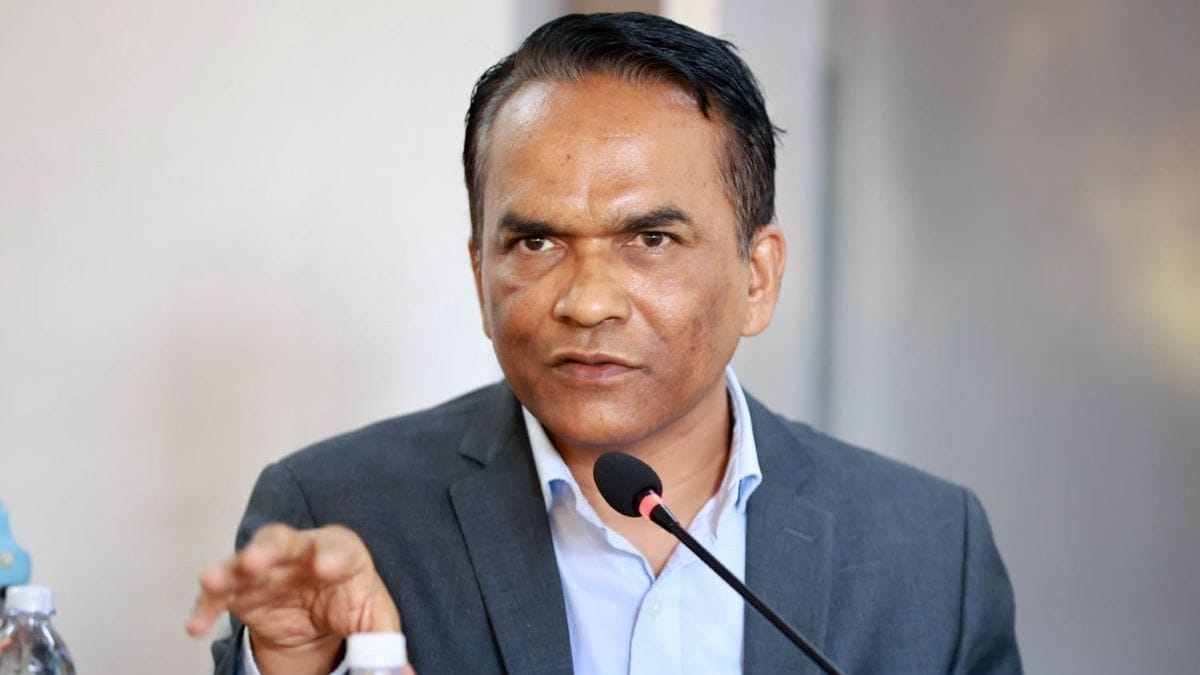
One man kept his chair. Biswo Nath Poudel, the governor of the Nepal Rastra Bank (NRB), appointed less than a year earlier after a tawdry political brawl, was not on the list. The chairmen of the three state-owned banks were also spared, though they later resigned at the government’s request. But it was the governor’s survival that set Kathmandu’s political drawing rooms buzzing. Why spare a man whose own appointment, barely a year earlier, had been so nakedly political it prompted a court challenge?
The answer begins with who Mr Poudel is and how he got the job. On paper he is every inch the qualified technocrat: a Berkeley-trained economist, former vice-chair of the National Planning Commission, former adviser to the finance ministry.
Yet his path to the governorship was a perfect diorama of the horse-trading that defines Nepali politics. In 2025, after the previous governor’s term ended, the two coalition partners—the Nepali Congress (NC) and the CPN-UML—spent two-and-a-half months in a tug-of-war over the post. The UML prime minister had promised it to the NC, then tried to steal it back. Four hopefuls resigned from other jobs in anticipation, only to be left stranded. The deadlock nearly collapsed the government. Mr Poudel emerged as the compromise, backed by the NC. He had stood as an NC parliamentary candidate in 2022 (he lost), and his opponents promptly challenged his appointment in court, citing a law that bars party members from the governorship. The NC claimed he had torn up his party card. Few believed it. As one columnist observed, a man who once campaigned for the party is plainly “close to the party, its agenda and ideals”.
The “notwithstanding” clause could have been pointed at the NRB Act. The government’s lawyers certainly knew how to draft one. Yet the central bank was left off the page.
The second piece of the puzzle sits in the finance ministry. Swarnim Wagle, the finance minister, shares with Mr Poudel a long and clubby professional history. When Mr Wagle was vice-chair of the planning commission in 2017-18, Mr Poudel was his adviser. Later Mr Poudel himself held that vice-chair post. They have debated on panels together; they move in the same small world of foreign-trained economists who shuttle between academia, international organisations and senior government advisory roles. Both hold doctorates from foreign universities—Mr Wagle from the Australian National University, Mr Poudel from Berkeley. They speak the same language of monetary aggregates and macro-prudential regulation. When the question of sacking the governor arose inside cabinet, Mr Wagle was reportedly the natural defender. No finance minister sacrifices a central-bank chief with whom he has a working relationship built over seven years unless the case is overwhelming. It was not.
Then there is the law. The NRB Act is a fortress. Section 22 says a governor can be removed only for specific causes—dereliction of duty, breach of the law, bringing the bank into disrepute—and only after a committee chaired by a former high-court judge and including a former governor has heard his defence. The courts have a track record of slapping down governments that try shortcuts; in 2022 an attempt to suspend a previous governor collapsed into legal farce. To sweep the governor away with the same stroke that erased university chiefs, the government would have needed to amend the NRB Act itself—a far more consequential fight.
And then there is the international audience. Nepal’s financial governance was under the stare of the Financial Action Task Force, the global dirty-money watchdog. The IMF in February completed an Article IV review warning of intensifying financial-sector vulnerabilities. Sacking the central-bank governor amid a mass purge of public officials would have sent a signal of chaos to credit-rating agencies, donors as well as foreign investors. Perhaps Mr Shah, for all his anti-establishment swagger, had chosen a Harvard-educated finance minister to reassure those audiences. Preserving the governor was a cheap way to signal that the revolution had limits.
It also helped that the governor’s policy instincts—a loose monetary stance with rates cut to historic lows—aligned broadly with the new government’s growth ambitions. Removing him would have created a leadership vacuum at a moment when the government was already scrambling to fill the holes it had blasted across the rest of the state.
For the moment the governor stays—an accidental monument to the limits of even the most determined purge. ■