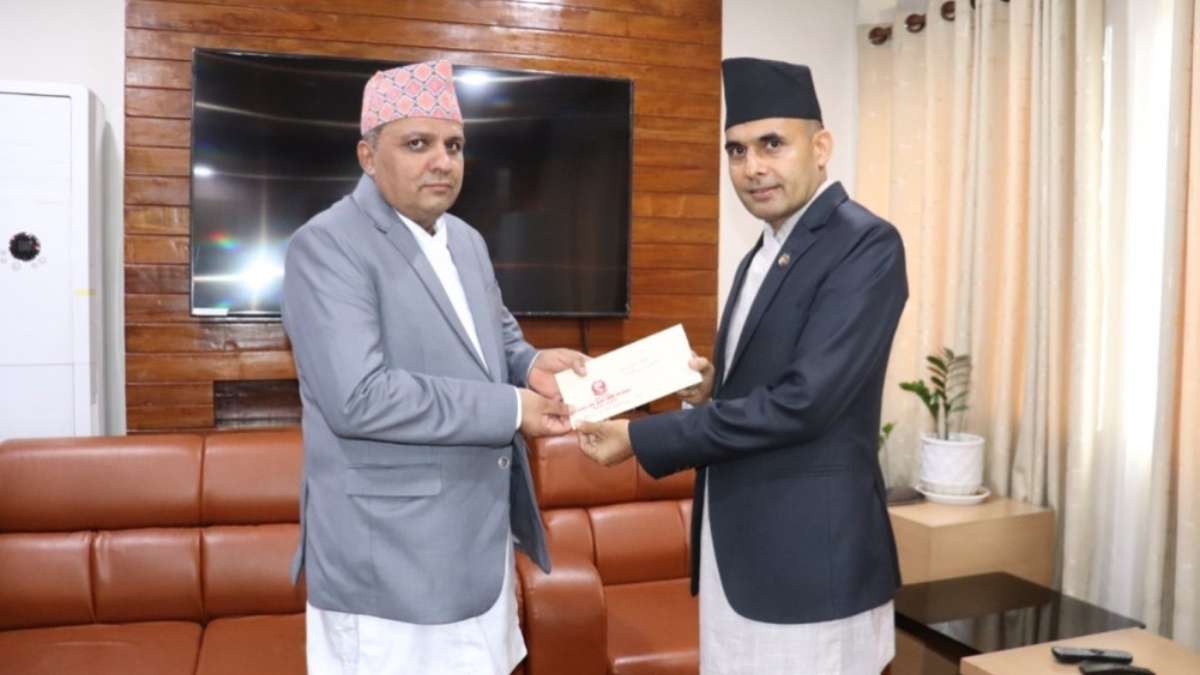
IMAGE VIA KANTIPUR
ARJUN GHIMIRE received his appointment letter as chairman of the Nepal Telecommunications Authority on July 13th, three days after the Cabinet formally confirmed what had been true for several months. He had been acting chairman since April, when the government issued an ordinance removing his predecessor, Bhupendra Bhandari, and four other board members simultaneously.
Bhandari was gone before a replacement had been identified. Ghimire ran the NTA in the interim, conducted the Smart Telecom proceedings and dealt with the aftermath of the CIB raid on Ncell’s headquarters in May: all without a formal mandate. He now has one, secured through a competitive process that nine candidates entered and one emerged from.
Communications Minister Dr Bikram Timilsina’s stated expectation: that he would “discharge his responsibilities in a fair, impartial and result-oriented manner”. That is an unusual set of conditions to attach to a telecom regulator’s appointment letter. It is also a list that describes almost nothing about how Nepal’s telecommunications sector has actually been governed for the past decade.
Ghimire spent most of his career inside the NTA, most recently as director of the Consumer Interest Protection Division. He knows the institution’s procedures and its accumulated habits. He also knows the Smart Telecom file in more detail than almost anyone outside the investigation agencies—how a company whose licence the NTA revoked in April 2023 and whose assets it declared state property the following month had those assets auctioned by Nepal Investment Mega Bank to Ncell without the NTA’s involvement or approval, for Rs4.60bn, before the CIB arrested four people in connection with the transaction. He knows that Ncell paid that money for equipment it cannot legally integrate into its network. That file is not resolved.
The Smart Telecom situation is Ghimire’s most immediate inheritance, but not his most consequential one. Ncell’s telecommunications licence expires in August 2029 and the renewal question has not been answered. The government and Ncell are in dispute over unpaid capital gains tax from the 2022 transfer of ownership from Axiata to Spectrlite, a dispute that is a prerequisite for any stable renewal conversation. Licence renewal for the country’s largest private mobile operator involves not just a fee negotiation but determinations of how Ncell’s spectrum is priced, what its network-sharing obligations are and what public interest conditions it must meet.
None of that work has started in any substantive sense, and the NTA’s capacity to lead it depends in part on Ghimire establishing the institution’s credibility before the process begins.
The third operator question is behind that one. The NTA formed a committee to study the feasibility of issuing a new basic telecommunications licence in October 2024. As of this week the committee has not produced a public recommendation. Three contenders—CG Communication, WorldLink and UTL—have made varying degrees of interest known.
UTL, which applied in June for licence renewal, carries unpaid dues that could total Rs29bn once penalties are included; its standing as a contender depends on resolving an arrears situation the NTA’s own records document in full. The history of this debate—committees formed, studies commissioned, governments changed, studies recommenced—is long enough to constitute its own chapter in Nepal’s regulatory history.
Timilsina has told Ghimire to formulate short, medium and long-term action plans. The short-term list writes itself: the Smart Telecom criminal investigation, the Rs7bn tax case pending against WorldLink, Ncell renewal groundwork and the third operator decision that has been pending since before the last three governments.
The medium-term list includes 5G commercial deployment—Nepal Telecom has conducted trials but Ghimire must manage spectrum allocation and roll-out conditions—and growing pressure to regulate internet-based services and OTT platforms. The long-term list is the NTA’s own credibility problem.
An institution whose chairman can be removed by ordinance on a working day, replaced in an acting capacity for months and then reconfirmed through a competitive process is not one that the market sees as stable or independent. Ghimire emerged from that process legitimately. He comes from inside the institution, which gives him knowledge, and was selected through open competition, which gives him a mandate neither his predecessor nor most of his predecessors could claim. The question now is whether institutional legitimacy, once established by process, can survive the political economy of a telecom market in which every major decision involves actors with enough resources and connections to make a regulator’s life difficult.
He expressed his commitment, on the day he received his appointment letter, to “working by focusing on solving problems and eliminating the existing shortcomings in the telecommunications sector”. Three years of work are ahead of him. The problems are well-documented. The shortcomings have been identified in every previous regulatory review. What has been missing is someone in the chair with the independence to act on what the reviews found. Ghimire has the mandate. The industry is watching to see if he uses it. ■