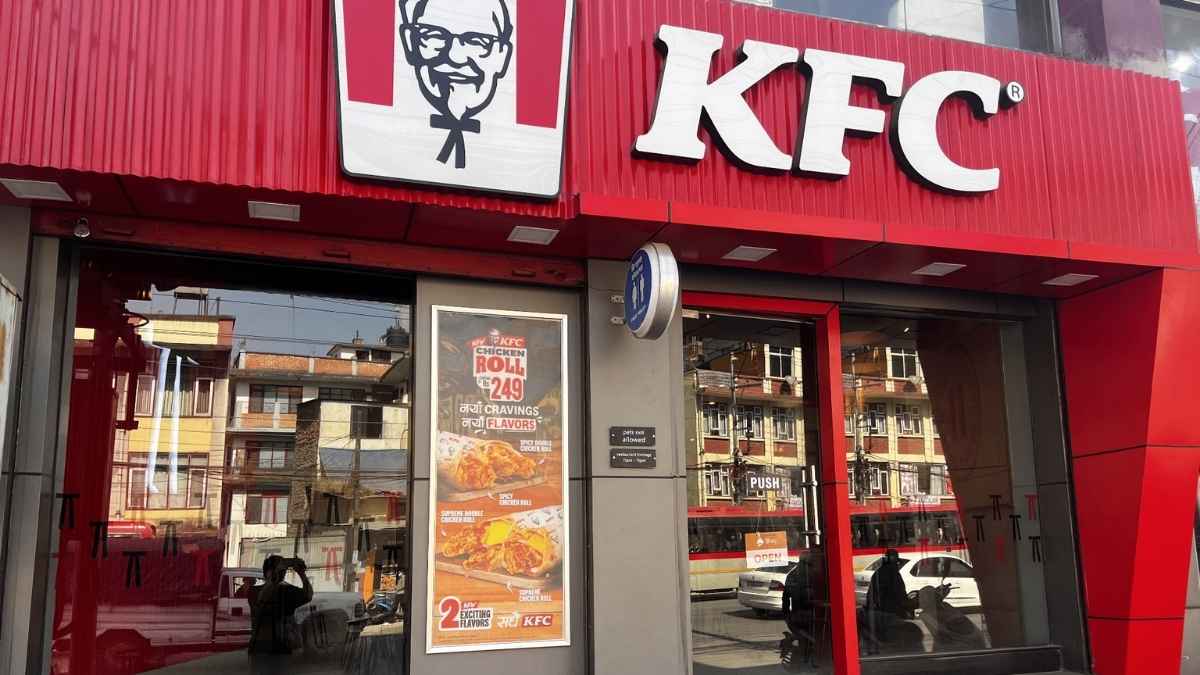
IMAGE VIA NOSH NEPAL
WALK THROUGH NEW ROAD in Kathmandu and you will find a restaurant called KKFC. The branding is red and white. The logo involves a cartoonish figure that bears a passing resemblance to Colonel Sanders. The menu has fried chicken. It has been operating for years. Nobody from the actual KFC has been able to do much about it; in part because KFC does not have a registered trademark in Nepal’s Department of Industry, and partly because, until very recently, Nepal’s intellectual property enforcement system treated KKFC’s existence as a civil matter with a maximum fine of Rs 100,000, roughly the cost of a week’s worth of fried chicken inventory.
The phenomenon is not limited to fried chicken. Coca-Cola appears alongside knock-offs like Club-Cola. Mountain Dew faces competition from a suspiciously named “Maintain Dew”. Brands like Adidas and Nike are frequently copied, with counterfeit versions openly displayed in shops.
The commercial logic is specific. A local business that copies the logo, colour scheme and packaging of a recognisable international brand is borrowing decades of brand equity that the original company paid for, at zero cost. The consumer confusion this generates is partly the point. The cost, for the original brand, is that its name now appears on products it did not make and cannot vouch for; its reputation is being spent by someone else.
The most striking case involved Kansai Nerolac Paints, an Indian subsidiary of Japan’s Kansai Paints. The company was barred from entering the Nepali market for years after a local firm registered the “Nerolac” trademark. In 2020, after a protracted six-year legal battle, Kansai Nerolac Paints Nepal finally won its trademark dispute. A Japanese-owned company with global brand recognition, significant legal resources and an established product spent six years and unknown legal fees recovering a trademark it had developed over decades; from a local firm that had registered the name first, before the legitimate owner had gotten around to filing in Nepal.
Trademark registration in Nepal typically takes between nine to twelve months. Franchise agreements for foreign brands cannot receive Department of Industry approval unless the trademark has been duly registered. Without trademark registration, foreign brands do not receive legal protection in Nepal. The process for a global brand to enter Nepal legally runs roughly like this: hire a local agent, file for trademark registration, wait nine to twelve months, obtain approval, then begin the franchise or direct entry process.
During those nine to twelve months, a local competitor can register a phonetically or visually similar mark, entrench themselves in the market and begin the litigation process that will drag out for years. Royalty payments are regulated and subject to approval from the Nepal Rastra Bank, and must not exceed 5 percent of net sales revenue unless otherwise approved; requiring prior clearance for foreign currency repatriation. A brand that has managed its global royalty rates, built its international franchise model and calculated its return on entering a market of 30 million people, now needs central bank approval for what it charges its own franchisee. The bureaucratic layers compound each other.
There is some recent progress. The Supreme Court’s landmark ruling in the Center Fruit case—in favour of Perfetti Van Melle—overturned the decisions of the Department of Industries and the Biratnagar High Court, ordering cancellation of the copycat registration, and acknowledged Nepal’s international obligations under TRIPS, the World Trade Organisation’s agreement on trade-related intellectual property rights. The court introduced the concept of passing-off legislation, borrowed from Indian Supreme Court precedent, to provide protection against brands that create deceptive similarity without literal copying.
This matters because most sophisticated trademark infringement does not replicate a mark exactly; it creates something close enough to benefit from the confusion. Nepal’s courts had not, before this ruling, had a clear legal tool to address that. Now they do; though the practical enforcement of that precedent depends on rights-holders filing complaints, engaging expensive legal representation, and waiting years for resolution.
The government has expressed growing concern over the rising number of trademark violations. Data from the department show that 356 cases related to trademark infringement were registered in the last fiscal year, while 483 cases were resolved. In the first eight months of the current fiscal year, 382 cases have been registered, but only 178 have been settled. New cases are rising faster than old ones are being resolved. The backlog grows. The Industrial Property Rights Bill 2025, which aims to strengthen enforcement, was tabled in the National Assembly in June last year.
However, progress stalled after the House of Representatives was dissolved following the Gen Z movement last September. The bill will be resubmitted. This has been the trajectory of Nepal’s IP reform for seven years.
Companies investing billions of dollars in research, innovation and brand development carefully evaluate whether their intellectual property will receive adequate legal protection before entering new markets. Counterfeit products pose risks far beyond financial losses; fake pharmaceuticals, electrical equipment, automotive components, cosmetics and food products can directly threaten public health and consumer safety.
When a franchise operator knows that a local competitor can copy their brand with a Rs 100,000 fine as the worst-case outcome, and that recovering their trademark through litigation takes six years on a good run, the rational decision is to stay out of that market and focus capital on countries where the protection is credible. Nepal is left with KKFC and Maintain Dew, and the tax revenue, the jobs and the consumer quality that the legitimate versions would have generated goes somewhere else.
The proposed Industrial Property Rights Bill envisions establishing a dedicated intellectual property office and raises maximum fines to Rs 1.5 million, fifteen times the current maximum.
However, it does not include provisions for imprisonment, as violations fall under industrial rather than criminal law. Rs 1.5 million is about $11,000. For a company with revenues in the billions, that is not a deterrent; it is a licensing fee for brand theft. Criminal penalties, available in every major economy for trademark counterfeiting, remain off the table. The new parliament needs to pass the bill first; and given its track record with this specific piece of legislation, nobody is counting on a swift timeline. ■