Silicon Valley thrives on code and contrarianism. It built its fortunes on the intellectual output of elite universities. Yet it now questions whether those same institutions still serve their purpose. The very ecosystem that once demanded PhDs and pedigrees now celebrates the teenage founder, the dropout CEO. Afoot is an insurgency that recasts formal education as deadweight rather than a launchpad.
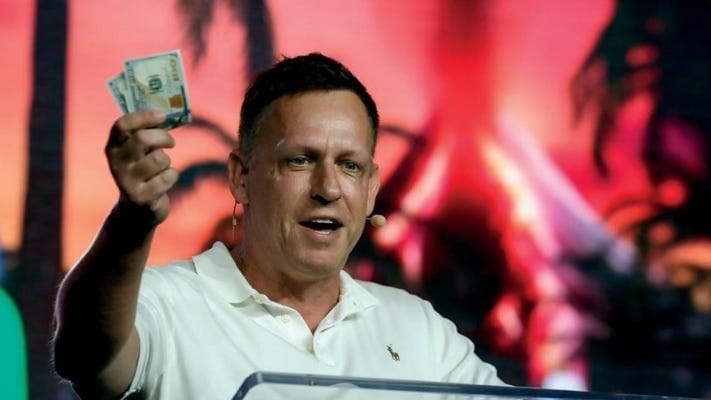
Peter Thiel, the libertarian financier and co-founder of Palantir, has become the movement’s unlikely dean. His fellowship offers $100,000 to bright minds willing to forgo university in favour of building companies. The offer is financial as well as philosophical: opt out of the four-year credential treadmill, skip the lectures and go straight to the pitch deck. Innovation has no time for tenured theorists in Thiel’s world.
Universities are accused of obsolescence. Critics describe academic institutions as sluggish relics, misaligned with the rapid metabolism of the tech industry. Degrees, they argue, function more as signalling devices than as training grounds. Meanwhile the skills that matter—coding, product design, market instinct—are often picked up on the fly. A weekend spent debugging a machine-learning model is deemed more valuable than a semester spent decoding Foucault.
The economics, too, have turned against the ivory tower. American students graduate with an average debt burden nearing $30,000. At elite institutions the bill can surpass $70,000 a year. That might be tolerable if the returns were guaranteed. Yet wage premiums for degrees have plateaued in some sectors while new technologies continually reshape the skills demanded. When a twelve-year-old can build an app with GPT’s help and ship it globally, the calculus shifts.
Technology is not the only culprit. A wider ideological backlash against elite institutions has gained momentum. Donald Trump’s administration flirted with defunding Ivy League universities, accusing them of ideological bias. Conservative think-tanks and Silicon Valley libertarians now speak the same language: universities are bureaucratic fiefdoms more concerned with politics than pedagogy.
The movement draws inspiration from a familiar cast of characters. Gates. Jobs. Zuckerberg. In Palo Alto their dorm-room success stories are treated as fact. The dropout is no longer a failure. It’s a refusal to wait for permission. Degrees don’t signal ambition anymore, only caution.
This narrative has proven particularly seductive to young men. In America male enrolment in higher education is tanking steadily. Some policymakers propose same-sex learning environments as a corrective measure, positing traditional co-educational models cater poorly to male learning patterns. The institutions that used to exclude women are now disproportionately losing men.
Academia for its part is not retreating. Economists still point to the data: university graduates earn more; they are more resilient in recessions; and they tend to accumulate knowledge that travels well across sectors. Moreover universities provide a kind of intellectual cross-training. A liberal education’s value is in, rather than immediate applicability, long-term adaptability—a hard sell in a valley addicted to iteration.
Some hybrid models have emerged. Palantir’s fellowship, though anti-institutional in spirit, is curricular in design. Fellows are nudged towards Thucydides and Hayek alongside Python and product design. The approach is part monastery, part accelerator. Not all fellows abandon academia permanently; some return later for perspective.
Recruiters too remain torn. Startups may idolise meritocracy but venture capitalists still scan resumes for Stanford, MIT or Caltech. That is producing a bifurcated pipeline. Companies hire for talent but cling to prestige. The practical skill of writing clean code coexists alongside the prestige of having once written a thesis.
The anti-college movement then is neither monolithic nor absolute. It represents a negotiation rather than a divorce. Even amongst the most strident rebels, education remains valued so long as it is fast, cheap and under their control. Online bootcamps, coding schools, AI tutors and modular courses proliferate. Education, like media or taxis before it, is being unbundled.
Whether this heralds a revolution or a refinement is unclear. Universities have survived printing presses, MOOCs and TikTok. They may well weather the Thiel Fellowship. Yet their monopoly on talent cultivation has cracked. Silicon Valley’s experiment has made one thing plain: knowledge no longer needs a campus. Whether it still needs a canon is the question that lingers.
The most ambitious minds for now are skipping class and building the platforms that will decide how the rest of us learn. ■