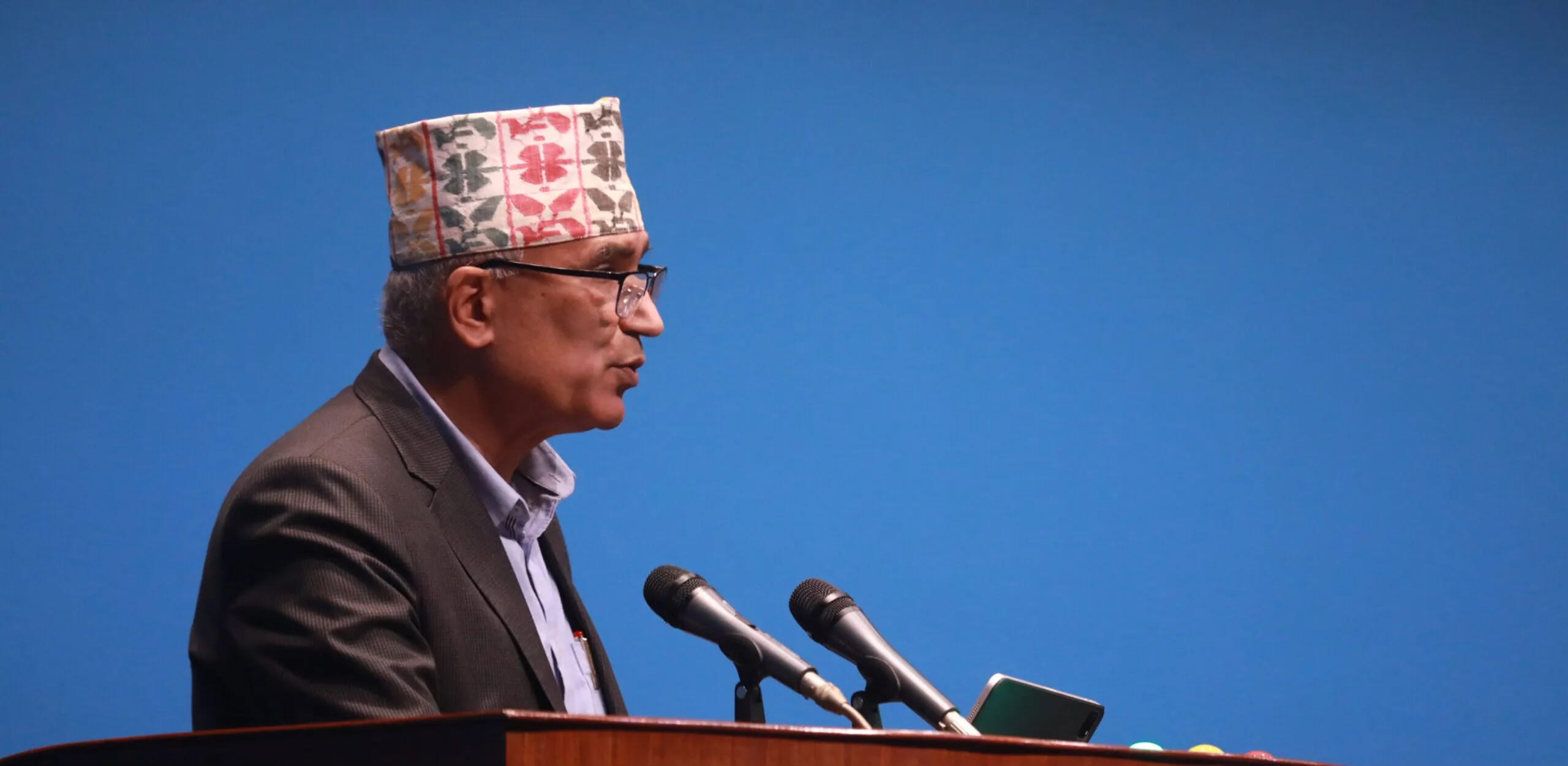
If budgets are, as the saying goes, a country’s moral autobiography, then Nepal’s latest fiscal plan reads like a study in arrested ambition. On May 29th Bishnu Paudel, the finance minister, tabled a NPR 1.96trn (≈ $14.44bn) budget for the fiscal year 2025–26—a 5.6% hike on last year, and barely enough to outrun inflation. The headline may suggest stability. But it has a familiar pattern: swelling wages, limp capital investment and a political class more adept at brinkmanship than reform.
Recurrent expenditure—largely civil service salaries and pensions—claims NPR 1.18trn, or roughly 60% of the budget. Capital spending, essential for long-term growth, is allocated a tiny NPR 407bn. In effect the state consumes most of what it raises, feeding its own machinery and leaving little for power plants, roads or innovation. Far from laying foundations for growth, the budget seems designed to keep the country’s head above water while politics flounders.
The gap between spending and revenue, meanwhile, is predictably wide. Domestic revenue is projected at NPR 1.3trn, necessitating borrowing of NPR 595bn—NPR 362bn domestically and NPR 233bn from foreign lenders. Grants amount to NPR 53bn, showing the nation’s enduring reliance on donor benevolence. As in many emerging economies, the tax base is narrow, compliance is poor and enforcement patchy. Public finance is less an engine of development than a ledger of mounting obligations.
Minister Paudel, of the ruling UML party, blamed “political instability” for lacklustre service delivery. That is putting it mildly. In recent months Parliament has been embroiled in scandal, with the main opposition boycotting the budget session in protest at a visa racket implicating the Home Minister. The fallout was legislative deadlock, outrage and no meaningful debate on fiscal priorities. What ought to have been a policy exercise devolved into political pantomime.
The federal structure confers little solace. NPR 582bn is earmarked for provincial and local governments via grants and shared revenues. But decentralisation, seven years into its constitutional experiment, has yet to mature. Many subnational units lack technical staff, financial oversight or absorptive capacity. The outcome is a fiscal shell game in which money moves but outcomes are elusive.
Public-sector pay encapsulates the rot. The government has frozen base salaries while raising the monthly dearness allowance from NPR 2,000 to NPR 5,000, more palliative than reformist. Civil servants are cocooned in tenure with little incentive to perform and few consequences for failure. Successive governments have paid lip service to meritocracy, only to retreat when faced with bureaucratic pushback. Reform is forever postponed.
Infrastructure, touted as the linchpin of growth, receives tepid attention. A NPR 4.15bn plan to remake the Tribhuvan International Airport into a “boutique international airport” seems more concerned with aesthetics than throughput. Regional airports in Pokhara and Lumbini attract dismal funding, but beyond tourism large infrastructure are starved. Roads remain potholed; electricity grids outdated; and urban planning largely aspirational.
Hints of economic transformation linger, but faintly. The budget nods to digitalisation and IT exports—areas where the educated youth and diaspora could provide a competitive edge. But progress is slow. Internet access is patchy, power outages are common and the business climate is hampered by red tape and regulatory opacity. Without deeper reforms in governance and infrastructure the digital economy risks becoming yet another slogan rather than a strategy.
Nepal’s predicament is hardly unique. Across South Asia the promise of youthful populations and geographic advantage is usually undermined by weak institutions and political myopia. Yet in Kathmandu the inertia feels especially self-inflicted. Development rhetoric is rehearsed with fluency, but the underlying model—a rent-seeking state sustained by remittances, aid and debt—is untouched.
There is, as ever, an alternative. Among others, expanding the tax base, rationalising expenditure and unshackling the bureaucracy would free up resources for genuine investment. But such changes call for political courage and administrative competence—which are in short supply. Rather the state appears resigned to borrowing to pay salaries, announcing airport upgrades and hoping that growth will materialise despite itself.
The cost of such inaction is not always immediately visible. It accumulates slowly—in abandoned projects, idle graduates, an erosion of trust in the state. The budget may arrive on time but its real test is in its ability to rewire the institutions that underpin development. On that front, progress is budgeted for another year. ■
Some figures have been updated