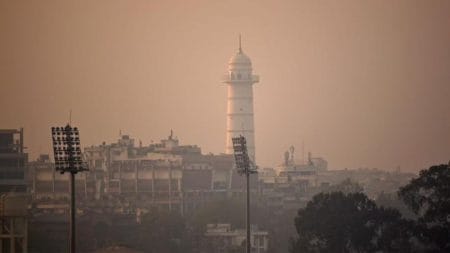
When a government talks up robotic surgery, AI farms and 5G networks in a country where nearly half of public schools still lack working toilets, it invites cheers—and doubt. Nepal’s budget for 2025–26, which begins in mid-July, tries to live in two centuries at once. It dreams of a Silicon Valley startup scene while still failing to blacktop village roads. The finance minister’s NPR 1.96trn ($14.7bn) plan wants to make the republic friendly to investors, wired to the world and fair to the poor. On paper, Nepal is racing ahead. On the ground, it is still lacing its shoes.
The budget speech is long on slogans and short on humility. It reads like notes from a Davos coffee break: digital government, young founders, AI in hospitals, tax holidays for startups. The aim is to haul an economy propped up by farming and remittances into the digital age, while also widening the safety net. That mix—tech faith on one side, welfare on the other—is brave for a state that still struggles to keep the lights on.
Public spending is set at 26% of GDP. Day-to-day costs—salaries, pensions and running the state—still swallow the bulk, at just over 60%. Investment in roads, power and other assets stays below a quarter. The rest goes on managing debt. Revenue is expected to reach NPR 1.24trn, leaving a wide hole to be filled with loans and aid. For a country that exports little and taxes few, this is less a push for growth than a high-wire act.
There are small signs of learning. One is a move to curb rakamantar—the end-year game of shuffling funds between schemes to burn through budgets. In theory, this should stop the usual rush to pour concrete on roads that lead nowhere. Another is the scrapping of 4,600 dead projects and the setting of a minimum size—NPR 30m—for federal schemes. Both are meant to trim patronage dressed up as “balanced development”. Whether ministers and MPs stick to the rules is another matter.
On business, the state has pulled on a startup hoodie. IT exports will get income-tax breaks of up to 75%. Digital nomads coding from Pokhara cafés will pay a flat 5%. Small firms earning under NPR 100m a year get a five-year tax holiday. “Sweat equity” now has legal standing. Exporters can invest up to a quarter of their earnings abroad, so long as half the profits come back. These are bold steps in a country where sending money out once felt close to treason.
Good ideas, though, must pass through thick red tape. The same budget promises biometric IDs, digital land records and a single KYC portal for banks. In most districts, people still queue for stamps and signatures. Even in Kathmandu, “online” often means downloading a form and printing it. The state dreams of paperless rule, but still bows to the rubber stamp.
Welfare keeps growing. More than NPR 109bn is set aside for social-security payments. The pension age will rise to 70, but current recipients are spared—a nod to a loud and loyal voting bloc. New health cover for children and wider school meals hint at Nordic dreams. But such spending is hard to reverse when money runs short. Nepal has little room to manoeuvre.
Farming, which still employs a third of the population, gets cash and kind words. NPR 28bn is earmarked for fertiliser subsidies, with talk of a local plant. Pesticides will face testing. New markets are promised. Yet the real problems—tiny plots, low machinery use, weak supply chains—remain. The focus stays on inputs, not reform.
Big infrastructure gets its usual spotlight. There are plans for better highways, tunnels, airports and even stadiums in thin air. Nijgadh airport, grand and green-hostile, is back again. Such schemes make for good photos. With slow land deals and poor buying rules, they make for slow progress.
Education does reasonably well, with NPR 211bn, about 11% of the total. Shifting the school-leaving exam to provinces nudges federalism forward. More daring is a “study and earn” plan that lets students work 20 hours a week. It works in rich countries. In Nepal’s informal job market, it may struggle.
Health gets NPR 95.81bn and a glossy future: AI diagnosis, robotic surgery, shiny hospitals. Many public wards, though, still suffer power cuts and broken lifts. Kanti Children’s Hospital is to become a “centre of excellence”. The title may ring hollow beside faulty machines and thin budgets.
A few pledges stand out. Half a million land certificates are to be issued in a year. If it happens, it could cut disputes and free up credit. An expo centre will rise at Bhrikutimandap. Civil servants will get an extra NPR 5,000 in allowance, but no pay rise. Slow steps, not big leaps, still drive the state.
This is a bootstrap budget: full of ambition, short on muscle. It borrows the language of tech prophets and welfare states, but rests on a tired bureaucracy steeped in favour and delay. The clash between dreams and delivery is not unique. In Nepal, where plans are made in slides and carried out in files, it is sharper.
The country may be reaching for the cloud. Without solid pipes below, it risks drowning in its own dreams. Fibre-optic visions still have to pass through dial-up rule. ■