Image: Reuters
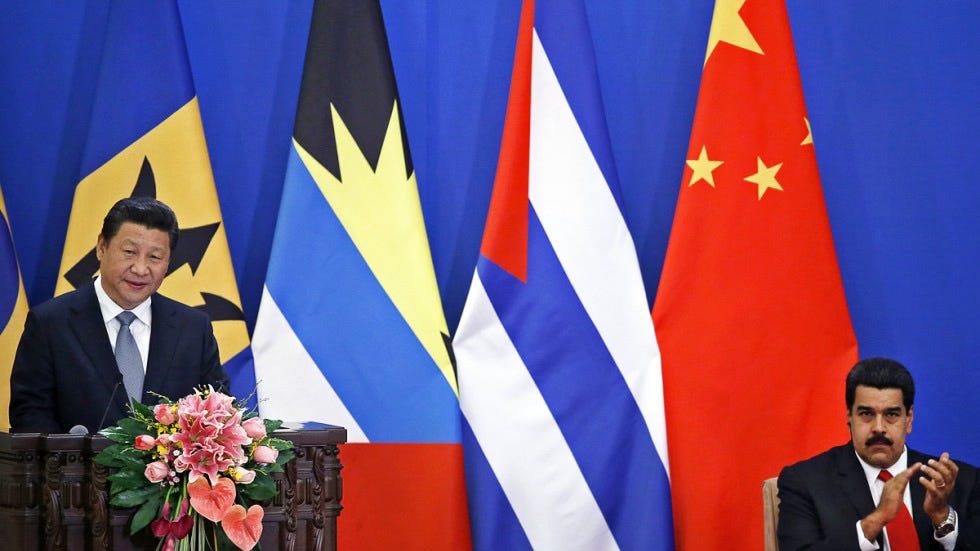
To an observer squinting at a map, Latin America may seem a backyard. But it has become anything but neighbourly. China, a Pacific power with no territorial stakes in the hemisphere, now ranks as South America’s largest trading partner. In May President Xi Jinping unveiled a $9bn credit line for Latin America and the Caribbean, part cheque, part charm offensive. The summit in Beijing brought more than mangoes and copper to the table; it served up a vision of a Sinocentric future for a region naturally seen as America’s domain.
Washington is not amused. Yet its recent responses resemble a fire drill conducted after the blaze. Under Donald Trump’s renewed presidency, the United States has rediscovered its old scepticism toward “ungrateful allies” and “bad deals”. Latin America, accustomed to being taken for granted, is drifting further into Beijing’s outstretched arms—not with ideological fervour but transactional clarity.
China’s interest in Latin America is not new. Sixteenth-century galleons ferried porcelain to Acapulco and silver to Guangzhou. But the modern courtship began in earnest after China joined the World Trade Organisation in 2001. Fuelled by its industrial rise, China’s appetite for raw materials turned the region into a strategic larder. Trade has since ballooned from a trifling $12bn in 2000 to over $500bn in 2024. Economists project it could hit $700bn by 2035.
In exchange for soybeans, copper, oil and lithium, Latin American countries receive Chinese manufactured goods and capital. Although critics grumble about cheap imports undercutting local industries, governments—often fiscally constrained and geopolitically ambivalent—welcome the cash. In countries such as Peru and Chile, China now absorbs over a third of exports. Beijing has signed free trade agreements with several countries and rolled its Belt and Road Initiative (BRI) across the isthmus with the ease of an empire on autopilot.
The scale of Chinese investment is stunning: nearly $9bn in foreign direct investment last year alone, and over $120bn in loans since 2005—usually with fewer strings than those attached by Western lenders. But these purse strings can also become snares. Venezuela, China’s most indebted Latin partner, has borrowed nearly $60bn, mostly secured against oil. With its economy in tatters Caracas now looks like a warning.
Hard hats and hard power
Chinese interests are not confined to mines and markets. Military ties have flourished—another great-power competition. Venezuela has stocked its arsenals with Chinese hardware since the U.S. embargo in 2006. Ecuador, Argentina and Bolivia have followed suit. China now supplies riot gear to Bolivian police and automatic weapons to Ecuador. It also trains officers, hosts joint exercises and makes port calls with its navy.
This activity has raised eyebrows in Washington, particularly when paired with Beijing’s growing intelligence footprint. Chinese ground stations in Argentina and Bolivia—ostensibly for space cooperation—are suspected by some U.S. officials of having dual-use capabilities. The irony is not lost on American strategists: just as Washington once warned of Soviet missiles in Cuba, it now frets about Chinese satellites in Patagonia.
Space is the newest frontier. China’s collaboration with Brazil on satellite development stretches back to the 1980s. But recent efforts—such as the China-CELAC Space Forum and the establishment of BRICS’ joint satellite committee—hint at a more ambitious celestial strategy. China’s largest overseas space facility sits in Argentina, and it continues to court countries for data-sharing and orbital collaboration.
Beijing is also investing in people. From cultural exchanges and Confucius Institutes to COVID-19 vaccine diplomacy, China has sought to cultivate goodwill and present itself as a reliable, nonjudgmental partner. In some cases vaccine shipments were rumoured to grease the wheels for Huawei’s 5G ambitions—a suggestion Brazil’s regulators tacitly confirmed by reversing a Huawei ban shortly after receiving millions of jabs.
This approach is effective in democracies and autocracies alike. In authoritarian regimes such as Cuba, Venezuela and Nicaragua, China’s willingness to deal without lectures on governance makes it an attractive patron. The U.S. Army War College dubs China an “incubator of populism”, not because it foments it but because populists find it congenial.
Even more potent is the diplomatic squeeze on Taiwan. Beijing insists countries must choose between recognising Taipei or doing business with the mainland. Honduras, the latest defector, jumped ship in 2023 after Taiwan refused an aid request. Only a smattering of Caribbean and Central American countries now maintain ties with Taipei—an erosion of allegiance the United States has failed to stem.
Gringos in retreat
American influence in the region has often been cyclical: assertive in crises, aloof in calm. The Trump administration preferred sticks to carrots, slapping sanctions on Cuba and Venezuela while cutting aid to Central America. Biden, by contrast, pitched a more cooperative tone, launching the Build Back Better World initiative and reviving hemispheric dialogue. But the sums allocated—just $6m in B3W’s first year—were paltry compared with China’s largesse.
Moreover, the U.S. fixation on Europe and the Middle East has left little bandwidth for its southern flank. A report by the U.S.-China Economic and Security Review Commission in 2024 warned Washington’s neglect risks ceding strategic terrain. The reassurances of influence—the Inter-American Development Bank, the Monroe Doctrine, even geographical proximity—no longer command the same weight.
Latin America is not necessarily falling into Beijing’s orbit. Rather, it is voting with its feet—infrastructure by infrastructure, contract by contract. China provides money, markets and minimal meddling. The United States offers history, scrutiny and hesitancy. For governments trying to finance development or balance budgets, the decision is often pragmatic rather than ideological.
But overreliance on China carries risks. As Chile, Peru and others become more entangled in Chinese value chains and indebted to its banks, their room for manoeuvre shrinks. Some analysts warn of a creeping dependency that reflects the very asymmetries Latin America once sought to escape.
Still, few in the region are under illusions. China may speak the language of partnership but it plays the game of power. And unlike Washington, it rarely forgets to show up—with a plan, a port and a cheque in hand. Latin America is not choosing between China and the United States. It is simply accepting the suitor who knocked first—and brought dinner. ■