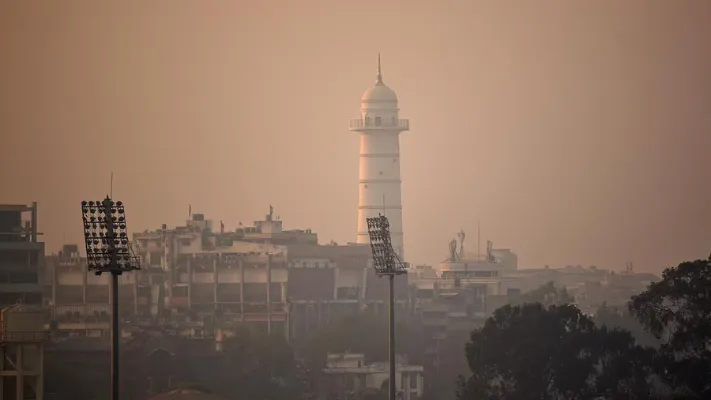
In Nepal the air kills more people than tobacco. That grim distinction, once hard to imagine for a country better known for its mountains than its smokestacks, is now a statistical certainty. A new report from the World Bank lays bare a startling fact: air pollution has overtaken all other risk factors—malnutrition, tobacco, poor sanitation—as the leading cause of premature death and disability in this country. It shaves 3.4 years off the life expectancy of the average Nepali and contributes to 26,000 premature deaths a year. So much for fresh Himalayan air.
This is not a vague public-health concern. It is a chronic economic and environmental crisis with measurable, compounding costs. The World Bank estimates poor air quality imposes an annual economic burden surpassing 6% of Nepal’s GDP. That is more than the rate at which the economy has been growing in the last 20 years or so. The culprits are familiar—dirty cookstoves, diesel engines, smoke-belching factories—but their persistence reflects something ugly: institutional inertia and political neglect.
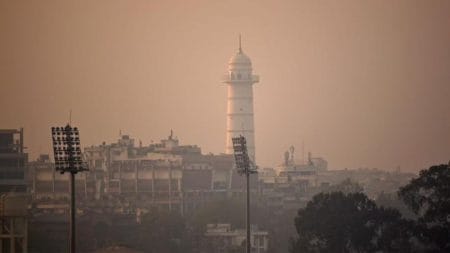
Kathmandu Valley, the urban and administrative heart of the country, now ranks among South Asia’s most polluted regions. The valley’s infamous winter smog (once attributed to cold weather and wood fires) has metastasised into a year-round phenomenon. Average PM2.5 concentrations—fine particulate matter small enough to lodge deep in the lungs—are already several times the World Health Organisation’s recommended limit.
Without action they are projected to hit 52 micrograms per cubic metre by 2035, triggering tens of thousands of additional deaths and widespread cognitive and respiratory impairments. The Tarai plains fare no better. Two-thirds of PM2.5 exposure there originates across the border, carried by wind currents from the industrial and agricultural cauldron of the Indo-Gangetic Plain.
As the report makes clear, geography has conspired against dirt-poor Nepal. The bowl-shaped Kathmandu Valley traps airborne pollutants like soup in a sealed pot. But the problem is not merely topographical. It is policy-made. Industries continue to burn coal and diesel in outdated boilers; households rely on smoky biomass stoves; cars and motorbikes clog narrow, dust-ridden roads with little oversight or maintenance. Forest fires—now the fourth-largest source of pollution—rage unchecked during the dry months. And enforcement is patchy, at best.
This is hardly a problem unique to the country, though. Across Asia, cities from Delhi to Dhaka grapple with similar ailments: a toxic cocktail of rapid urbanisation and weak regulation, plus cross-border drift. But Nepal’s case is stunning for its scale relative to its economy—and for how little progress has been made despite decades of warnings. Since 2010 air quality has remained stubbornly poor. Technological fixes exist. Political will does not.
That may be changing. The report provides a roadmap that, though ambitious, is hardly utopian. It calls for multi-sectoral, multi-regional interventions: electrifying vehicle fleets, supporting cleaner fuels in industry, reducing road dust and promoting electric or pellet-based cookstoves. Forest fire management and regional coordination with neighbouring countries are also important, given the shared airshed of the Himalayan foothills. Importantly, the report stresses cost-effectiveness: not all solutions are equally impactful, and a smarter portfolio of actions—prioritising high-emission sectors—could yield big health and economic gains.
This is not a zero-sum game between growth and environment. Clean air is good economics. Improved air quality boosts labour productivity and slims down healthcare costs. It also boosts the country’s appeal to tourists and investors. As it stands, frequent smog disrupts flights and deters visitors. It weighs on public health systems already stretched thin. One study found 75% of chronic obstructive pulmonary disease (COPD) cases and nearly half of all strokes in the nation are attributable to air pollution.
Yet the politics of pollution are murky. Few Nepali politicians have built careers on clean air. The costs of reform are immediate and visible: higher capital costs for cleaner technologies, disrupted industries, political backlash. The benefits, by contrast, are dispersed and delayed. Moreover, the transboundary nature of the problem means even perfect domestic policy would not fully solve it. In the Tarai, for example, pollution from India overwhelms local sources. That makes diplomacy as essential as regulation.
Still, there are grounds for cautious optimism. Nepal has made strides in electrifying transport with growing interest in e-bikes and electric buses. Public awareness is rising. Civil society organisations, environmental watchdogs and some municipalities have begun to push for more transparency and stricter enforcement. But these efforts are still fragmented and underfunded.
What is needed now is something rarer than blue skies over Kathmandu: coordination. Air pollution does not respect political boundaries, nor should its solutions. The country must integrate environmental policy with industrial, transport and health planning. It must invest in monitoring and regional cooperation. Above all it must accept that clean air is not a luxury good. It is a basic input to development.
The fog that hangs over the Kathmandu Valley reflects a governance system clouded by short-termism and a public sector struggling to rise to the scale of the trouble. If Nepal hopes to breathe easier it will need more than fresh studies and lofty declarations. It will need to act—fast. Because while the air may be invisible, its consequences are anything but. ■