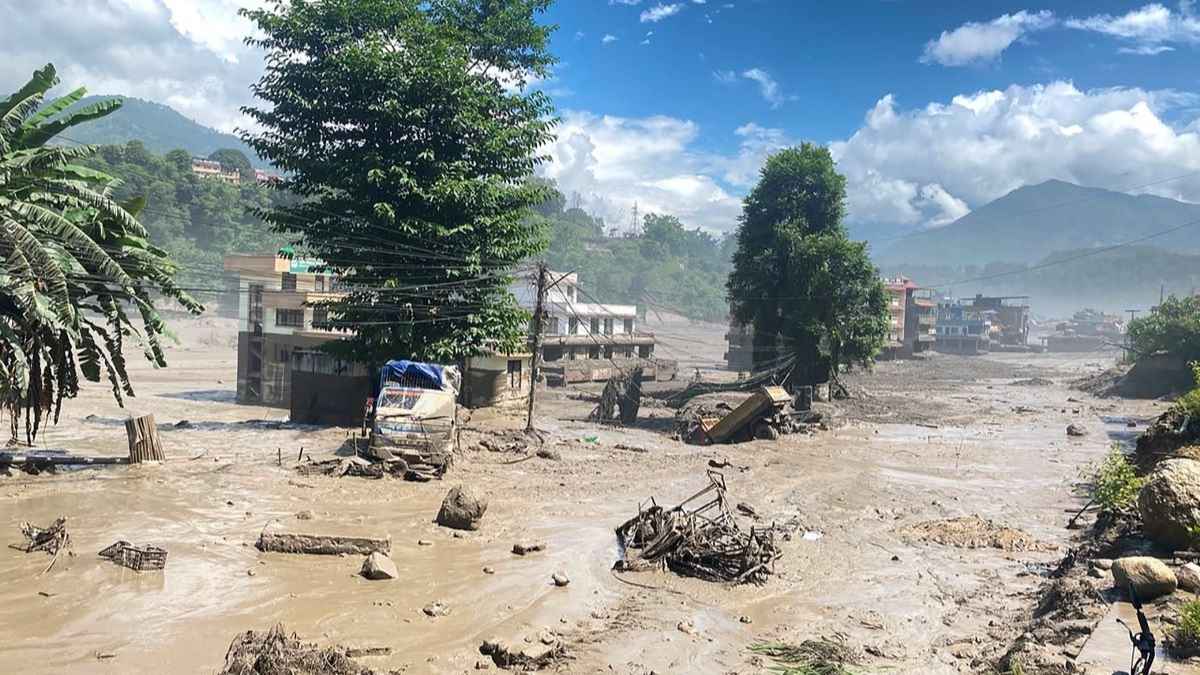
IMAGE VIA SETOPATI
THE BHOTEKOSHI river was already running high when a slab of the Langtang Lirung glacier broke away on August 26th, sending ice and rock into valleys that had known nothing but steady monsoon rain. Within hours twelve hydropower plants had vanished. Bridges connecting Rasuwa and Nuwakot to the rest of Nepal were gone. By September 11th the death toll stood at 1,385, with 5,130 people still missing and 13,676 rescued.
The Foreign Ministry has now put a price on rebuilding. Damage from the floods is estimated at $1.8bn; economic losses at $883m. The total needed for reconstruction comes to $4.78bn.
Where that money comes from is the question preoccupying the Finance Ministry. Foreign Minister Shisir Khanal has said plainly that Nepal prefers grants to loans. “Given the way the loan portion is ballooning compared to our GDP, if we are able to generate grants and aid in a considerable amount, it would be easier for us,” he told the Kathmandu Post. Finance Minister Swarnim Wagle has been more guarded, noting that grants cannot meet all of Nepal’s needs.
The maths behind the preference is not hard to follow. Nepal’s public debt has reached some 44.9 per cent of GDP, according to the Nepal Rastra Bank. External debt has risen from 20.6 per cent to 24 per cent of GDP since 2021. A joint World Bank-IMF debt sustainability analysis still classifies Nepal at low risk of distress, but the central bank has noted that its composite indicator score has weakened and that only about one-third of the capital budget was spent last year, meaning borrowed money is increasingly servicing recurrent costs rather than building assets.
Nepal has begun putting its case to the world. The government is framing the disaster as a climate justice matter, arguing that countries which contributed little to global emissions should not have to borrow to rebuild after climate-driven floods. Dharam Raj Uprety, the country’s disaster management chief, told Reuters the $5bn first-phase recovery estimate would be shared with the World Bank, the Asian Development Bank and the embassies of the United States, Britain, India, China, Japan and the EU. “It’s not only a disaster induced by flood, it’s massive. A disaster induced by climate change,” he said.
That pitch faces an ugly precedent. Pakistan secured roughly $11bn in pledges after the 2022 floods, but nearly 42 per cent of that was allocated for oil imports rather than reconstruction, and only $3.4bn had been disbursed by early 2024.
Early offers to Nepal have come in the form of loans and emergency credit. The World Bank’s country director, David Sislen, told Finance Minister Wagle that up to Rs 25bn ($163m) could be made available, but as emergency assistance rather than outright grants. China has offered cash assistance and India has sent relief supplies, but neither has matched the scale of the reconstruction bill.
Govinda Raj Pokharel, who oversaw the post-earthquake needs assessment in 2015, offered a blunt assessment. “In the current global financial and economic architecture, it is almost impossible to receive sufficient grants and aid,” he said. He suggested soft loans as a fallback and urged the government to approach wealthy individuals and philanthropic organisations for grants.
The National Planning Commission is preparing a Post-Disaster Needs Assessment due within five weeks, which officials expect will raise the damage estimate by at least 30 per cent above the initial figure of Rs 400bn. That assessment will form the basis of a donor conference. Prime Minister Balendra Shah is expected to raise the flooding at the United Nations on September 24th.
Nepal’s preference is clear-cut. So is the shape of the response so far: pledges that arrive as credit, disbursements that lag commitments. And a reconstruction bill that will sit on the government’s balance sheet long after the floodwaters have receded. ■