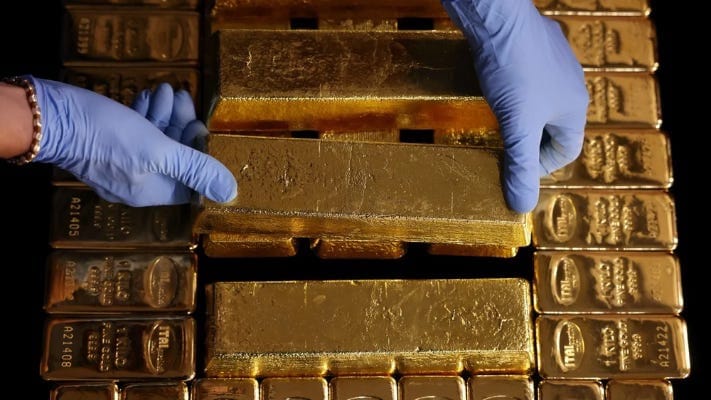
When central bankers start behaving like survivalists, it may be time to worry. In the last three years official institutions have purchased more than 1,000 tonnes of gold annually, hoarding the shiny metal as a strategic reserve. The last time buying was this brisk, Lyndon Johnson was in office and the world still operated under the Bretton Woods system. Now with bullion prices nudging record highs and outpacing stocks, bonds and bitcoin, gold has resumed its old role: the asset of last resort.
The comeback is a stunning turn for an asset once written off as an anachronism. When the gold standard was scrapped in the 1970s, Keynes’s famous dismissal of gold as a “barbarous relic” looked prescient. Central banks shed their holdings. Economists moved on. Gold was relegated to basements and conspiracy theories. But history has a habit of repeating, more so when institutions wobble. The same distrust that drove gold hoarding in the 1930s is now driving it again: only this time with central banks leading the charge.
Provoking gold’s revival is a new wave of doubt about the dollar. For decades the greenback’s unrivalled liquidity and ubiquity gave it pride of place in global finance. But the dollar’s dominance is now under strain from fiscal recklessness, political dysfunction and geopolitical backlash. The Trump administration’s penchant for unilateral sanctions and muscular trade policy has sent a chill through foreign capitals. If America can freeze a rival’s assets at will, others reason, perhaps their own reserves are not as safe as they once thought.
Hence the pivot to gold. Unlike Treasury bills, bullion cannot be devalued, defaulted on or sanctioned. It does not depend on trust in a government, a central bank or even a currency. You can’t print it. You can’t hack it. In extremis, you can dig a hole and bury it. For central bankers in Beijing or Ankara or New Delhi, that simplicity holds considerable appeal.
Indeed the shift is already visible in the balance sheets. In 2023 gold surpassed the euro as the second-largest reserve asset among global central banks. Much of the new demand is coming from emerging markets less aligned with the West. China, India, Turkey and Russia have all been net buyers, seeking to insulate themselves from potential Western financial coercion. The logic is gold may be inert but it is also neutral.
Not that private investors are standing aside. With inflation sticky and interest rates unpredictable and global tensions high, gold’s status as a crisis hedge has again come to the fore. During the pandemic bullion surged past $2,000 per troy ounce. In 2024 as fears mounted over renewed Middle East conflict and “Liberation Day” tariffs from a re-elected Trump, it edged past $3,000. Even bitcoin enthusiasts—who claimed to have reinvented gold in digital form—are grudgingly conceding the original’s resilience. “Gold is the new gold,” quips Kenneth Rogoff, a Harvard economist.
Yet the rally has not come without scepticism. A record 45% of fund managers surveyed by Bank of America recently said gold is overvalued. Many now see it as the most “crowded” trade in markets. Prices have rocketed so fast that physical logistics are straining to keep up: earlier this year a rush to import gold into New York prompted queues at the Bank of England’s vaults, the second-largest gold repository in the world.
Still, even sceptics admit gold has earned its place in the modern portfolio. What was once seen as a nostalgic asset for doomsayers has become a hedge for grown-ups. Central banks are not betting on meteoric gains. They are buying ballast—something to hold steady when all else rocks.
The shift is also philosophical. In an age when trust in institutions is fraying, from the independence of the Fed to the stability of American democracy, gold provides a kind of apolitical certainty. Its value may fluctuate, but its nature does not. For those alarmed by trillion-dollar deficits and weaponised finance, bullion is a counter-narrative.
Critics of gold, of course, point to its historical baggage. The gold standard, they remind us, exacerbated the Great Depression by tying governments’ hands. Pegging currencies to a fixed commodity introduced rigidity at precisely the moment when policy flexibility was most needed. Gold, they argue, was not a foundation of stability but a constraint on recovery.
This is true, but irrelevant. No serious policymaker today is advocating a return to Bretton Woods. What has changed is the perceived reliability of the institutions that underpin it (not the monetary system). In this light, gold’s resurgence is less about nostalgia than necessity.
The irony, of course, is that the more trust evaporates in fiat currencies and fiscal discipline, the more plausible the relic becomes. If the post-1971 monetary order was a 60-year experiment, some now wonder whether the experiment is drawing to a close. One mining executive likens this to a “back to the future” moment. Another sees the current period as a textbook example of why an apolitical store of value still matters.
It is unlikely gold will ever reclaim its crown from the dollar. The greenback remains unrivalled in terms of liquidity, global usage and institutional infrastructure. But that is not the point. Gold does not need to replace the dollar to regain relevance. It merely needs to remind the world that alternatives, however inconvenient, still exist.
Central banks for now will keep stacking bars; vaults will remain crowded; and Keynes will have to share the last laugh. In times of confusion, it turns out, nothing glitters quite like the original. ■