You ain’t going nowhere Image via Pardafas
Diplomacy is not usually taught in economics departments. Yet Nepal’s foreign ministry might benefit from a short course in trade theory. Sandwiched between two assertive giants, it finds itself drawn into geopolitical currents far more powerful than its own economic weight. The instinct among Kathmandu’s mandarins has been to hedge: balancing China’s chequebook diplomacy against India’s proximity and power. But hedging is not the same as strategy. As a growing literature in geoeconomics now argues, dependence itself is a source of vulnerability. Measuring it, rigorously and precisely, ought to be the first task of any serious foreign policy.
The country’s diplomatic tilt has shifted over the last decade. The 2015 blockade, prompted by India’s displeasure over Nepal’s new constitution, remains a watershed. Though unofficial, it halted fuel and medicine supplies and exposed Kathmandu’s reliance on Delhi. China made a spectacle of support by supplying fuel. Beijing’s message was clear: alternatives exist.
Since then China has courted the country with a well-worn playbook: sweeping infrastructure pledges and influence campaigns. A few roads and power plants have broken ground; the rest are still trapped in feasibility studies.
Scholarships and bureaucratic exchanges have softened the edges. Party-to-party ties, particularly with Nepal’s fractious communists, have provided ideological glue. Beijing presents its overtures as partnership rather than patronage: a framing that flatters Nepal’s sovereignty even as it chips away at it.
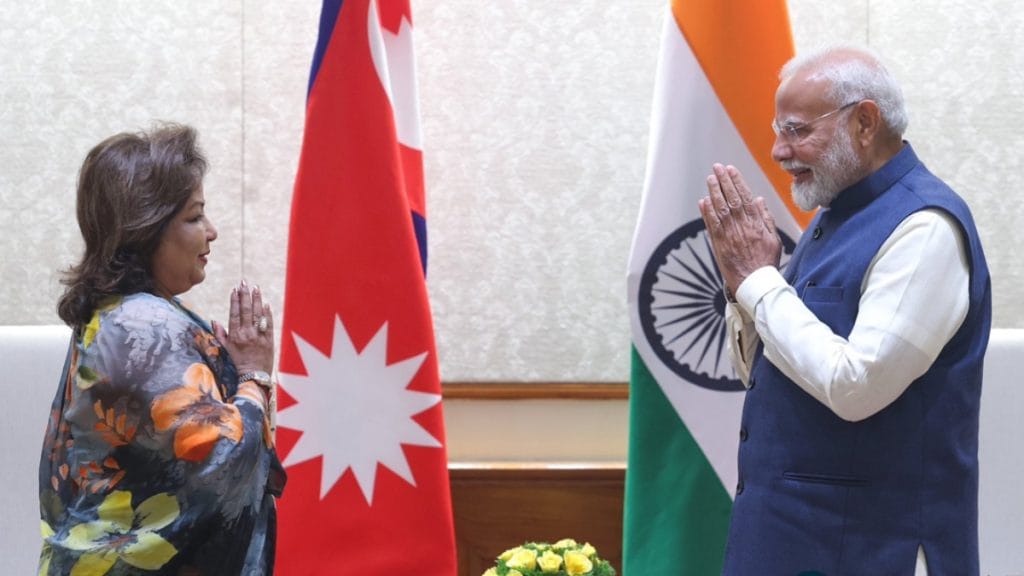
India by contrast has delivered aid and credit lines totalling nearly $2bn since the blockade. Its trade ties are still deep. But its diplomacy lacks sophistication. Projects are slow and politicised. The Adani Group, a politically connected conglomerate, has emerged as the main conduit of private-sector involvement. Its interests now span multiple airports and proposed energy ventures. Gautam Adani’s ties to Prime Minister Narendra Modi have not gone unnoticed in Kathmandu, where officials mutter about opacity and favouritism. When a single company embodies regional ambition, the risks of overexposure multiply.
That reflects more than caprice. They echo the patterns Albert Hirschman mapped out in 1945. Hirschman, an economist with an eye for power, developed a method to quantify dependence. His index—the Herfindahl-Hirschman Index, or HHI—is now a staple of competition policy. Yet his original worry lay not with monopolies but with geopolitical coercion. Nazi Germany, he showed, used trade dependencies to subjugate neighbours. The lesson: mutually beneficial trade can still produce asymmetric leverage.
That insight has been revived by a new generation of scholars. Christopher Clayton, Matteo Maggiori and Jesse Schreger are building models that apply economic rigour to geopolitical power. Their work, labelled “geoeconomics”, quantifies the sticks and carrots wielded by big economies. Their key finding: power does not rise proportionally with market share. It accelerates sharply as dominance nears totality.
The mathematics are revealing. If a single provider supplies 80% of a country’s critical input, alternatives must grow fourfold to fill the gap. Raise that share to 90%, and substitutes must expand ninefold. A ten-point rise in dominance increases replacement costs by 500%. Small states then face enormous risk from even incremental increases in dependency.
Nepal’s exposure is pronounced. Over 80% of exports head to India. Nearly all fuel comes from across the southern border. Chinese financing is rising, but shrouded in opacity. Telecom infrastructure is increasingly Chinese-made. Education and training flows now split largely between Indian and Chinese institutions. At each node—energy, communications, capital, human capital—Nepal is caught in a duopoly.
Diversification would seem the obvious answer. Yet Hirschman’s successors warn of overcorrection. Economic networks gain value through scale and participation. If small countries isolate themselves in pursuit of autonomy, they reduce their own attractiveness. That can provoke wider decoupling, leaving them stranded.
There is, however, a middle path. Clayton and colleagues argue even small diversification can yield big returns. Reducing dependency from 90% to 80% halves the hegemon’s leverage. Shifting a 1% foothold to 10% gives rivals disproportionately more clout. These dynamics also apply in reverse. America and its allies, dominant in global finance, can amplify their influence through small expansions. The same logic holds for China in its growing role as lender, builder and educator.
Nepal has room to manoeuvre. Energy exports to Bangladesh have begun. New connectivity projects with Southeast Asia are under discussion. The European Union and Japan have signalled interest in investing in green infrastructure and public service delivery. The Gulf, too, plays an outsized role in remittance flows and labour migration. None can replace the gravitational pull of the two Asian giants. But each can dilute their leverage.
The problem is not the absence of options but in the lack of a framework to evaluate them. The foreign ministry remains focused on protocol. Trade policy is fragmented across agencies. Economic diplomacy is episodic and reactive. No unit within government tracks concentration risk across sectors. Hirschman’s ideas have yet to find institutional expression in Kathmandu.
A Ministry of Geoeconomics is unlikely to be announced anytime soon. But a dashboard that tracks dependency metrics—import shares, supplier substitutability, financial exposure—would be a start. A national investment strategy that benchmarks projects against diversification value would be better. A diplomatic doctrine that ties foreign alliances to strategic redundancy would be best of all.
Nepal’s sovereignty is not merely a question of geography or politics. It is a function of optionality. Hirschman showed how countries can be strong without being large, so long as they are difficult to coerce. That is the kind of strength the country ought to pursue. The formula exists. It begins with counting. ■