Photo: AFP
Editor’s update: Donald Trump has announced to impose a 25% tariff on Indian imports to America, along with an unspecified penalty, criticising India’s trade policy.
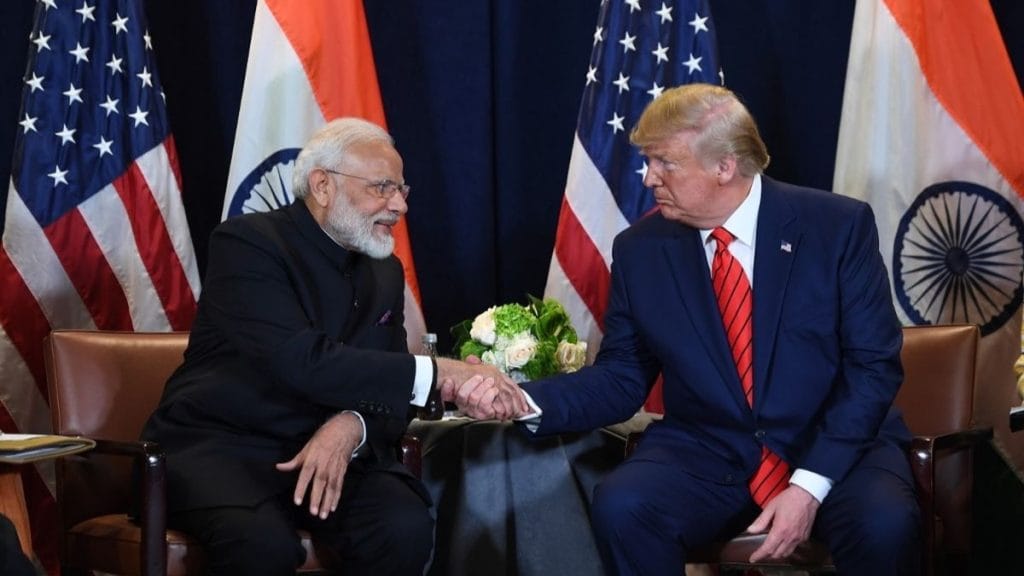
Donald Trump enjoys a good tariff. He also enjoys a good show. India is caught in the middle of both. As America prepares to impose a 26% levy on Indian goods, Trump has dangled a bit smaller range, 20% to 25%, as a gesture of negotiation, without actually offering terms New Delhi can accept. Talks are under way but outcomes remain uncertain.
The two countries ought to be natural commercial allies, or so the saying goes. Bilateral trade is around $130bn. Indian pharmaceutical and auto-parts exporters see America as a key market. And American tech firms are eager to court India’s burgeoning middle class. Both governments have incentives to signal strength while claiming progress. But style is getting in the way of substance.
Trump’s approach to trade follows a familiar rulebook. First he announces a punishing tariff. He then pauses implementation, granting his counterparts time to offer concessions. If they resist he raises the stakes. If they comply he declares victory. Previous iterations of this pattern have been seen with Japan, Vietnam, the Philippines and the European Union. India is among the few yet to ink a deal.
Narendra Modi’s government is playing for time. It has resisted American demands to open its dairy and agriculture sectors and has flatly rejected the prospect of allowing genetically modified imports. Rather it has offered zero tariffs on a narrow list—auto components, pharmaceuticals, some electronics—where Indian firms are already globally competitive. Behind closed doors Indian officials say a deal is likely before autumn, though an interim agreement by August 1st is off the table.
The hold-up is not only about tariffs. It is about domestic politics, too. Modi faces state elections and cannot afford to alienate India’s farming base, which is fiercely protective of import barriers. Meanwhile Trump is keen to portray himself as the architect of global trade resets, not merely another dealmaker tweaking clauses. His trade team, led by Jamieson Greer, says India must grant deeper access to American goods while sidestepping thornier questions about reciprocity and subsidy.
The economic hit of the threatened tariffs would be uneven. Some Indian sectors, such as textiles, leather and electrical machinery, are more exposed than others. Multinationals shifting manufacturing out of China have increased investment in India, but few will relish new costs on cross-border supply chains. Apple, for example, is expanding iPhone assembly in India with the expectation of tariff stability. That assumption now looks fragile.
Trump’s rhetoric does more than shape expectations: it influences markets. The Indian rupee has slipped to 87.24 against the dollar amid the tariff tension, and equity markets have see-sawed in response to White House remarks. The cost of uncertainty is mounting even before any duty is applied.
There is a geopolitical tension, too. America has spent decades cultivating India as a counterbalance to China. That relationship spans defence, energy, education and technology. Tariff threats muddy the waters. Washington has already irked New Delhi by claiming credit for an India-Pakistan ceasefire and hosting Pakistan’s military chief for a state visit. Indian officials were not amused.
Still, both capitals recognise the risks. The alternative to a deal is a trade war that benefits neither. For India higher tariffs would corrode competitiveness in American markets. For America alienating a strategic partner while coaxing it to help counter China could undermine its own regional vision. Yet both leaders appear to believe that brinkmanship brings influence.
Trump’s style invites ambiguity. He drops vague hints about the deal in casual comments—this time while flying on Air Force One after a trip to Scotland—but does not explain what the conditions are. He has said India imposes more tariffs “than almost any other country”, a claim that is true only when averaged across sectors without considering exemptions or trade facilitation measures.
India’s average tariff rate is about 12%, according to the World Trade Organisation, though the spread is uneven and enforcement variable. Trump’s proposed 20-25% levies would surpass those of recent administrations and mark the highest American import taxes since Herbert Hoover’s Smoot-Hawley Act of 1930. That episode triggered retaliations and deepened the Great Depression. The historical resonance is not flattering.
Some Indian exporters have suggested full tariff parity with America, in which both sides remove duties altogether. Such proposals are politically delicate. Zero tariffs would force Indian producers to compete head-on with American scale and subsidies. The prospect for agriculture is toxic. But trade liberalization, if reciprocated, could benefit Indian manufacturers and consumers alike.
The Indian government has invited Trump to a defence summit in the autumn. The hope in New Delhi is the pageantry of a state visit might unlock room for a “headline deal”, a term used by the U.S.-India Strategic Partnership Forum in Washington. In their view, the administration cares about headlines as much as policy.
The next act is due by Friday. It may end with a friendly agreement or higher tariffs, but that is not the main issue. Both leaders are showmen before they are negotiators. If anything meaningful comes out of this, it will likely be a side effect rather than the goal. The two biggest democracies are busy making noise for now. The real agreement, if there is one, has yet to appear. ■