Image: Bloomberg
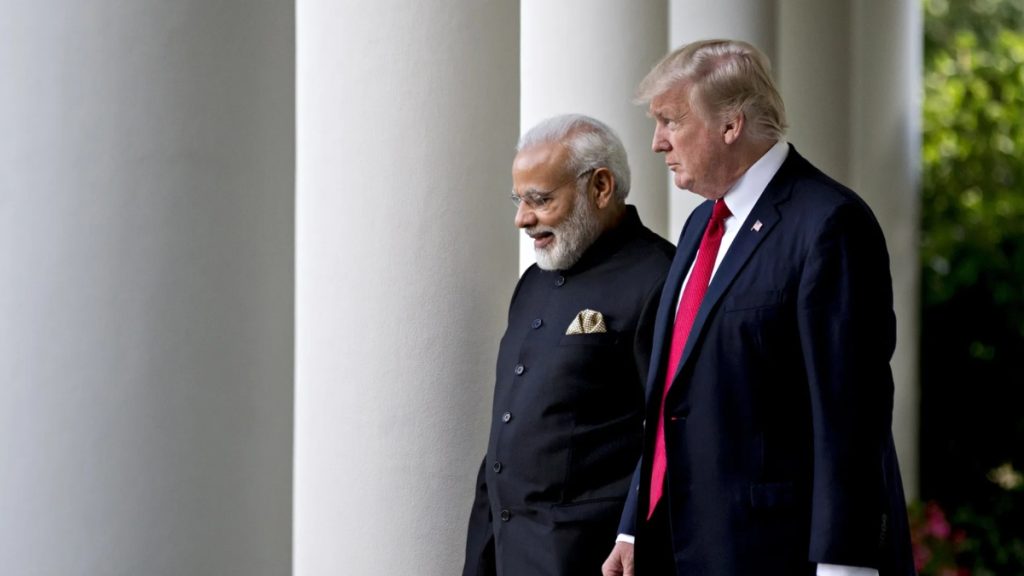
Few global leaders have flattered Donald Trump with the exuberance shown by Narendra Modi. The Indian prime minister coined the slogan “Make India Great Again” to charm his American counterpart and hailed a “mega” partnership, as well as walked lockstep through trade and security overtures. Yet the affection has not proved reciprocal. Trump’s latest fusillade—a 25% tariff on Indian goods paired with a string of inflammatory remarks—is a sharp turn from transactional diplomacy to outright coercion.
The tariffs landed with little warning. Officials working on the America-India trade deal first heard about them from journalists, according to reports. By then Trump had accused India of being an “obnoxious” trading partner, condemned its military ties with Russia, called both countries “dead economies” and derided its role in BRICS, a bloc he labelled “anti-the United States”. What appeared to be a routine escalation in negotiations quickly escalated into a public browbeating.
India’s foreign-policy establishment, accustomed to dealing with competing alliances, has found itself cornered. Foreign Minister Subrahmanyam Jaishankar describes India’s foreign policy as “hedging”, balancing rivals without picking sides. That approach has allowed India to buy Russian oil, host American defence officials, join the Quad security dialogue and remain a founding BRICS member: all without picking a side. Trump threatens to disrupt that.
Energy is at the heart of the friction. Since the Russian invasion of Ukraine, India has become a big buyer of discounted Russian oil. That share now tops one-third of its total crude imports, compared with negligible figures before the war. Indian refiners have capitalised on lower prices to stabilise domestic inflation and meet soaring energy demand. But Trump, frustrated with Vladimir Putin’s refusal to accept his ceasefire proposal, has turned to India as leverage. His threat of “secondary tariffs” on nations trading with Russia targets India.
The Indian government has responded with caution. Officials are exploring ways to placate America without appearing subservient. These include expanding imports of American natural gas and technology products, reducing the bilateral trade surplus and continuing talks over a phased deal. Retaliatory tariffs have been ruled out for now. Yet domestic pressures are growing. Modi’s government, bruised by opposition attacks and nervous about oil-driven inflation, faces little incentive to capitulate publicly.
Trade negotiations were already teetering. American demands to open India’s dairy and agriculture sectors, which are politically sensitive, had met resistance. These industries employ millions and wield electoral clout. Proposals to allow genetically modified crops, shelved during earlier discussions, resurfaced unexpectedly during talks. Indian negotiators viewed that as a breach of protocol and a political overreach. The resulting impasse left limited room for manoeuvre.
Washington’s position also appears disjointed. Earlier visits by Vice President JD Vance, in which the partnership was described as “win-win”, had created expectations of cooperation across energy and defence as well as commerce. That mood evaporated when Trump claimed to have brokered a peace between India and Pakistan, which New Delhi rejected outright. The decision to host Pakistan’s army chief soon after further strained trust. India’s strategic community, which had viewed Trump as a reliable if erratic ally, began to reassess.
Some in Washington see the confrontation as deliberate. Trump is recalibrating his foreign policy to pressure Russia and reframe global alliances. By turning up the heat on India he signals to Moscow transactional friendships come with a cost. But the tactic assumes India will fold. That may be a miscalculation. India has no mutual defence treaty with America. Its economy is big enough to seek alternative markets. Its diplomatic playbook values autonomy over alignment.
China is watching closely. Trump’s earlier tariffs on Chinese goods, surpassing 100% in some sectors, had provoked a brief trade truce. Beijing also used rare earth exports as leverage. By contrast India offers a softer target. But punishing Delhi for dealing with Moscow could backfire by nudging it closer to Beijing and the Kremlin. While no love is lost between India and China, mutual interest in resisting American pressure could provoke tactical cooperation.
The wider risk is perception. If Trump’s administration treats India as an expendable partner, useful for photo-ops but dispensable under stress, it undermines the very premise of a shared Indo-Pacific strategy. The Quad, intended as a bulwark against Chinese assertiveness, depends on sustained trust. Alienating its most populous member weakens the platform and emboldens adversaries.
Economic fallout may take time to manifest. Indian refiners can source crude from OPEC+ producers, though at higher prices. American tech exports may soar if a trade deal materialises. But the diplomatic damage is immediate. Modi cannot afford to appear weak before domestic voters, especially ahead of crucial state elections. Nor can his government afford to be publicly rebuked by a supposed ally.
The future of America-India relations now depends on what Trump chooses to do: escalate further or restrain. If Putin ignores his deadline Trump may seek to penalise Russia’s customers. That would drag India deeper into a geopolitical contest it has sought to avoid. Alternatively if Trump reaches a new bargain with Moscow, India may be sidelined.
Either way India’s calculus is changing. The pursuit of strategic autonomy is intact for now, but hedging is growing harder. Trump’s blunt approach has pierced the veil of diplomatic ambiguity that allowed India to embrace Washington without abandoning Moscow. What comes next is unlikely to be mega. ■