IMAGE: Hungarian Institute of International Affairs
Every few months, a plain-covered journal called American Affairs makes its way to professors’ offices, policymakers, tech founders’ lofts and congressional aides’ inboxes. At 250 pages, it is hardly designed for browsing. Yet inside are essays that quote Marx, advocate wealth taxes and praise Chinese industrial policy—published under a banner that once championed Donald Trump.
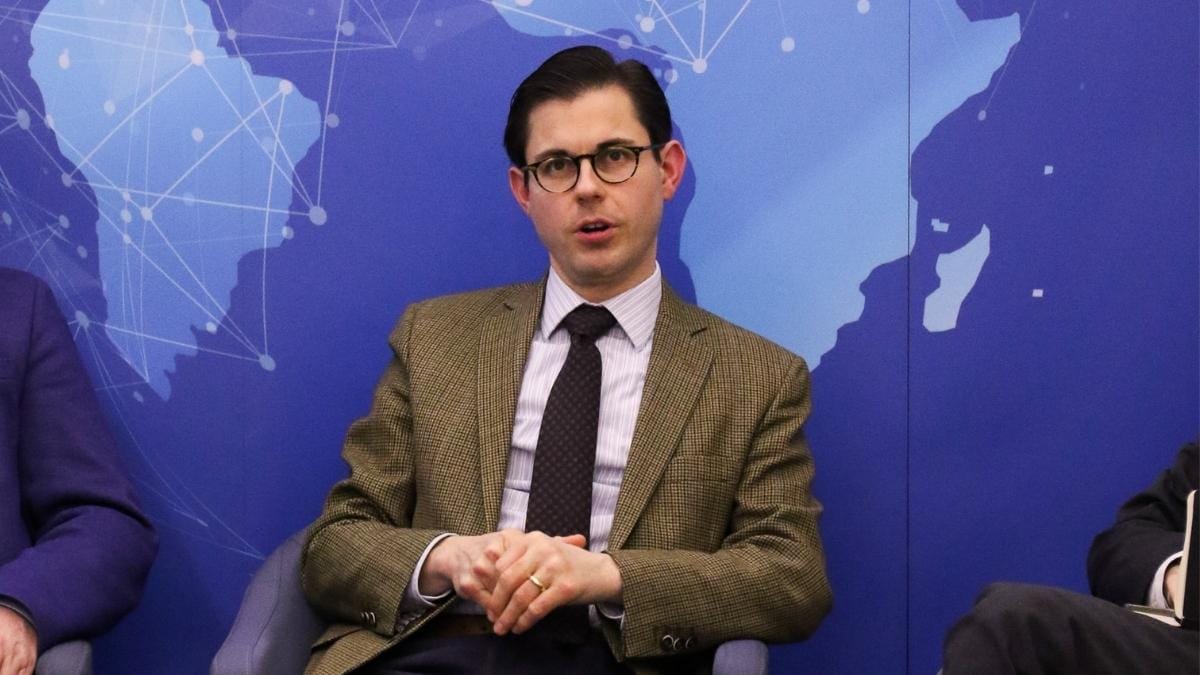
Its founder, Julius Krein (pictured), is harder to summarise than the content. The 39-year-old financier-turned-editor oversees the journal from a small Boston office, funded partly by Hewlett Foundation grants and partly by conference ticket sales. He receives no salary from the non-profit that owns American Affairs, although his private company, which supplies editorial services, was paid over $300,000 last year. It operates more like a mission than a start-up.
The mission is clear enough: to construct an intellectual foundation for a post-neoliberal political order. Unlike the think-tank reports it occasionally resembles, American Affairs is not in the business of white papers or policy memos. It operates more like an ideological observatory, spotting the signals that others miss and giving shape to a movement still inchoate.
Krein’s previous career—stints at Blackstone, emerging markets research and a tour through hedge funds—left him unimpressed. “People made bets, then reverse-engineered a theory to justify them,” he says. Journalism, on the other hand, rewards actual thought.
What neoliberalism forgot
Since its debut in 2017, the journal has featured Marxist philosophers, antitrust crusaders and nationalist industrialists. The ideological promiscuity is deliberate. Krein’s collaborators include Michael Anton, a Trump official who once described the 2016 election as a desperate charge into the cockpit of a crashing plane. Another contributor is Matt Stoller, a Substack-savvy populist who believes corporate monopolies have degraded the daily lives of Americans—via non-compete clauses and Kafkaesque customer-service lines. There are also essays on nuclear power, shipbuilding, semiconductor policy and the theological underpinnings of Pope Francis’s economic philosophy.
The one consistent theme is that neoliberalism—the economic consensus forged in the 1980s, defined by deregulation, global trade and capital mobility—has exhausted its political legitimacy. The symptoms are: deindustrialisation, geographic inequality, political volatility. Trump’s rise was not so much an aberration as a referendum.
Even so, Krein has distanced himself from Trumpist politics. After Charlottesville (in 2017 a white nationalist rally there turned violent, resulting in one death and widespread condemnation) he disavowed the movement’s worst instincts. The journal is not interested in conspiracies or cultural resentments. It is focused on “pivot points of economic power”, which reflect a belief that national renewal begins with material production rather than performative politics.
Krein’s worldview draws on older American traditions. Michael Lind, a frequent contributor, calls it a revival of “national developmentalism”—the 19th-century model championed by Alexander Hamilton and Henry Clay, which used tariffs and infrastructure to cultivate domestic industry. The analogy is imperfect but instructive. Clay’s canals and railways were as much about state-building as freight.
Lind spent three decades on the margins of economic debate, criticising NAFTA and the World Trade Organisation before it was fashionable. Now he finds himself on the masthead of a journal that proposes American versions of “Made in China 2025” and suggests that Washington study, not scorn, Beijing’s industrial playbook.
This is not the sort of nationalism that drapes itself in bunting. It is pragmatic, even technocratic. One essay proposed ways to expedite export licences for drones. Another explored why US chipmakers lag their Asian counterparts. Krein heads a trade association that lobbies for reindustrialisation and boasts members such as Andreessen Horowitz and Palantir.
Supporters argue industrial policy is no longer a heresy. The Biden administration embraced elements of Krein’s programme: tariffs on China, subsidies for chip plants, infrastructure spending with strings attached. Even the idea of taking equity stakes in strategic firms—once unthinkable—has entered the realm of plausibility. (The White House has taken a 10% stake in Intel.)
Critics are less convinced. Scott Lincicome of the Cato Institute calls industrial policy a recycled illusion. He cites the Jones Act, a century-old shipping rule that protects American shipyards while inflating costs and reducing capacity. Protectionism, he argues, ossifies rather than revives.
The intellectual right is also divided. Many remain wedded to free-market orthodoxy or are uncomfortable with Krein’s willingness to entertain wealth taxes and corporate regulation. Some simply dislike the word “policy”. But among those unbothered by ideological purity, American Affairs has built influence. The journal has no official affiliation with the Trump administration but its fingerprints are visible on policy documents circulating in Washington. Krein calls this “vindication by events”.
Journals of this kind have a track record. National Review helped define Cold War conservatism. The New Republic offered the Clinton White House a lexicon of triangulation. Their circulation was small; their impact was not.
Moreover the gap it seeks to fill is real. There is little patience for globalisation that delivers shareholder gains and regional decline. Nor is there much appetite for a culture war that dodges economic questions entirely. Krein’s journal may not offer a manifesto, but it is trying to make sense of a system that no longer explains itself.
That may not win elections. But it does help those who do. ■