IMAGE: GETTY IMAGES
THE WORLD’S most liveable city is Copenhagen, for the second year running. Vienna and Melbourne follow close behind. But this year’s EIU Liveability Index, which assesses 173 cities across 30 indicators, tells a less static story than the top three might suggest. The global average score remains 76.1 out of 100, unchanged from 2025. Yet under that flat line, regional fortunes are pulling sharply apart.
Western Europe still leads with an average score of 91.7, just ahead of North America’s 90.4. But Europe’s score has stagnated. Culture and environment scores have dipped, continuing a trend of erosion that began with the Ukraine war and has been reinforced by terrorist attacks and public protests.
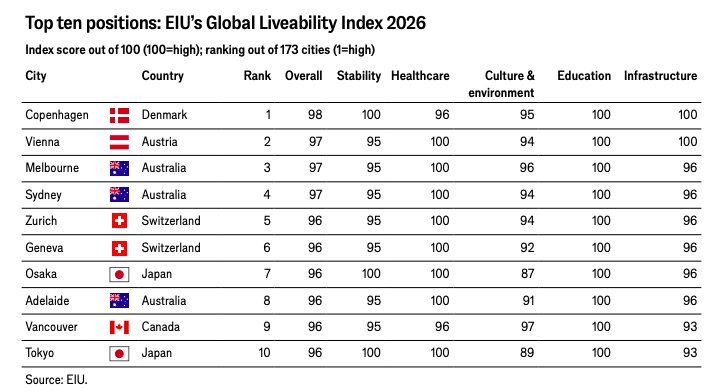
Meanwhile Asia has become the most improved region, its average rising by 0.3 points to 73.9. Nine Asian cities now sit in the top 20, against seven European ones.
The main drag on global liveability this year has been the Middle East and North Africa, where the average score fell a full point. The Iran war, which began in February with Israeli and American strikes, is the cause. Iran’s subsequent attacks on neighbours and its blockade of the Strait of Hormuz have rippled across the region. Muscat fell 14 places in the rankings, Kuwait City 12. Tehran is a new entrant to the bottom ten, joining Kyiv, whose ranking has slipped further still.
Stability scores across all 173 cities fell by an average of 0.5 points, continuing a recent trend. The Middle East bore the brunt this year. But other categories have moved in the opposite direction. Healthcare scores have risen by an average of 0.7 points, driven largely by Chinese cities. After years of public investment, five Chinese cities now score above 80 for healthcare, with another four just below. Fuzhou, an industrial city in the south-east, leads the list of biggest upward movers, climbing seven places. Yet political restrictions keep culture and environment scores low across most Chinese cities, limiting further gains.
New York also moved up, gaining 1.2 points and three places. The improvement came entirely in the stability category, the product of years of falling crime rates and reduced terrorist threats. New York remains the third-lowest-ranking American city. Lisbon rose sharply on better healthcare. Tokyo’s culture and environment score improved.
The bottom ten cities, by contrast, are defined by war and poverty. Damascus remains last, though its healthcare scores have improved since the fall of Bashar al-Assad in December 2024. Tripoli has also seen better healthcare, but stays second from bottom. Caracas narrowly escaped the bottom ten this year after the United States instigated a change of government in January.
The index’s stability category, weighted at 25%, measures threats ranging from petty crime to military conflict. It is where the Iran war has done its damage. The healthcare category, weighted at 20%, has been the main source of improvement. The two trends are connected only by geography: as the Middle East deteriorates, Asia advances.
Western Europe’s lead is narrowing. North America, at 90.4, is within striking distance. Asia’s average now tops eastern Europe’s. The global average has held steady only because gains in healthcare and infrastructure have offset losses in stability and culture. Whether that trade-off continues depends on forces the index measures but does not control: from war and investment to the slow churn of public policy. Copenhagen may stay on top but the map beneath it is shifting. ■