Image: Bloomberg
On August 27th America fired its latest shot in the trade wars. India, the world’s fastest-growing big economy, found itself saddled with some of the highest tariffs in global commerce. America, citing India’s persistent purchases of discounted Russian oil, imposed a punitive 25% duty—on top of an existing 25% reciprocal rate—on a swathe of Indian exports. The move, confirmed by Donald Trump earlier this month, was widely interpreted as a pressure tactic targeted at the Kremlin, though India was the one left nursing the bruise.
Few had expected a breakthrough in America-India trade talks. Fewer still anticipated an escalation this abrupt. Alyssa Ayres, a former State Department official, called the turn of events “head-spinning”. In Delhi the mood was less dizzy, more exasperated. Indian policymakers, caught in the crossfire of geopolitics, see the tariffs as collateral damage in Washington’s attempt to isolate Vladimir Putin. As Ashok Malik, a former Indian foreign ministry adviser, put it, “Trump is trying to get at Putin and India is a soft target to do so”.
If that was the intention, the results have been predictably lopsided. India’s imports of Russian crude have indeed fallen, though more likely due to tighter shipping sanctions than any White House saber-rattling. Yet the consequences for Indian industry are real. A report by the Global Trade Research Initiative, a Delhi-based think-tank, forecasts a collapse in America-bound exports from $86.5bn in 2024 to $50bn by 2026. Gems, garments, shrimp and carpets—sectors that collectively employ millions—could see shipments tumble by as much as 70%. Standard Chartered predicts the tariffs may shave a full percentage point off India’s GDP growth.
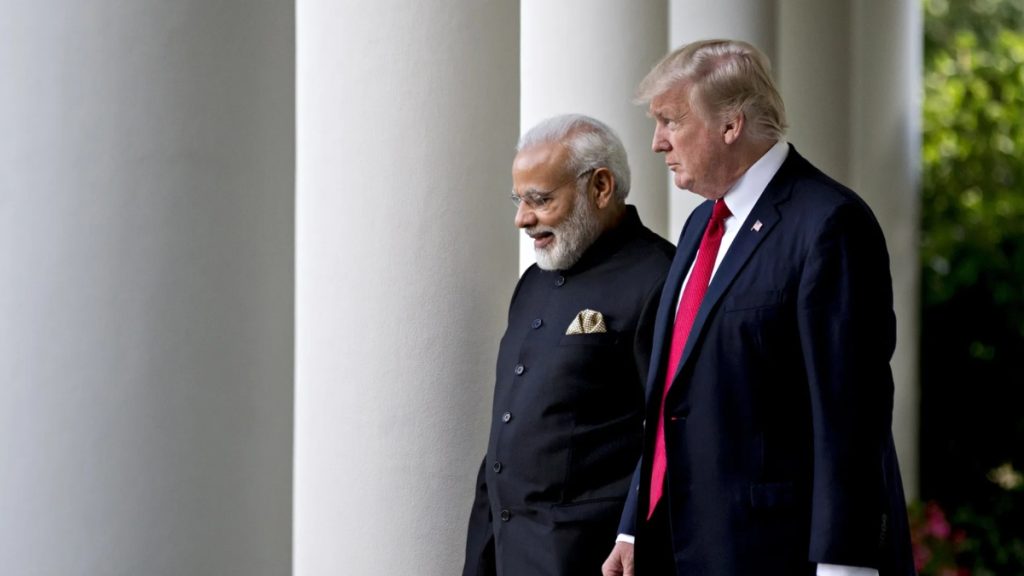
American negotiators cite Delhi’s reluctance to liberalise its vast agricultural and dairy markets. Indian officials counter such sectors are politically sacrosanct. Prime Minister Narendra Modi has vowed to “never compromise” on food sovereignty. Behind the scenes, trade diplomacy has ground to a halt. A planned visit by American officials was scrapped. Modi and Trump have not spoken directly in months, and mutual irritation is now publicly visible. Trump has ridiculed India’s “dead economy”, lashed out at Apple for shifting some production there and cosied up to Pakistan—an enduring irritant for Delhi.
Yet amidst the recriminations, something curious has occurred. Faced with 50% tariffs on its biggest export market, Modi’s government has begun accelerating reforms that had long languished in committee. Consumption taxes were abruptly cut, catching even Modi’s own ministers off guard. Plans to overhaul the goods and services tax (GST)—previously mired in bureaucratic tedium—are being dusted off and streamlined. Two high-level panels, one led by the cabinet secretary, the other by the government’s chief policy think-tank, have been tasked with pruning redundant regulations and lowering compliance costs for businesses.
The goal, according to officials involved in the process, is to send a clear message: India remains open to investment, regardless of Washington’s mood swings. Sonal Varma of Nomura describes the reforms as “a laundry list” of long-delayed changes, covering everything from labour law to land acquisition. What matters, she argues, is not whether tariffs endure but whether India is seen to be modernising. “Notwithstanding what’s going on with the US,” she says, “the perception must be that India is serious about improving the investment climate.”
The economic case is sound. With inflation at an eight-year low and the banking sector largely rehabilitated, the macroeconomic environment gives Delhi space to act. Private consumption, which constitutes 60% of GDP, is far more consequential to India’s growth trajectory than foreign trade. Even in 2024 exports to America accounted for a mere 2% of output. The bigger drag on growth has historically been domestic inefficiency. Onerous labour laws and fragmented tax structures have deterred formal job creation and kept productivity low. Factory regulations are so Byzantine that it tends to be cheaper to operate two medium-sized plants than one big one.
Whether the current flurry of reform activity marks a genuine inflection point or a politically convenient patch-up is unclear. Modi, never shy of a populist flourish, unveiled the tax cuts from the ramparts of the Red Fort during his Independence Day speech. The pressure is real. With Standard & Poor’s upgrading India’s credit outlook and global investors increasingly wary of geopolitical instability elsewhere, Delhi sees a narrow window to reposition itself as an investment haven.
Sceptics, including some within the Indian government, worry about policy made under duress. The GST overhaul, for example, may win headlines but lose coherence in execution. Meanwhile talks with Russia and China have intensified as India hedges its diplomatic bets. Modi is due in Beijing this weekend, his first visit in seven years. Foreign Minister Subrahmanyam Jaishankar has publicly urged Russian firms to deepen their engagement. If the White House was hoping to isolate Moscow via Delhi, the tariffs may have produced the opposite effect.
India will weather this storm. Its economy is structurally resilient, if chronically underperforming. Although America remains its most important strategic partner, the relationship, already fraught with unmet expectations, has entered a choppier phase. If a silver lining exists, it lies in the peculiar fact that Trump’s tariffs may do more to modernise India’s economy than two decades of multilateral persuasion ever did.
As for Modi, his tax cuts may or may not spur consumption, but they have achieved something rarer in Indian politics: policy without a press leak. That, if nothing else, deserves a cheer. ■
An earlier version of this piece incorrectly said Trump slapped additional tariffs on August 26th. It was on August 27th. Sorry.